




01. Edit your hockey scouting report template online
Type text, add images, blackout confidential details, add comments, highlights and more.

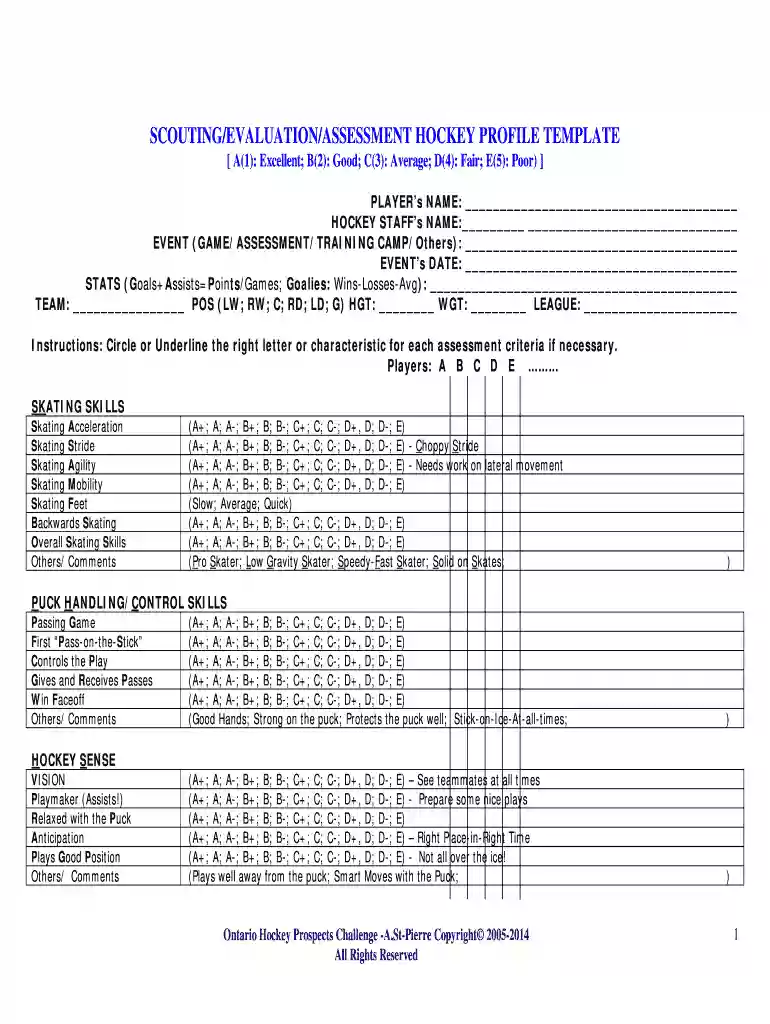
Type text, add images, blackout confidential details, add comments, highlights and more.

Draw your signature, type it, upload its image, or use your mobile device as a signature pad.

Send hockey scouting template via email, link, or fax. You can also download it, export it or print it out.
A hockey scouting report template is a structured document that provides a systematic approach for evaluating and documenting a player’s performance and skills. This template typically includes various attributes such as skating ability, puck handling, shooting proficiency, hockey sense, competitiveness, character, and overall performance during games or training sessions. Evaluators use these templates to create a uniform assessment that can be easily understood and referenced by coaches, scouts, and team managers. By standardizing evaluations, these templates ensure that important player information is captured systematically to aid in decision-making and recruitment.
Key elements often included in a hockey scouting report template include:
Using a hockey scouting report template involves several steps to ensure comprehensive and effective evaluations. First, the evaluator should familiarize themselves with the template’s structure and the categories included in the report. Each category typically has a scoring system (like A through E) to provide a numeric representation of each skill area.
Preparation: Gather all relevant materials, such as video footage of games, previous evaluations, and player statistics. This background research informs the evaluator's insights during the assessment.
Observational Analysis: Attend games or practices to directly observe the player in action. Take notes on their performance based on the key elements outlined in the template. Observing live gameplay allows for capturing nuances that might not be apparent through statistics alone.
Scoring: Use the predefined rating system to evaluate each skill area. Be objective, and support scores with specific examples from your observations. For instance, if a player demonstrates excellent skating ability, note a specific play where they effectively outmaneuvered opponents.
Comments Section: Fill in the comments section with additional qualitative insights. Providing context for the numeric scores makes evaluations more valuable and interpretable for others reviewing the report.
Final Assessment: Conduct an overall evaluation summarizing the player’s strengths, weaknesses, and potential areas for growth. This section should inform coaches and decision-makers about the player's fit for the team or potential for development.
The fundamental components of a hockey scouting report template are critical for delivering an accurate player evaluation. Understanding these elements allows evaluators to capture essential performance metrics effectively.
Player Information: Basic details such as the player’s name, age, position, and team. This section provides context that is crucial for any future reference or discussions.
Skill Ratings: Each skill area should have a corresponding rating that reflects the evaluator’s assessment. This is crucial for quantifying performance and facilitating comparisons across various players.
Observational Comments: A narrative section that allows evaluators to provide insights beyond numerical ratings. Specific examples strengthen the evaluation and offer context for the scores assigned.
Overall Evaluation Summary: A section dedicated to providing a concise summary of the player's overall performance, including potential areas for improvement and whether the player aligns with the expectations of a particular level of play (e.g., junior league, collegiate, or professional).
Completing a hockey scouting report template requires careful attention to each section of the document. This detailed process ensures that evaluations are robust and reliable.
Gather Player Data: Start with the player’s personal information such as their name, age, team details, and playing position. This makes it easy to reference the document later.
Evaluate Skills Individually: Go through each skill category one by one. Watch game footage and record observations that influence your scoring. Look specifically at how players perform in real time and in different scenarios, such as during power plays or penalty kills.
Score Each Skill: Assign ratings based on the established criteria in the template. Do this methodically to ensure consistency across the document.
Compile Observational Insights: Write pertinent comments for each skill assessment. Include specific instances from games that support your observations and help contextualize the rating.
Create Overall Assessment: Summarize the entire evaluation, capturing not only the total score but also the player’s potential contributions to the team. Identify strengths that can be capitalized on and areas where further development might be beneficial.
Review and Revise: Double-check the completed report for accuracy and clarity. Ensure that the final report is organized, coherent, and free from errors.
The utility of a hockey scouting report template extends across various scenarios including youth leagues, high school tournaments, and professional tryouts.
Youth Hockey Assessments: Coaches use the template during practices or games to evaluate young players' abilities and track their progress over a season. This promotes targeted training focusing on specific skill sets.
High School Scouts: High school coaches use the template to prepare their athletes for recruitment into college athletics. By compiling robust scouting reports, they can effectively showcase player potential to college scouts.
Professional Tryouts: NHL scouts or team managers often attend showcases and tournaments where they utilize the scouting report template to evaluate and compare prospective players for draft considerations.
By implementing a hockey scouting report template in these scenarios, teams can make informed decisions regarding player development and recruitment. Each completed report serves both as a historical reference and a dynamic tool for ongoing evaluation.
At DocHub, your data security is our priority. We follow HIPAA, SOC2, GDPR, and other standards, so you can work on your documents with confidence.
by J Ho 2023 Cited by 10 These findings indicate skills that contribute to player specialization, providing new information about the developmental trajectory of juniorRead more
IL -. An AppleWorks template for getting your budget in shape. Make fast copies of your disks. PI@:lClebaU - Bounce balls off walls to your hearts content.Read more
Students will score an average of 80% on scouting reports using a common rubric developed by the Fitness and Sports faculty. Students will observe and report onRead more


