




Here's how it works

01. Edit your form online
Type text, add images, blackout confidential details, add comments, highlights and more.

02. Sign it in a few clicks
Draw your signature, type it, upload its image, or use your mobile device as a signature pad.

03. Share your form with others
Send it via email, link, or fax. You can also download it, export it or print it out.
How to use or fill out Minnesota Attorney Client with our platform

- Click ‘Get Form’ to open the Minnesota Attorney Client document in the editor.
- Begin by entering the date at the top of the form. This is essential for record-keeping and establishing timelines.
- Fill in your name, address, city, state, and zip code in the designated fields. Ensure accuracy as this information identifies you as the client.
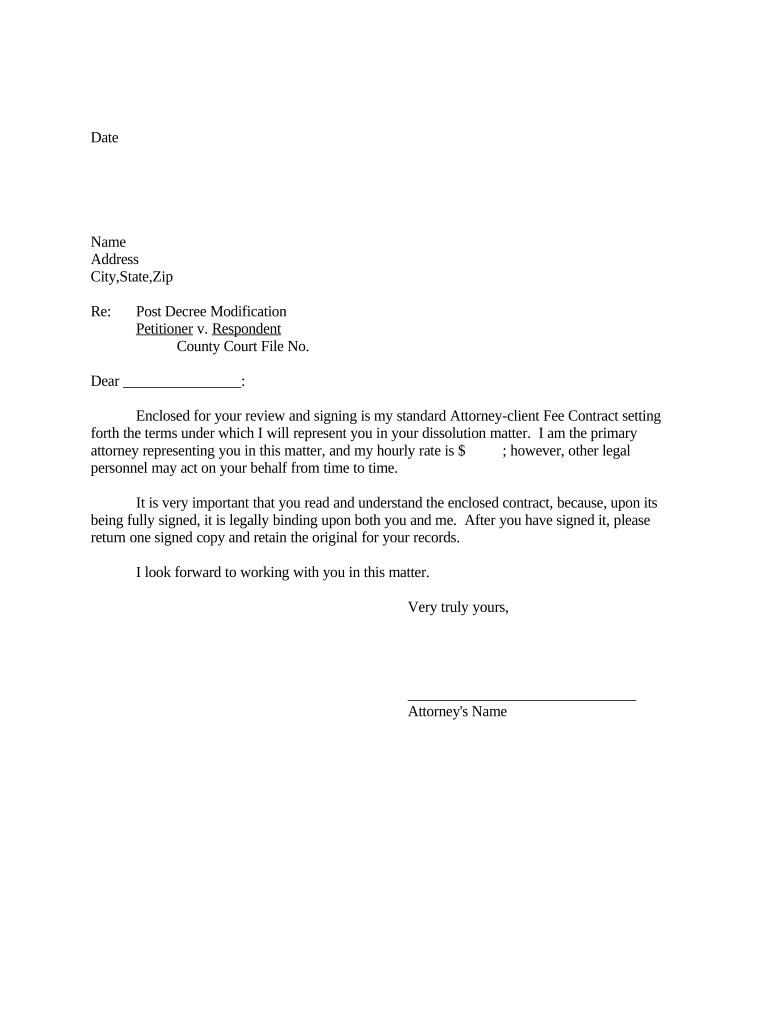
- In the 'Re:' section, specify whether you are the Petitioner or Respondent in your case. Include your County Court File Number for reference.
- Review the Attorney-client Fee Contract carefully. Pay attention to the hourly rate and understand that other legal personnel may assist you.
- Once satisfied, sign the document electronically within our platform. After signing, download a copy for your records and return one signed copy to your attorney.
Start using our platform today to streamline your document editing and signing process for free!
Fill out minnesota attorney client online
It's free
It's free
Got questions?
We have answers to the most popular questions from our customers. If you can't find an answer to your question, please contact us.
Contact us
What is not covered by attorney-client privilege?
RULE 1.7: CONFLICT OF INTEREST: CURRENT CLIENTS (2) there is a docHub risk that the representation of one or more clients will be materially limited by the lawyers responsibilities to another client, a former client, or a third person or by a personal interest of the lawyer.
What are the three elements of the attorney-client privilege?
A: Firstly, the privilege requires that three things exist: 1) an attorney (including his whole office and staff) and a client; 2) a private communication; 3) the purpose of providing legal advice. Once you have those three things, the privilege covers everything and is construed very broadly.
What is a lawyers client called?
Rule 1.5(a), Minnesota Rules of Professional Conduct, requires a lawyers fee to be reasonable and sets out a non-exclusive list of factors to consider in determining whether a fee is reasonable, including whether the fee is contingent. In most cases, contingent fees are allowed by Rule 1.5(c).
What are the legal exceptions to client confidentiality?
When Confidentiality Can Be Broken: Exceptions to the Rule Legally Mandated Reporting. Child abuse or neglect: Elder abuse: Threats of violence: Severe mental illness: Court Orders and Subpoenas. Protecting Yourself from Harm. Consulting with Colleagues.
What are the exceptions to the attorney-client privilege?
Crime or Fraud Exception. If a client seeks advice from an attorney to assist with the furtherance of a crime or fraud or the post-commission concealment of the crime or fraud, then the communication is not privileged.
Security and compliance
At DocHub, your data security is our priority. We follow HIPAA, SOC2, GDPR, and other standards, so you can work on your documents with confidence.
Learn more


People also ask
What are the exceptions to the solicitor client privilege?
The Supreme Court has only recognized two exceptions to the Privilege: public safety and innocence at stake. In practice, there exist a group of other exceptions often referred to as Lawyers exceptions or self-defence exceptions.