Attorney in fact 2026

Get Form
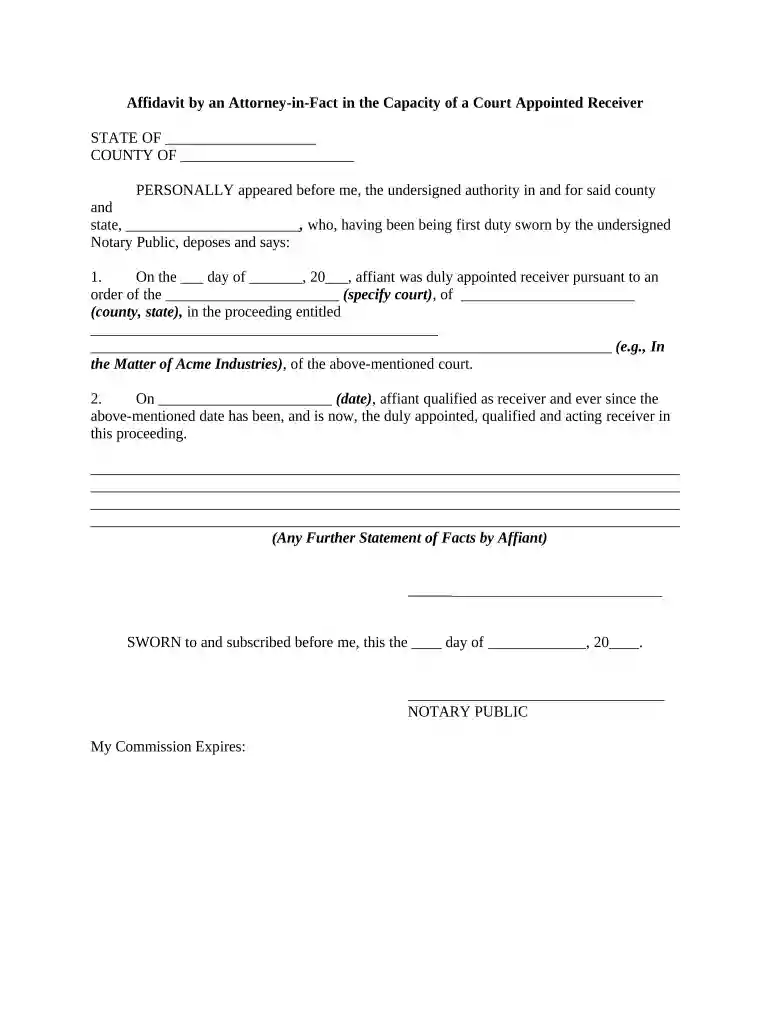
attorney in fact Preview on Page 1

Here's how it works

01. Edit your attorney in fact online
Type text, add images, blackout confidential details, add comments, highlights and more.

02. Sign it in a few clicks
Draw your signature, type it, upload its image, or use your mobile device as a signature pad.

03. Share your form with others
Send attorney in fact sample via email, link, or fax. You can also download it, export it or print it out.

How to use or fill out attorney in fact with our platform

Form edit decoration
9.5
Ease of Setup
DocHub User Ratings on G2
9.0
Ease of Use
DocHub User Ratings on G2
  1. Click ‘Get Form’ to open the attorney in fact document in the editor.
  2. Begin by filling in the STATE and COUNTY at the top of the form. This information is crucial as it identifies the jurisdiction of your affidavit.
  3. In the first section, enter your name where indicated, ensuring that it matches your legal identification. This establishes your identity as the affiant.
  4. Specify the date of your appointment as receiver in the designated field. This date is important for establishing a timeline of your authority.
  5. Next, indicate the court's name and location where you were appointed. This provides context for your role and legitimizes your affidavit.
  6. In the section for further statements, provide any additional facts relevant to your appointment or duties as a receiver. Be clear and concise.
  7. Finally, sign and date at the bottom of the form before a Notary Public to validate your affidavit legally.

Start using our platform today to streamline your document editing and signing process for free!

be ready to get more

Complete this form in 5 minutes or less

Get form

Got questions?

We have answers to the most popular questions from our customers. If you can't find an answer to your question, please contact us.
Contact us
Unlike an Attorney-in-Fact, whose powers are limited to the period of time you are alive, or an Executor, whose powers are limited to a period of time after you die, your Trustee can serve both during your lifetime and after your death. A Trustees powers, however, are limited to those assets held in the trust.
Signing as an attorney-in-fact involves executing documents on behalf of another person (the principal) under the authority granted by a power of attorney. The signature must clearly indicate the representative capacity to avoid confusion or errors, typically formatted as: Jane Smith, by John Doe, Attorney-in-Fact.
Definition and Citations: Actual, real; as distinguished from implied or inferred. Resulting from theacts of parties, instead of from the act or intendment of law.
Second, an Attorney-in-Fact only has control over those assets not held in a trust, as trust assets are governed by a Trustee. An Executor is named in your Will to shepherd your probate assets through the probate court process and ultimately to your beneficiaries upon your death.
Its important to note that an attorney-in-fact is not the same as a lawyer or an attorney. A lawyer is a professional who is licensed to practice law, while an attorney-in-fact is simply a person who has been given the authority to act on behalf of another person.

Security and compliance

At DocHub, your data security is our priority. We follow HIPAA, SOC2, GDPR, and other standards, so you can work on your documents with confidence.

Learn more
ccpa2
pci-dss
gdpr-compliance
hipaa
soc-compliance

People also ask

Actual, real; as distinguished from implied or inferred. Resulting from theacts of parties, instead of from the act or intendment of law.
Limitations and Restrictions The principal can limit the types of transactions the attorney in fact can conduct, such as restricting the purchase or sale of certain assets. Some documents may include conditions, allowing the attorney in fact to act only under specific circumstances, like the principals incapacity.

attorney in fact form