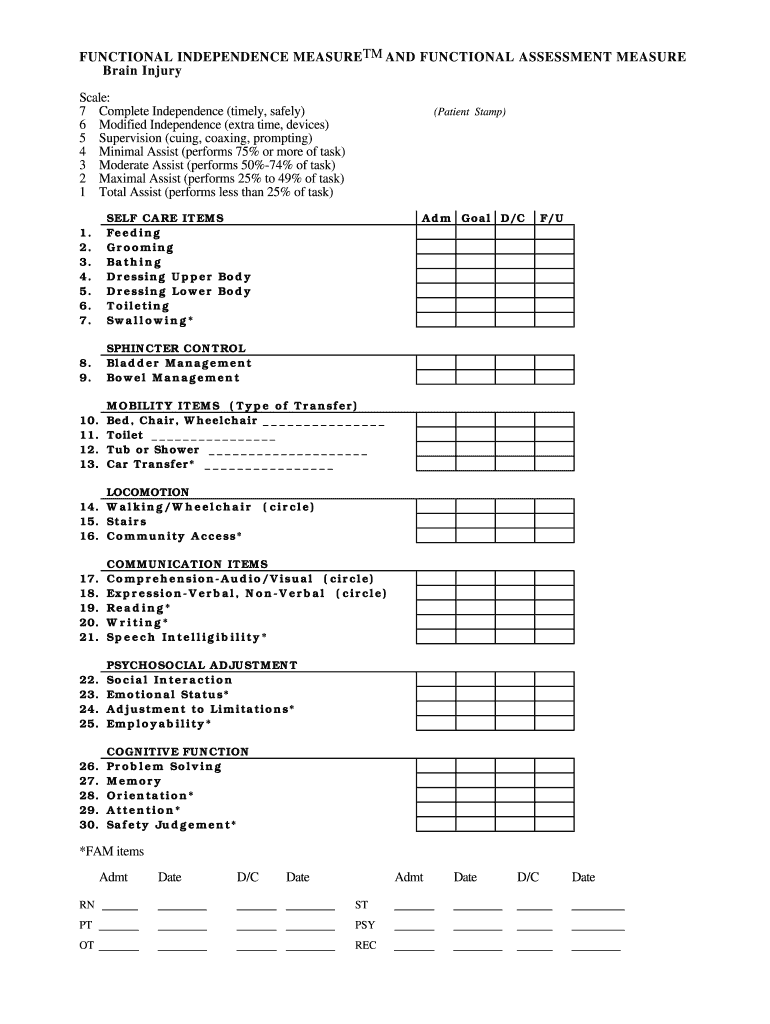







Definition & Meaning of the FIM Assessment PDF
The FIM (Functional Independence Measure) assessment PDF is a standardized tool used to evaluate an individual's level of independence in performing activities of daily living (ADLs). It encompasses various domains of function, including self-care, mobility, communication, social cognition, and cognitive function. The FIM assessment categorizes these abilities into distinct levels, allowing healthcare professionals to gauge a person's capabilities and the support they may require.
This tool is essential in rehabilitation settings, particularly for individuals recovering from brain injuries, strokes, or other conditions affecting functional abilities. It provides a common language for clinicians to describe patient needs and progress, making it a vital component of patient assessment and treatment planning.
How to Use the FIM Assessment PDF
Using the FIM assessment PDF involves systematic steps to ensure accurate and effective evaluation. Here are the detailed steps:
-
Download the FIM Assessment PDF: Obtain the form from a reputable source, ensuring that it is the most current version.
-
Familiarize Your Team: Ensure all team members using the assessment are trained in its application. Understanding the scoring system and criteria for each item is critical for consistent results.
-
Conduct the Assessment: Have the individual perform various tasks representative of self-care, motor functions, and communication skills. It may involve observing the individual or asking them to perform specific actions.
-
Score the Assessment: Assign scores based on the individual's performance. The FIM scale ranges from one (total dependence) to seven (complete independence). It is crucial to be objective and follow the defined criteria closely.
-
Document Results: After scoring, ensure the results are thoroughly documented. This will help track progress over time and support ongoing care and treatment plans.
-
Review and Analyze: Discuss the scores with relevant team members to interpret results and make informed decisions about the individual's care plans.
How to Obtain the FIM Assessment PDF
To obtain the FIM assessment PDF, follow these steps:
-
Visit Trusted Websites: Check medical and rehabilitation institutions' websites or resources dedicated to assessments in healthcare.
-
Contact Your Institution: Reach out to your healthcare or rehabilitation facility for access. They often have standardized documents and may provide training alongside the assessment.
-
Professional Associations: Look for resources provided by professional associations related to rehabilitation, such as the American Congress of Rehabilitation Medicine (ACRM).
-
Educational Resources: Some universities or research organizations involved in rehabilitation may provide access to the FIM assessment PDF as part of their educational materials.
Important Terms Related to the FIM Assessment PDF
Understanding key terms related to the FIM assessment is crucial for effective use. Key terms include:
-
Activities of Daily Living (ADLs): Basic self-care tasks such as bathing, dressing, eating, and mobility.
-
Functional Independence: The degree to which an individual can perform activities without assistance.
-
Scoring Criteria: Descriptions of performance levels that guide scoring from one to seven.
-
Rehabilitation: The process of helping individuals recover lost skills and regain independence.
-
Cognitive Function: Mental processes involved in gaining knowledge and comprehension, including memory and reasoning.
-
Multidisciplinary Team: A group of professionals from various fields working together for patient care, such as doctors, nurses, physical therapists, and occupational therapists.
Steps to Complete the FIM Assessment PDF
The completion of the FIM assessment PDF follows an organized process that helps ensure accuracy. These are the steps involved:
-
Preparation: Gather necessary tools and materials, including the FIM assessment PDF and criteria guidelines.
-
Initial Evaluation: Conduct a preliminary assessment to identify areas of concern and focus for evaluation.
-
Assess Each Domain: Use the FIM’s structured categories—self-care, mobility, communication, and cognition—to evaluate the individual comprehensively.
- Self-Care: Evaluate tasks such as bathing, dressing, and eating.
- Mobility: Assess walking, transferring, and using mobility aids.
- Communication: Look at the individual’s ability to express needs and understand language.
- Social Cognition: Evaluate aspects such as interpersonal interactions and social acceptance.
-
Scoring and Comments: After each assessment item, score the performance based on the FIM definitions, providing comments as necessary for clarity.
-
Review and Finalize: Compile all scores and feedback before finalizing the assessment for submission or review by the team.
Who Typically Uses the FIM Assessment PDF
The FIM assessment PDF is utilized by various professionals within healthcare and rehabilitation settings. Typical users include:
-
Rehabilitation Therapists: Occupational and physical therapists often use the FIM to create targeted rehabilitation plans.
-
Nurses: Nursing staff may use the FIM for ongoing assessments and monitoring of patients' progress during recovery.
-
Physicians: Doctors review FIM assessments to understand the functional status of patients and guide treatment decisions.
-
Social Workers: They may use the assessment to identify resources and services needed by patients transitioning back to their daily lives.
-
Insurance Evaluators: Insurers may analyze FIM scores to determine coverage and reimbursement for rehabilitation services.
-
Researchers: Scholars studying functional recovery may utilize FIM data for clinical studies and outcome assessments.