




Here's how it works
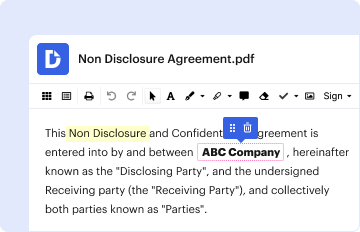
01. Edit your adhd asrs online
Type text, add images, blackout confidential details, add comments, highlights and more.
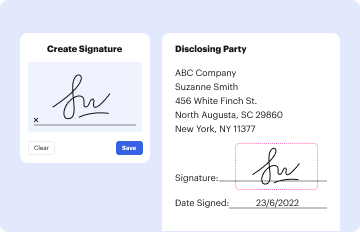
02. Sign it in a few clicks
Draw your signature, type it, upload its image, or use your mobile device as a signature pad.

03. Share your form with others
Send adult adhd self report scale via email, link, or fax. You can also download it, export it or print it out.
How to use or fill out Adult ADHD Self-Report Scale (ASRS-v I) with our platform

- Click 'Get Form' to open the Adult ADHD Self-Report Scale (ASRS-v I) in the editor.
- Begin by entering your name and today's date at the top of the form. This personal information is essential for your healthcare professional.
- Proceed to Part A, where you will find a series of questions regarding your experiences over the past six months. For each question, rate yourself using the provided scale by placing an 'X' in the box that best describes your feelings.
- After completing Part A, move on to Part B, which focuses on specific symptoms related to ADHD. Again, use the same rating scale to indicate how often you experience these symptoms.
- Once you have filled out all sections, review your responses for accuracy. You can easily make edits directly within our platform before finalizing.
- Finally, save your completed checklist and share it with your healthcare professional during your appointment for further discussion.
Start using our platform today for free and take control of your ADHD assessment process!
Fill out Adult ADHD Self-Report Scale (ASRS-v I online
It's free
It's free
Got questions?
We have answers to the most popular questions from our customers. If you can't find an answer to your question, please contact us.
Contact us
What is the best test for adult ADHD?
The World Health Organization* has prepared a self-screening questionnaire you can use to determine if you might have adult ADHD. The Adult Self-Report Scale (ASRS) Screener will help you recognize the signs and symptoms of adult ADHD.
What is the best ADHD assessment tool for adults?
Several brief screening tools have been developed for adult ADHD. The most frequently used is the World Health Organizations Adult ADHD Self-Report Scale (ASRS V1. 1).
How is the ASRS rating scale scored for ADHD?
The points are summed for a range of 0-24, with a cutpoint of 14 or more to screen positive for ADHD. The total score can be classified in four-stratum: 0-9=low negative, 10-13=high negative, 14-17=low positive range, and 18-24=high positive range.
What is the most commonly used evaluation form for adult ADHD?
Adult ADHD Self-Report Scale (ASRS) The Adult ADHD Self-Report Scale (ASRS v1.1) is an 18-item self-report questionnaire designed to assess Attention Deficit Hyperactivity Disorder (ADHD) symptoms in adults (18+).
How do you interpret the ASRS results?
For the ASRS, Average classifications (40- 59 T-score range) show typical levels of concern; the Slightly Elevated term (60-64) indicates somewhat more concern than is typical; Elevated Score (65-69) describes more concerns than are typically reported; and a Very Elevated Score (70+) is a result with many more concerns
Security and compliance
At DocHub, your data security is our priority. We follow HIPAA, SOC2, GDPR, and other standards, so you can work on your documents with confidence.
Learn more


Related forms

PDF Version of a Compilation of (most of
The document discusses the Atonement of Jesus Christ, emphasizing its significance as a transcendent event that reconcil ...
How Dark were the 'Dark Ages'Four Myths you probably believe
The article by Davis Bitton challenges the notion of the 'Dark Ages' as a period of cultural and intellectual decline in ...

Bowling Course Notes
The document provides comprehensive notes on the history, terminology, equipment, rules, etiquette, scoring, technique, ...

Download - Brigham Young University - geology byu
The dissertation by Sandra M. Hamaker explores the relationship between fault zone architecture and groundwater compartm ...

Eukaryotic Cells
The document provides a comprehensive overview of eukaryotic cells, detailing their characteristics and differences from ...

What's the big picture? - Brown University
The document is a newsletter from the Department of Computer Science at Brown University, detailing various updates and ...

Impostor Syndrome Links and Bibliography - Google Docs
The document is the Winter Career Fair 2013 Handbook from the California Institute of Technology, detailing various comp ...

PDF (Ch 5) - thesis library caltech
The document presents the development and application of novel clickable cross-linkers (CXLs) for mass spectrometry-base ...
People also ask
What is the gold standard for adult ADHD assessment?
The gold standard for an adult ADHD diagnostic assessment is a detailed exploration of the clinical and behavioural presentation, using a semi-structured diagnostic interview, supported by supplementary and/or collateral information (53).
What is the ASRS score for adult ADHD?
The cutoff for ADHD is marked at 14, indicating that individuals who score 14 or above show symptoms that are consistent with an ADHD diagnosis.
What is the best screening tool for adult ADHD?
ASRS-6 (DSM-V), WURS-25, CAARS-s:sV and TRAQ10 are suitable instruments for screening of ADHD in adults in primary care. The highest test accuracy was shown by ASRS 6 (DSM-V) (Sensitivity=0.83 [0.670.92], Specificity=0.87 [0.930.8], AUC=0.92, I2=8.612.3 %).