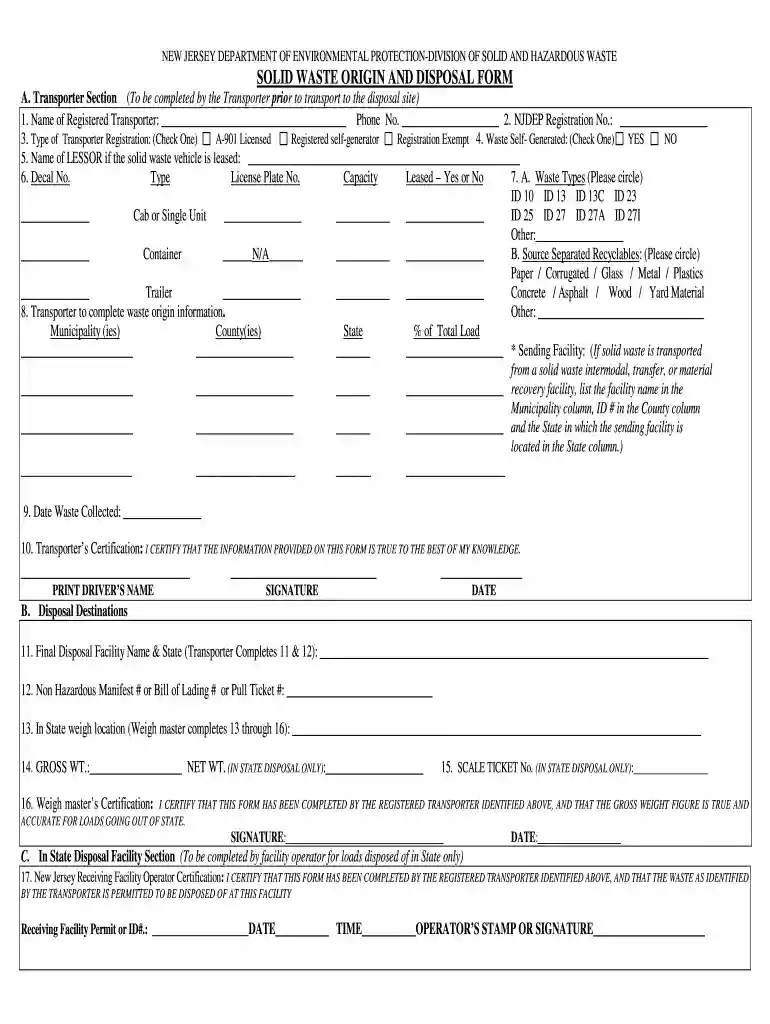
Solid waste origin and disposal form 2026

Get Form
solid waste origin and disposal form Preview on Page 1

Here's how it works

01. Edit your solid waste origin and disposal form online
Type text, add images, blackout confidential details, add comments, highlights and more.

02. Sign it in a few clicks
Draw your signature, type it, upload its image, or use your mobile device as a signature pad.

03. Share your form with others
Send waste disposal form pdf via email, link, or fax. You can also download it, export it or print it out.

How to use or fill out solid waste origin and disposal form with our platform

Form edit decoration
9.5
Ease of Setup
DocHub User Ratings on G2
9.0
Ease of Use
DocHub User Ratings on G2
  1. Click ‘Get Form’ to open it in the editor.
  2. Begin with the Transporter Section. Fill in the Name of Registered Transporter and Phone Number, ensuring accuracy as per NJDEP registration.
  3. Complete the NJDEP Registration No. and check the appropriate Type of Transporter Registration box.
  4. Indicate whether the waste was self-generated by checking 'YES' or 'NO'.
  5. If applicable, provide the Name of LESSOR for leased vehicles along with Decal No., Type, License Plate No., and Capacity.
  6. Circle the Waste Types being transported and Source Separated Recyclables as necessary.
  7. Fill in Municipality, County, State, and % of Total Load for accurate waste origin information.
  8. Enter the Date Waste Collected and complete the Transporter’s Certification section by printing your name, signing, and dating.
  9. For Disposal Destinations, provide Final Disposal Facility Name & State along with Non-Hazardous Manifest # or Bill of Lading #.
  10. Complete Gross WT. and NET WT. fields as required by weigh master certification.

Start using our platform today to streamline your solid waste documentation process for free!

be ready to get more

Complete this form in 5 minutes or less

Get form

Got questions?

We have answers to the most popular questions from our customers. If you can't find an answer to your question, please contact us.
Contact us
From traditional landfilling and incineration to modern approaches like recycling and composting, a range of disposal methods are employed to efficiently and sustainably manage solid waste.
The waste management hierarchy is a conceptual framework designed to guide and rank waste management decisions at both the individual and organisational level. It gives top priority to waste prevention, followed by re-use, recycling, recovery and finally disposal.
Five Methods for Waste Disposal Preventing and Reducing Waste Generation. Throwing away new and even unnecessary items is the primary source of waste formation we have. Recycling. Incineration. Composting. Sanitary Landfill. Contact WB Waste.
Consult with interested parties. Identify potential waste streams. Evaluate the reuse and recycling program. Consider waste collection strategies. Determine locations or criteria for waste management sites. Select potential waste management facilities. Create a waste management-focused community outreach plan.
The term solid waste management mainly refers to the complete process of collecting, treating and disposing of solid wastes. In the waste management process, the wastes are collected from different sources and are disposed of. This process includes collection, transportation, treatment, analysis and disposal of waste.

Security and compliance

At DocHub, your data security is our priority. We follow HIPAA, SOC2, GDPR, and other standards, so you can work on your documents with confidence.

Learn more
ccpa2
pci-dss
gdpr-compliance
hipaa
soc-compliance
be ready to get more

Complete this form in 5 minutes or less

Get form

People also ask

The sources of solid waste include residential, commercial, institutional, and industrial activities. Certain types of wastes that cause immediate danger to exposed individuals or environments are classified as hazardous; these are discussed in the article hazardous-waste management.
RCRA states that solid waste means any garbage or refuse, sludge from a wastewater treatment plant, water supply treatment plant, or air pollution control facility and other discarded material, resulting from industrial, commercial, mining, and agricultural operations, and from community activities.
Solid Waste Disposal Methods and Management Landfilling. Landfills are engineered sites where solid waste is deposited and compacted. Incineration. Recycling. Composting. Waste-to-Energy. Hazardous Waste Treatment. Source Reduction. Biogas Generation.

disposal form sample