Consent peels form 2026

Get Form
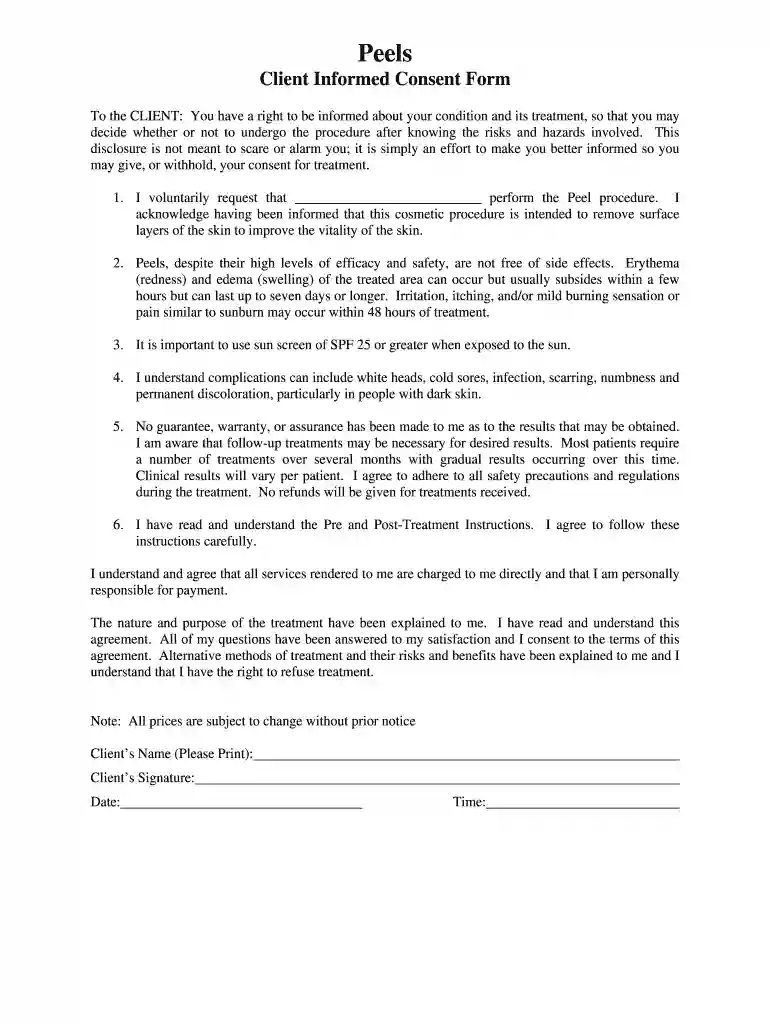
chemical peel consent form Preview on Page 1

Here's how it works

01. Edit your chemical peel consent form online
Type text, add images, blackout confidential details, add comments, highlights and more.

02. Sign it in a few clicks
Draw your signature, type it, upload its image, or use your mobile device as a signature pad.

03. Share your form with others
Send printable chemical peel consent form via email, link, or fax. You can also download it, export it or print it out.

Definition and Meaning of the Consent Peels Form

The consent peels form, also recognized as the chemical peel consent form, is a critical document in the cosmetic and dermatological fields. This form ensures that clients are thoroughly informed about the procedures, benefits, risks, and potential side effects associated with chemical peels. By signing this form, clients acknowledge their understanding and acceptance of these factors, which promotes informed decision-making regarding their treatment.

  • Purpose: The primary purpose of the consent form is to mitigate liability for practitioners while empowering clients with knowledge.
  • Key Details: Clients are informed about different types of chemical peels, including superficial, medium, and deep peels, which vary in intensity and recovery time.
  • Legal Importance: The document serves as a legal safeguard, confirming that the client voluntarily consents to the procedure after being advised of its nature and any associated risks.

This form typically includes language about the necessity of following pre-treatment and post-treatment care instructions to optimize outcomes and minimize complications.

How to Use the Consent Peels Form

Using the consent peels form involves several straightforward steps to ensure compliance and clarity for both the practitioner and the client.

  • Initial Provision: Practitioners must provide the consent form before the consultation or the actual procedure takes place.
  • Guided Discussion: During the appointment, practitioners should discuss the details of the form—including the nature of the procedure, expected results, risks, and necessary aftercare—ensuring clients have ample opportunity to ask questions.
  • Client Acknowledgment: After the discussion, clients should confirm their understanding of the treatment and explicitly sign the consent form. This step is crucial in ensuring that clients are actively engaged in their care process.

It is essential for practitioners to keep signed consent forms on file for legal and ethical reasons, reflecting a commitment to transparency and client safety.

Key Elements of the Consent Peels Form

The consent peels form is structured to cover several core elements essential for informed consent.

  • Client Information: Section for client's name, contact, and relevant medical history that may affect treatment.
  • Procedure Details: Clear explanation of the chemical peel procedure, including types and expected outcomes.
  • Risks and Side Effects: Comprehensive list of potential risks such as skin redness, peeling, allergic reactions, or infection, reflecting the variability of responses based on individual skin types.
  • Financial Responsibility: A clause acknowledging that clients understand the costs associated with the procedure and are financially responsible for payment.
  • Consent Acknowledgment: A statement that must be signed by the client, indicating they have read, understood, and agree to proceed with the treatment.

Each element is pivotal in helping clients understand their treatment thoroughly, reinforcing their autonomy and the practitioner’s accountability.

Steps to Complete the Consent Peels Form

Completing the consent peels form should be approached systematically to ensure that all relevant information is captured accurately.

  1. Read Thoroughly: Clients should begin by reading the entire document to comprehend all sections.
  2. Consult with Practitioner: Any uncertainties about the procedure or implications should be discussed with the practitioner for clarification.
  3. Fill in Personal Details: Clients need to provide their name, contact information, and any relevant medical history.
  4. Acknowledge Risks: Clients should carefully review the risks and side effects, ensuring they understand them before signing.
  5. Signature and Date: The final step requires clients to sign and date the form, indicating their consent and understanding of the treatment.

Following these steps ensures that the form is filled out completely and accurately, benefitting both the client and the practitioner.

Legal Use of the Consent Peels Form

The legal use of the consent peels form is essential for compliance with healthcare regulations and for protecting both clients and practitioners.

  • Informed Consent Standard: The form adheres to the legal requirements of obtaining informed consent, a critical aspect of ethical medical practice that protects clients' rights.
  • Liability Protection: By obtaining signed consent, practitioners may shield themselves from legal action related to complications stemming from the treatment, provided that they have fully informed their clients.
  • Documentation: Plaintiffs in negligent lawsuits must prove that consent was not properly obtained or that the risks were inadequately communicated. The consent form serves as vital documentation in such cases.

Overall, the legal framework surrounding the consent peels form underscores its importance as a tool for medical ethics and patient care, fostering trust between clients and practitioners.

be ready to get more

Complete this form in 5 minutes or less

Get form

Got questions?

We have answers to the most popular questions from our customers. If you can't find an answer to your question, please contact us.
Contact us
A Skincare Facial Consent Form provides all necessary information about your patients such as their personal and contact information, health and skin details with their consent to terms and conditions.
It requires individuals to provide clear and specific permission to process their data. There are various types of consent, including explicit consent, implied consent, opt-in consent, and opt-out consent. The type of consent required depends on the context and applicable data protection laws.
4 Elements of Sexual Consent 1) Answer Must Be Yes Your partner must express a desire to engage in sexual activity with you by stating so in the affirmative. 2) Some People Cannot Consent. 3) Prior Involvement Does Not Count. 4) You Must Know If You Have Consent.
I have read and I understand the provided information and have had the opportunity to ask questions. I understand that my participation is voluntary and that I am free to withdraw at any time, without giving a reason and without cost. I understand that I will be given a copy of this consent form.
What Are the 4 Principles of Informed Consent? Decision-Making Capacity. Disclosure. Documentation of Consent. Competency.

Security and compliance

At DocHub, your data security is our priority. We follow HIPAA, SOC2, GDPR, and other standards, so you can work on your documents with confidence.

Learn more
ccpa2
pci-dss
gdpr-compliance
hipaa
soc-compliance