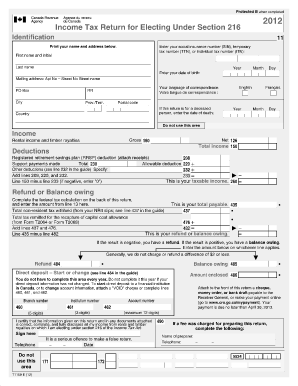
Complaint court form 2026

Get Form
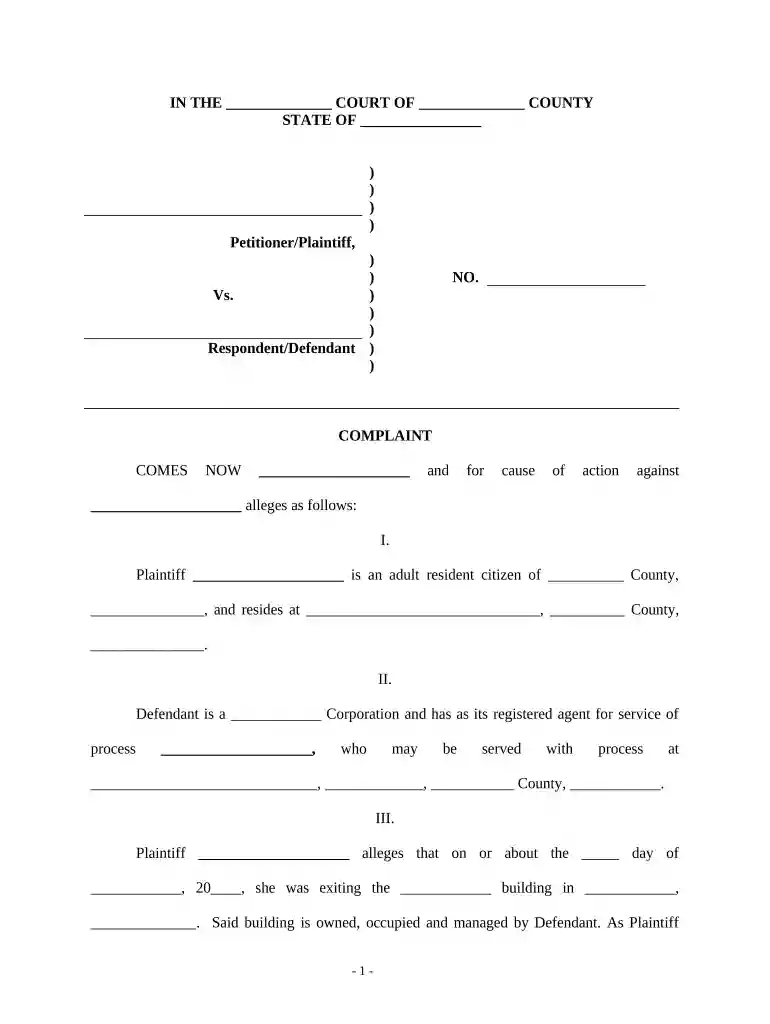
complaint court form Preview on Page 1

Here's how it works

01. Edit your form online
Type text, add images, blackout confidential details, add comments, highlights and more.

02. Sign it in a few clicks
Draw your signature, type it, upload its image, or use your mobile device as a signature pad.

03. Share your form with others
Send it via email, link, or fax. You can also download it, export it or print it out.

How to use or fill out complaint court form with our platform

Form edit decoration
9.5
Ease of Setup
DocHub User Ratings on G2
9.0
Ease of Use
DocHub User Ratings on G2
  1. Click ‘Get Form’ to open the complaint court form in the editor.
  2. Begin by filling in the court name and county at the top of the form. This identifies where your complaint is being filed.
  3. In the Petitioner/Plaintiff section, enter your name and address details accurately to establish your identity as the complainant.
  4. Next, provide information about the Respondent/Defendant, including their name and registered agent for service of process.
  5. Detail the incident in Section III, describing what happened, where it occurred, and how it led to your injuries. Be specific about dates and locations.
  6. In Section IV, outline the negligence claims against the defendant. Clearly list each act of negligence that contributed to your injury.
  7. Finally, summarize your damages in Section VI, including medical expenses and any ongoing suffering. Ensure all amounts are accurate.
  8. Complete the signature section at the bottom of the form with your name, title, address, and contact information before submitting.

Start using our platform today to easily fill out your complaint court form for free!

be ready to get more

Complete this form in 5 minutes or less

Get form

Got questions?

We have answers to the most popular questions from our customers. If you can't find an answer to your question, please contact us.
Contact us
Your complaint should include: An explanation of what you have done to resolve the problem, including results of any reviews and appeals. Information about why you feel you were treated unfairly. Copies of any relevant documents such as review or appeal decisions.
A complaint is the pleading that starts a case. Essentially, a document that sets forth a jurisdictional basis for the courts power, the plaintiffs cause of action, and a demand for judicial relief.
Comply With the Relevant Federal, State, and Local Rules. Research Before Writing. Allege Subject Matter Jurisdiction, Personal Jurisdiction, and Venue. Jurisdiction. Draft Concise and Plain Statement of the Facts. Factual Allegations. Draft Separate Counts for Each Legal Claim. Plead Facts With Particularity Where Necessary.
A complaint is a document that describes what the plaintiff wants (money or some other type of relief) and why she believes she is entitled to that relief. It also identifies the defendant (the party being sued). When the plaintiff files the complaint, she will pay a filing fee to the court.
Explain the problem Rather than saying, Your information is wrong. Please fix it now. Explain what the correct situation should be by introducing it with the expression There has been a misunderstanding. This makes it clear what you want while not blaming the person you are complaining to for making the mistake.

Security and compliance

At DocHub, your data security is our priority. We follow HIPAA, SOC2, GDPR, and other standards, so you can work on your documents with confidence.

Learn more
ccpa2
pci-dss
gdpr-compliance
hipaa
soc-compliance

People also ask

Civil cases are started by a private party, such as a person or business, who believes they have been harmed by another party. The goal is to provide relief or compensation to the victim. Typically, civil lawsuits seek monetary compensation for the victim or a solution to end further harm through an injunction.
A complaint letter or email needs to be short and to the point. They need to stick to the facts what their complaint is, how this has come about, what they have done about it, what response they got, what information they can provide in support of their complaint, what they want to happen next.

Related links