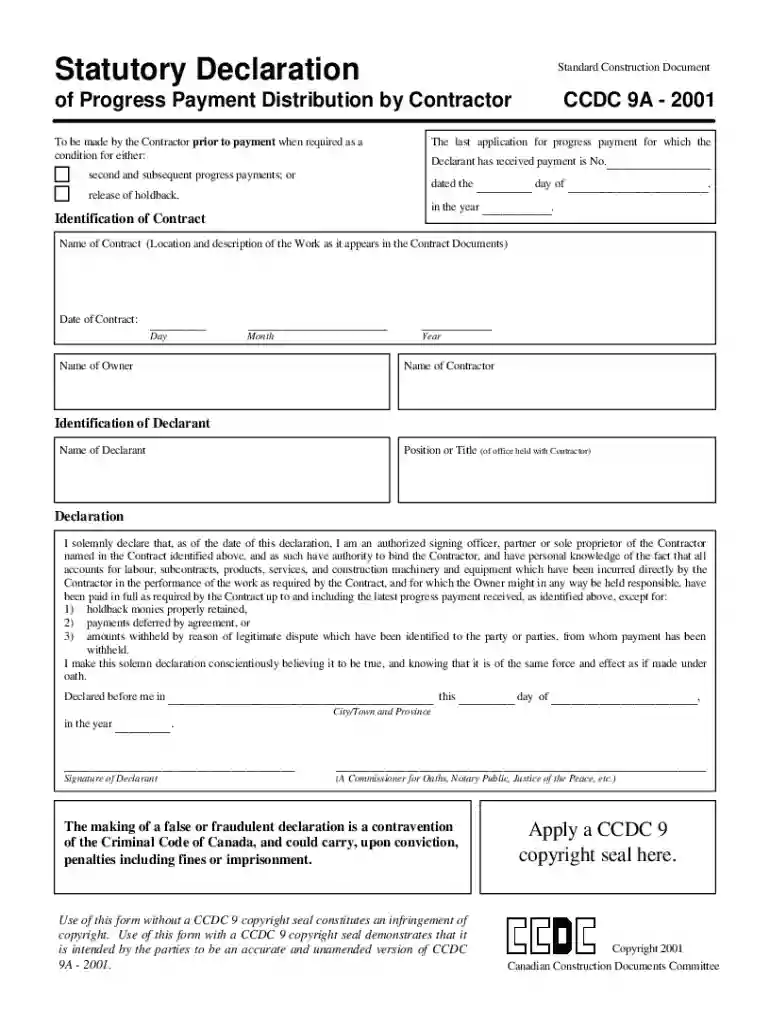
Statutory declaration form ontario 2026

Get Form
statutory declaration form ontario Preview on Page 1

Here's how it works

01. Edit your statutory declaration form ontario online
Type text, add images, blackout confidential details, add comments, highlights and more.

02. Sign it in a few clicks
Draw your signature, type it, upload its image, or use your mobile device as a signature pad.

03. Share your form with others
Send statutory declaration form ontario pdf via email, link, or fax. You can also download it, export it or print it out.

Definition and Meaning of the Statutory Declaration Form Ontario

A statutory declaration form in Ontario is a legal document that allows an individual to assert the truth of specific facts in a formalized way. Unlike an affidavit, which is sworn before a commissioner of oaths, a statutory declaration is made under the law without a need for a sworn witness. This form serves as a tool for individuals and organizations to provide legally recognized evidence of their claims or facts when required for various legal procedures, including financial transactions, legal compliance, and other formal declarations.

Key Characteristics:

  • Legally binding: The statutory declaration carries legal weight, and providing false information may lead to penalties.
  • Simplified process: The form can be filled out and submitted without needing a legal representative, making it accessible for individuals.
  • Flexibility: It can be used in a variety of circumstances, from personal declarations to professional contexts.

Steps to Complete the Statutory Declaration Form Ontario

Filling out a statutory declaration form in Ontario requires careful attention to detail. Here’s a step-by-step guide to ensure the form is completed accurately:

  1. Obtain the Form: The statutory declaration form can typically be downloaded from legal resources or government websites. It may also be available at legal offices.
  2. Provide Personal Information: Fill in your full name, address, and contact details at the top of the form. Always ensure that the information is current and accurate.
  3. State Your Declaration:
    • Clearly outline the facts you are declaring. Use straightforward language to prevent misunderstandings.
    • If multiple declarations are needed, list them in order.
  4. Sign the Form: Unlike affidavits, a statutory declaration does not require a witness signature. However, the individual must sign the document to validate it.
  5. Submission: Depending on the requirements of the entity requesting the declaration, submit the completed form via the preferred method (mail, online, or in-person), ensuring you keep a copy for your records.

Who Typically Uses the Statutory Declaration Form Ontario

The statutory declaration form in Ontario is versatile and used by various individuals and entities, including:


  • Individuals: People may use this form for personal matters such as confirming their identity, residency, or providing evidence in legal situations.
  • Businesses: Companies might require statutory declarations for compliance reasons, such as confirming ownership details or operational status.
  • Contractors and Subcontractors: In construction, statutory declarations may be employed to certify payment distributions and ensure adherence to labor agreements.
  • Legal Professionals: Lawyers may use or advise clients to use statutory declarations to substantiate claims during legal procedures or disputes.
decoration image ratings of Dochub

Legal Use of the Statutory Declaration Form Ontario

The legal framework surrounding statutory declarations in Ontario provides clear guidelines regarding their use. The form has specific applications in various legal contexts:

  • Evidence Submission: Statutory declarations can serve as evidence in court or other legal contexts where proof of certain facts is needed.
  • Real Estate Transactions: Used to declare ownership and other relevant details during property transfers or sales.
  • Business Compliance: Companies may utilize it to ensure that operational declarations comply with industry regulations, establishing trust with regulatory bodies and clients.
  • Financial Transactions: Banks and financial institutions may require statutory declarations to assess the truthfulness of information provided by applicants.

Key Elements of the Statutory Declaration Form Ontario

Understanding the critical components of the statutory declaration form is essential for its accurate completion. The main elements include:

  • Declaration Statement: The core claim or set of facts being asserted.
  • Personal Information Section: The declarant’s full name, address, and contact information.
  • Signature Section: Where the individual must sign to affirm the truth of the stated declaration.
  • Notarization: While not always required for a statutory declaration in Ontario, including a notarization can offer additional protection and legitimacy, particularly for complex assertions.

Important Terms Related to Statutory Declaration Form Ontario

Several terms are frequently associated with statutory declarations in Ontario that are helpful to understand:

  • Affidavit: A written statement made under oath, submitted in a legal context, often requiring a witness.
  • Commissioner for Oaths: An individual authorized to administer oaths and affirmations, often part of the process for affidavits but not statutory declarations.
  • Legal Penalties: Consequences of making false statements in statutory declarations, which may include fines or imprisonment for perjury.
  • Compliance: Adhering to legal requirements that may necessitate the filing of a statutory declaration.

These terms and their functions are crucial for individuals navigating legal or administrative processes in Ontario and beyond.

be ready to get more

Complete this form in 5 minutes or less

Get form

Security and compliance

At DocHub, your data security is our priority. We follow HIPAA, SOC2, GDPR, and other standards, so you can work on your documents with confidence.

Learn more
ccpa2
pci-dss
gdpr-compliance
hipaa
soc-compliance