






Definition and Meaning of Motion Summary Judgment Template
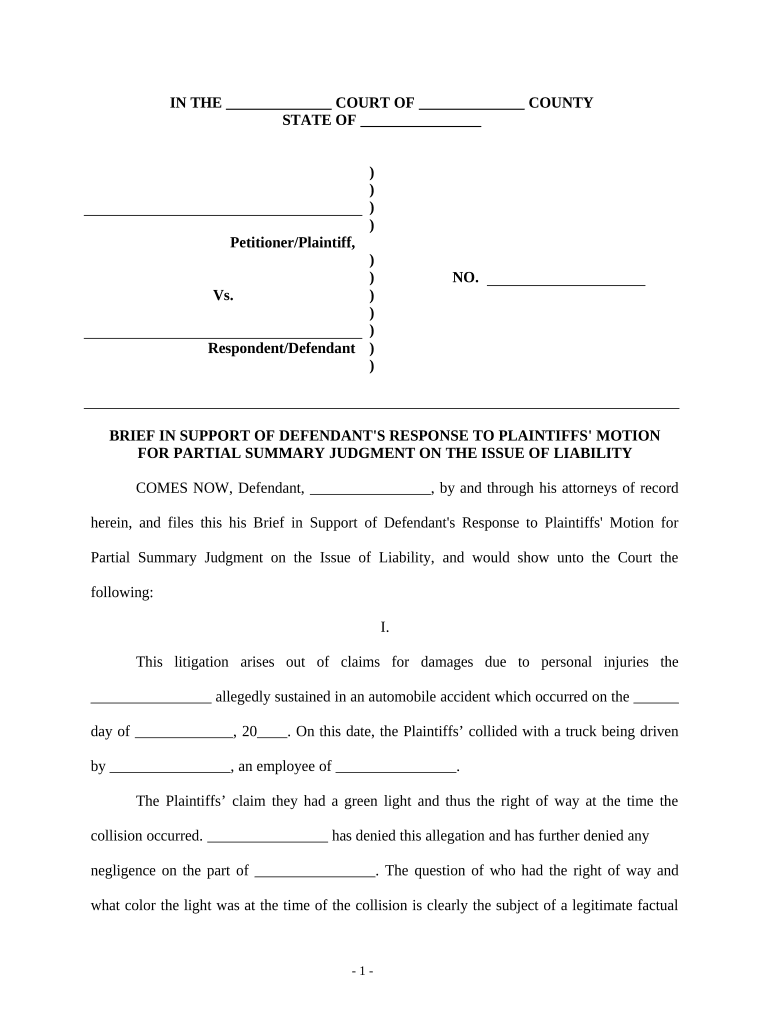
A motion summary judgment template is a legal framework designed for parties seeking to obtain a judgment from the court in a civil case without proceeding to a full trial. This document asserts that there are no substantial factual disputes requiring a jury’s examination and aims to resolve the case based on legal principles alone. By utilizing a motion for summary judgment, a party can request the court to rule in their favor on particular issues or the entire case, which can expedite legal proceedings and reduce associated costs.
Elements of Motion Summary Judgment Template
- Introduction: The template typically includes an introduction that outlines the purpose of the motion, specifying what the movant seeks to achieve.
- Statement of Facts: A clear and concise summary of the relevant facts of the case, highlighting the evidence that supports the party's position.
- Legal Standards: Reference to the applicable legal standards governing motions for summary judgment, which often delineates the burden of proof on the movant and the requirements for the court to grant the motion.
- Argument Section: Detailed arguments substantiating the request for summary judgment, supported by statutory citations and case law precedents.
- Conclusion: A succinct conclusion reiterating the request for the court to grant the motion.
How to Use the Motion Summary Judgment Template Effectively
Using a motion summary judgment template effectively involves careful adherence to the structure and content outlined within the document. Here are steps to guide its effective use:
-
Understand the Purpose: Clearly define the objective of the motion and what specific issues you want the court to address.
-
Accurate Statement of Facts: Ensure the facts presented are not only relevant but also accurately reflect the case. Misrepresentation can lead to the motion's denial.
-
Cite Legal Authorities: Include relevant statutes, rules, and case law that support your position, establishing that the legal basis for your motion is sound.
-
Prepare Arguments Thoroughly: Break down each argument into manageable parts for clarity. Address potential counterarguments and show why they do not negate your position.
-
Review for Compliance: Ensure that the motion complies with local court rules regarding formatting, filing procedures, and deadlines.
Steps to Complete the Motion Summary Judgment Template
Completing a motion summary judgment template involves several critical steps that should be followed to ensure all necessary components are included:
-
Gather Evidence: Collect all necessary documents, affidavits, and supporting materials that substantiate your claims.
-
Draft the Motion: Using the template, begin filling in the sections. Start with the introduction and proceed systematically through the statement of facts, legal standards, arguments, and conclusion.
-
Edit and Revise: Carefully edit the drafted motion to ensure clarity, conciseness, and legal precision. Check for grammatical errors and adherence to legal jargon.
-
Legal Review: If possible, have the motion reviewed by a legal professional to ensure its robustness and compliance with relevant laws and rules.
-
File the Motion: Submit the completed motion to the appropriate court by the specified filing method, which could be electronic or physical submission depending on local regulations.
Important Terms Related to Motion Summary Judgment Template
Familiarity with key terms associated with the motion summary judgment process aids in the proper use of the template and enhances the clarity of legal discussions:
-
Movant: The party submitting the motion for summary judgment.
-
Respondent: The opposing party in the case who will respond to the motion.
-
Material Fact: A fact that could potentially affect the court's decision on the outcome of the case.
-
Burden of Proof: The obligation of the movant to demonstrate that there is no genuine issue of material fact.
-
Affidavit: A written statement made under oath, which may be submitted as evidence in support of the motion.
Legal Use of the Motion Summary Judgment Template
The motion summary judgment template is utilized within the legal context to expedite proceedings by resolving disputes before trial, thereby saving time and resources. The legal foundation for this motion is provided by court rules, which outline how and when it can be employed. A party typically files the motion when it believes that no material disputed facts exist and that the law favors them substantially.
This tool is particularly useful in various cases, including personal injury claims, contract disputes, or any civil litigation where the facts are clear-cut and do not require jury intervention.