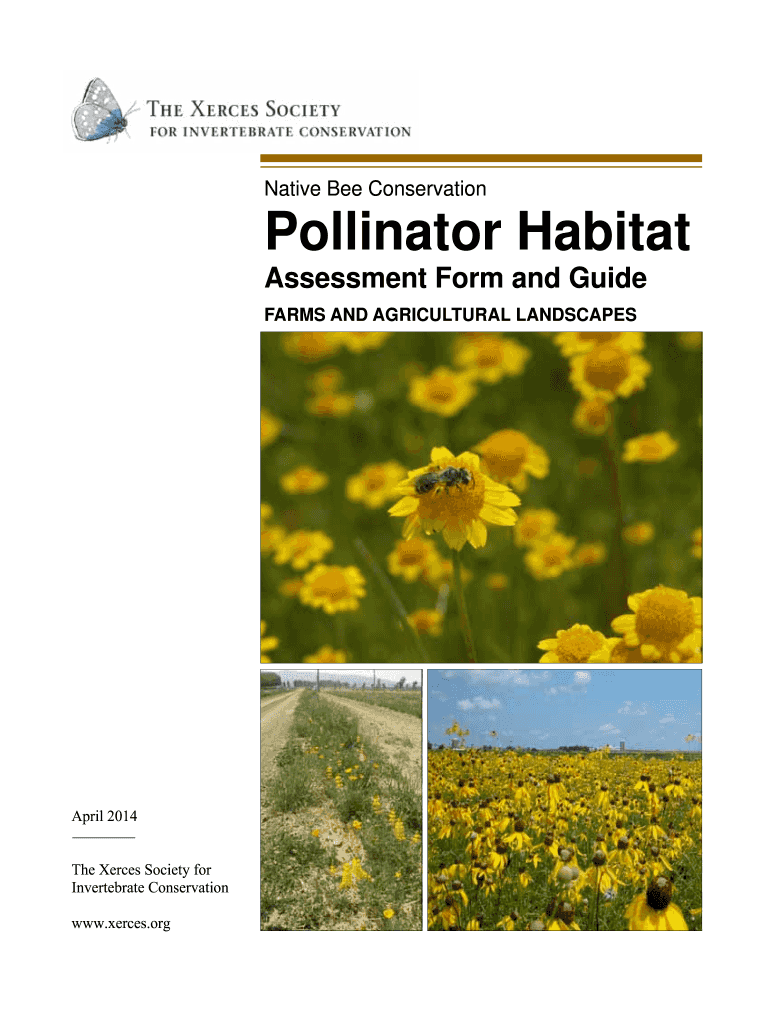
Pollinator Habitat Assessment Form and Guide - The Xerces Society - xerces 2026

Get Form
xerces 2023 Preview on Page 1

Here's how it works

01. Edit your xerces 2023 online
Type text, add images, blackout confidential details, add comments, highlights and more.
02. Sign it in a few clicks
Draw your signature, type it, upload its image, or use your mobile device as a signature pad.
03. Share your form with others
Send xerces2023 via email, link, or fax. You can also download it, export it or print it out.

How to use or fill out Pollinator Habitat Assessment Form and Guide - The Xerces Society - xerces with our platform

Form edit decoration
9.5
Ease of Setup
DocHub User Ratings on G2
9.0
Ease of Use
DocHub User Ratings on G2
  1. Click ‘Get Form’ to open the Pollinator Habitat Assessment Form in the editor.
  2. Begin by filling out the Site Summary section, including details such as Owner/Operator, County, and Date. This foundational information is crucial for tracking your assessment.
  3. Proceed to Section 1: Landscape Features. Here, assess the percent of natural vegetation within a half-mile radius and select the appropriate score based on your observations.
  4. Continue to Section 2: Farmscape Features. Evaluate additional features present on your farm that support pollinators, scoring each applicable option.
  5. In Section 3: Foraging Habitat, assess the percentage of vegetative cover and number of pollinator-friendly species blooming in different seasons. Record your scores accordingly.
  6. Move to Section 4: Native Bee Nesting Habitat. Identify sites suitable for ground-nesting and wood-nesting bees, scoring based on their abundance.
  7. Finally, complete Section 5: Farm Practices by evaluating pesticide use and land management techniques that impact pollinator health.
  8. Once all sections are filled out, review your scores and transfer them into the summary table to calculate your overall score for habitat assessment.

Start using our platform today to easily fill out the Pollinator Habitat Assessment Form for free!

be ready to get more

Complete this form in 5 minutes or less

Get form

Got questions?

We have answers to the most popular questions from our customers. If you can't find an answer to your question, please contact us.
Contact us

Sure, it is possible with DocHub. This safe and compliant online service has a phone-based signing option. When you log in to your DocHub account and add your Pollinator Habitat Assessment Form and Guide - The Xerces Society - xerces to our editor, complete all blank fields and utilize the Sign tool on the top barf. Click on Create your signature and choose Phone from the available choices. Here, you scan a QR code using your smartphone and draw your signature on your phone display, as you usually do when signing hard copies. If you access DocHub right from your mobile device, you can eSign your document by drawing your electronic signature, adding its photo, or simply with a typed name.

It is a no-brainer on a computer or via a mobile phone to fill out a Pollinator Habitat Assessment Form and Guide - The Xerces Society - xerces with DocHub. All you need to do is open any installed browser on your smartphone and proceed to the DocHub site. Once authenticated, add your document and open it in editing mode. Use our toolbar to make your edits and save adjustments. Optionally, keep your document in your files or send it to a recipient immediately.

As a result, the researchers concluded that moths are more efficient pollinators than day-flying insects such as bees, which are traditionally thought of as hard-working.
Butterflies and other pollinators like to bask in the sun and some of their favorite wildflowers grow best in full or partial sun with some protection from the wind.
Dry Pollinator Garden plants thrive in dry, drought-prone, well drained soils. Dry sites are usually found on hills and/ or sandy soils.

Security and compliance

At DocHub, your data security is our priority. We follow HIPAA, SOC2, GDPR, and other standards, so you can work on your documents with confidence.

Learn more
ccpa2
pci-dss
gdpr-compliance
hipaa
soc-compliance
be ready to get more

Complete this form in 5 minutes or less

Get form

People also ask

What are the benefits of membership? The biggest benefit of your membership is the knowledge that you are directly helping to protect invertebrates and conserve their habitat. Additionally, you will receive two issues of Wings: Essays on Invertebrate Conservation each year as well as regular updates on our work.
To please your bees and your butterflies, opt for plants of all shapes and colors that will bloom from early spring to late fall. Planting clumps, rather than individual flowers or plants, will also make it easier for pollinators to find you.
Green roofs and living walls. Green roofs and living walls with wildflowers or pollinator-friendly plug plants can provide vital habitats for pollinators in urban environments where space is limited and food is sparse. Wildflower-rich green roofs are low-maintenance.
The Xerces Society for Invertebrate Conservation is an international nonprofit organization that protects the natural world through the conservation of invertebrates and their habitats.

Related links