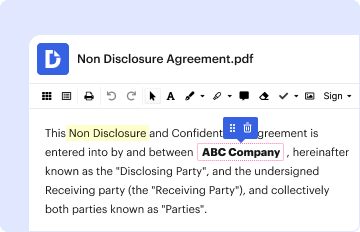
Create your Real Estate Easement Legal Form from scratch

Start Building Now
Title decoration

Here's how it works

01. Start with a blank Real Estate Easement Legal Form
Open the blank document in the editor, set the document view, and add extra pages if applicable.
02. Add and configure fillable fields
Use the top toolbar to insert fields like text and signature boxes, radio buttons, checkboxes, and more. Assign users to fields.
03. Distribute your form
Share your Real Estate Easement Legal Form in seconds via email or a link. You can also download it, export it, or print it out.

A brief tutorial on how to create a polished Real Estate Easement Legal Form
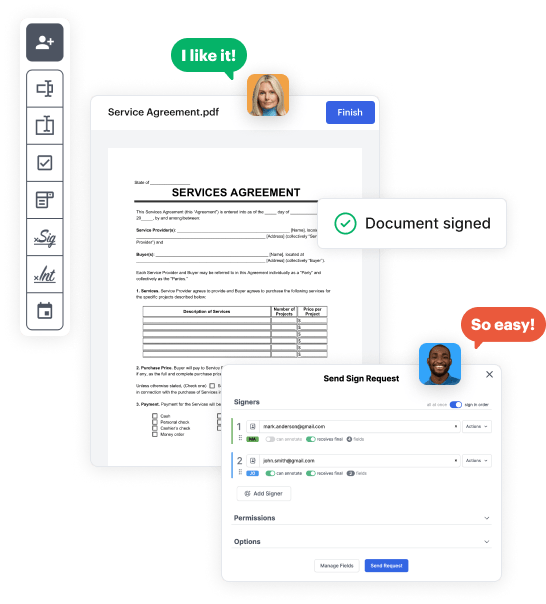
Form edit decoration

Step 1: Log in to DocHub to begin creating your Real Estate Easement Legal Form.

First, sign in to your DocHub account. If you don't have one, you can easily register for free.

Step 2: Go to the dashboard.

Once signed in, navigate to your dashboard. This is your central hub for all document-centric tasks.

Step 3: Start new document creation.

In your dashboard, choose New Document in the upper left corner. Choose Create Blank Document to craft the Real Estate Easement Legal Form from a blank slate.

Step 4: Add template fillable areas.

Add different fields like text boxes, images, signature fields, and other fields to your template and designate these fields to particular users as needed.

Step 5: Adjust your form.

Refine your template by incorporating directions or any other required information utilizing the text option.

Step 6: Go over and tweak the form.

Meticulously review your created Real Estate Easement Legal Form for any mistakes or essential adjustments. Leverage DocHub's editing capabilities to perfect your form.

Step 7: Send out or export the form.

After completing, save your file. You may select to retain it within DocHub, transfer it to various storage solutions, or send it via a link or email.

be ready to get more

Build your Real Estate Easement Legal Form in minutes

Start creating now

Got questions?

We have answers to the most popular questions from our customers. If you can't find an answer to your question, please contact us.
Contact us
Creation by law: Upon a petition from an owner of landlocked property and if the petitioner can show that such an easement is necessary to access said property, Georgia courts may order that an access easement to said property be created as a matter of law.
Prescriptive easements as opposed to express or written easements may be acquired by use for a period of either seven years or twenty years, depending on the type of use.
4 Types of Easements Express Easements. Implied Easement by Existing Use. Easement by Necessity. Prescriptive Easement.
Easement by implication That means you can often use the neighboring parcel in a limited way to access your parcel. This is sometimes known as a driveway easement in Georgia. The easement can last as long as its the only way to reasonably access the landlocked property.
Implied Easement Elements​ There must be a common ownership of a parcel and a transfer or conveyance of one parcel, or a portion of a parcel, to another. Prior to the division of title, there must have been an existing obvious, and apparently permanent, use of the quasi-easement by the common owner.
be ready to get more

Build your Real Estate Easement Legal Form in minutes

Start creating now

Related Q&A to Real Estate Easement Legal Form

Include all relevant information Identify the existing property and the proposed easement. Specify what type of easement is being created (e.g. right of way, access, etc.) Include the legal description of the easement. Specify the duration of the easement (e.g. 20 years, in perpetuity, etc.)
500, 183 S.E. 852 (1936). Obstruction of private right of way after right to use way is acquired is unlawful. - Once an easement has been acquired, the owner of the servient tenement may not unilaterally alter the path of the easement.
Temporary Sewer Easements are typically an additional 20 feet outside of the permanent easement with 10 feet on each side of the 20 feet wide permanent easement. The combined width of a temporary and permanent easement is typically 40 feet.

Additional resources on building your forms