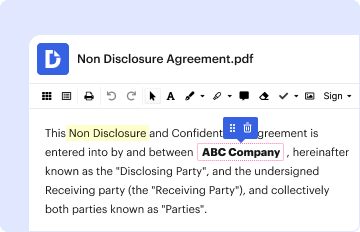
Create your Property Division Legal Form from scratch

Start Building Now
Title decoration

Here's how it works

01. Start with a blank Property Division Legal Form
Open the blank document in the editor, set the document view, and add extra pages if applicable.
02. Add and configure fillable fields
Use the top toolbar to insert fields like text and signature boxes, radio buttons, checkboxes, and more. Assign users to fields.
03. Distribute your form
Share your Property Division Legal Form in seconds via email or a link. You can also download it, export it, or print it out.

Build Property Division Legal Form from scratch by following these step-by-step instructions

Form edit decoration

Step 1: Get started with DocHub.

Start by setting up a free DocHub account using any available sign-up method. Just log in if you already have one.

Step 2: Sign up for a free 30-day trial.

Try out the whole collection of DocHub's pro features by registering for a free 30-day trial of the Pro plan and proceed to build your Property Division Legal Form.

Step 3: Create a new blank doc.

In your dashboard, hit the New Document button > scroll down and hit Create Blank Document. You will be redirected to the editor.

Step 4: Organize the document’s view.

Use the Page Controls icon indicated by the arrow to toggle between two page views and layouts for more flexibility.

Step 5: Start inserting fields to design the dynamic Property Division Legal Form.

Use the top toolbar to add document fields. Add and configure text boxes, the signature block (if applicable), embed images, etc.

Step 6: Prepare and customize the added fields.

Arrange the fields you added based on your chosen layout. Modify the size, font, and alignment to ensure the form is easy to use and neat-looking.

Step 7: Finalize and share your document.

Save the finalized copy in DocHub or in platforms like Google Drive or Dropbox, or create a new Property Division Legal Form. Send out your form via email or use a public link to reach more people.

be ready to get more

Build your Property Division Legal Form in minutes

Start creating now

Got questions?

We have answers to the most popular questions from our customers. If you can't find an answer to your question, please contact us.
Contact us
If you have evidence of a fault-based ground for divorce, you can file a family court case and let a judge decide who must move out at a temporary hearing. If you dont have evidence of a fault-based ground for divorce, then one of you has to move out: You can ask him or her to move out. You can move out yourself.
A Separation Agreement is a document that two people in a marriage use to divide their assets and responsibilities while they are separated.
The properties of division are as follows: If a and b (where bb is not equal to zero) are the whole numbers, then ab (expressed as a/b) is not necessarily the whole number. If a is any whole number, then a1=a. This means any real number divided by the number 1 gives the quotient as the number itself.
The formula to calculate the division of two numbers is: Dividend Divisor = Quotient + Remainder. The remainder is the leftover number in the division operation. If 46 is divided by 5, we get the quotient as 9 and the remainder 1.
South Carolina is an equitable division state; that is, the Family Court Judge hears the evidence from both spouses and then determines what he or she thinks is a fair and equitable division of marital property. The Judge considers a number of factors in making the decision.
be ready to get more

Build your Property Division Legal Form in minutes

Start creating now

Related Q&A to Property Division Legal Form

Division of property, also known as equitable distribution, is a judicial division of property rights and obligations between spouses during divorce. It may be done by agreement, through a property settlement, or by judicial decree.
0:18 1:17 To get x equals three another way of stating the division property of equality is as follows if aMoreTo get x equals three another way of stating the division property of equality is as follows if a equals B. And C equals d. Then a divided by C equals B divided by D.
The division property of equality states that if both sides of an equation are divided by a common real number that is not equal to 0, the quotients remain equal. This property is true for all real numbers and even algebraic expressions using variables.

Additional resources on building your forms