Create your Legal Document Example from scratch

Start Building Now
Title decoration

Here's how it works

01. Start with a blank Legal Document Example
Open the blank document in the editor, set the document view, and add extra pages if applicable.
02. Add and configure fillable fields
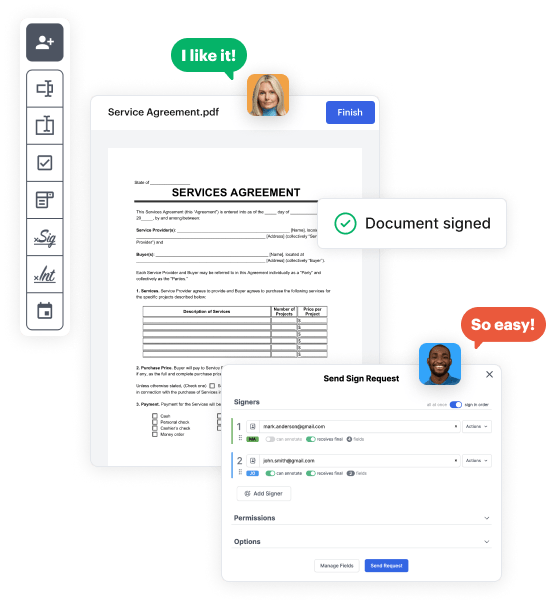
Use the top toolbar to insert fields like text and signature boxes, radio buttons, checkboxes, and more. Assign users to fields.
03. Distribute your form
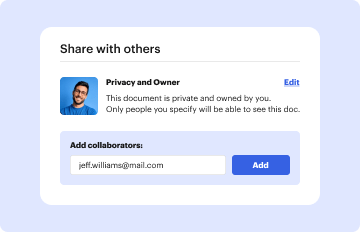
Share your Legal Document Example in seconds via email or a link. You can also download it, export it, or print it out.

Create your Legal Document Example in a matter of minutes
Form edit decoration

Step 1: Access DocHub to set up your Legal Document Example.

Begin signining into your DocHub account. Explore the advanced DocHub functionality free for 30 days.

Step 2: Go to the dashboard.

Once logged in, go to the DocHub dashboard. This is where you'll build your forms and manage your document workflow.

Step 3: Design the Legal Document Example.

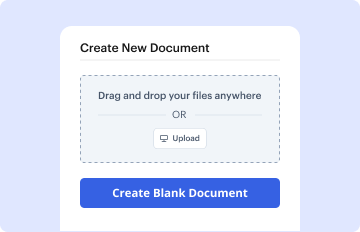
Click on New Document and select Create Blank Document to be taken to the form builder.

Step 4: Set up the form layout.

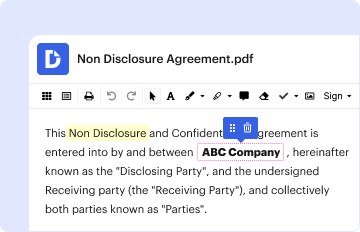
Use the DocHub toolset to add and configure form fields like text areas, signature boxes, images, and others to your form.

Step 5: Add text and titles.

Add necessary text, such as questions or instructions, using the text tool to guide the users in your document.

Step 6: Configure field properties.

Alter the properties of each field, such as making them compulsory or arranging them according to the data you plan to collect. Assign recipients if applicable.

Step 7: Review and save.

After you’ve managed to design the Legal Document Example, make a final review of your form. Then, save the form within DocHub, export it to your preferred location, or distribute it via a link or email.


be ready to get more

Build your Legal Document Example in minutes

Start creating now

Got questions?

We have answers to the most popular questions from our customers. If you can't find an answer to your question, please contact us.
Contact us
While those documents are usually 8.5 x 11 inches, legal documents are 8.5 x 14 inches. If youll be printing on that size paper, start your document formatting by choosing the right size for your document. Go to Layout and choose the Size option.
Heres how to write a legal document in 10 simple steps: Plan Out the Document Before You Begin. Write with Clear and Concise Language. Ensure the Correct Use of Grammar. Be as Accurate as Possible. Make Information Accessible. Ensure All Necessary Information Is Included. Always Use an Active Voice.
Start with an introduction and then proceed to the main part where you support your argument with the existing evidence. Start every new idea with a new paragraph so that the transition between your main arguments seems smooth. The conclusion in a law paper is usually more condensed compared to a regular essay.
Important points to include in a legal document. Party details. List the names, numbers, addresses (email or physical), and any other relevant information of all parties involved. Background information. Motion. Roles and responsibilities. BdocHubes or contingencies. Dates and signatures.
The preamble of a contract is the introductory paragraph that identifies the parties to the agreement. It is typically followed by paragraphs known as recitals (also called the background section).
be ready to get more

Build your Legal Document Example in minutes

Start creating now

Related Q&A to Legal Document Example

If you do not begin your brief with an issue statement, that is, a syllogism ending in a question, then open with an introduction that gives the judge a short and persuasive overview of the case. Present the facts plainly and set forth the issues clearly.
Initialling a document involves marking each page with the parties initials to signify consent to the content on that page. It is not legally required to initial contracts in 2024, but it adds security by preventing page substitution and ensuring agreement on any changes made.
Some examples include individual contract clauses, licensing agreements, complaints, and interrogatories. Sample documents can be found in a number of places including law firm collections or knowledge management systems, and paid databases such as Lexis and Westlaw.

Additional resources on building your forms