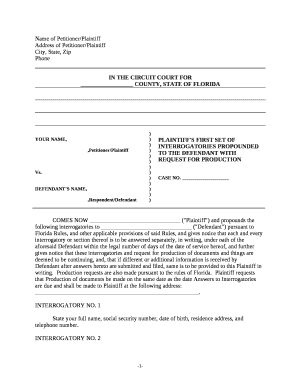
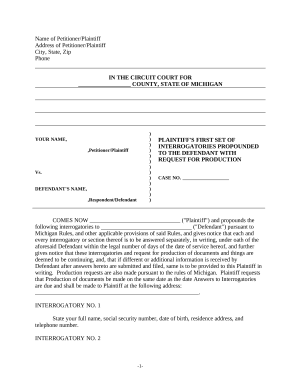
Increase your efficiency with Divorce Interrogatories Forms

Form administration consumes to half of your office hours. With DocHub, it is possible to reclaim your office time and improve your team's productivity. Get Divorce Interrogatories Forms collection and discover all document templates relevant to your day-to-day workflows.

Effortlessly use Divorce Interrogatories Forms:

  1. Open Divorce Interrogatories Forms and employ Preview to get the relevant form.
  2. Click Get Form to start working on it.
  3. Wait for your form to upload in the online editor and start editing it.
  4. Add new fillable fields, icons, and pictures, adjust pages, etc.
  5. Fill your file or set it for other contributors.
  6. Download or share the form by link, email attachment, or invite.

Accelerate your day-to-day file administration using our Divorce Interrogatories Forms. Get your free DocHub account today to discover all forms.


Video Guide on Divorce Interrogatories Forms management

video background

Commonly Asked Questions about Divorce Interrogatories Forms

Draft Interrogatories Strategically Only ask specific questions that address the crux of the matter where possible. Avoid board or vague questions. The opposing partys legal team may simply file objections against these, citing irrelevance, wasting your time. Also, ask questions sequentially.
Use Form Interrogatories to request information State the date and place of your birth. State your present address. Describe each injury or illness related to the INCIDENT. List all rent payments and rent credits made or claimed by or on behalf of defendant beginning 12 months before the NOTICE TO QUIT was served. Request Form Interrogatories | California Courts | Self Help Guide ca.gov discovery-civil form-int ca.gov discovery-civil form-int
The person who makes the answers must sign them, and the attorney who objects must sign any objections. (c) Use. An answer to an interrogatory may be used to the extent allowed by the Federal Rules of Evidence.
The family law interrogatory form contains questions regarding property valuations, property held by others, retirement and other benefits, and even gifts made of community property. More importantly, the form gives attorneys the option of requiring the responding party to complete a Schedule of Assets and Debts.
Interrogatories are written questions sent by one party in a lawsuit to another party in that same suit, which the responding party must answer under penalty of perjury. Interrogatories allow the parties to ask who, what, when, where and why questions, making them a good method for obtaining new information.
You must respond to the request and swear under oath that your response is true. Then youll deliver your response to the other sides attorney (or to the other side, if they dont have an attorney).
Read the question very carefully. Answer only the question that is asked, and avoid the temptation to over-explain your answer. If the question contains several parts, you may break your answer into parts as well. It is also possible that you might object to the question.
Responses to interrogatories should be formatted like court filings, with the case and court information, and include the name of the responding party, the propounding party, and the set number, as directed by Cal. Code Civ. Proc. 2030.210(b) and Cal.
You have to respond to interrogatories in writing to the best of your ability. If you do not answer an interrogatory question, and then the other side learns that you did in fact know the answer, it could have a negative impact on your case at trial.