
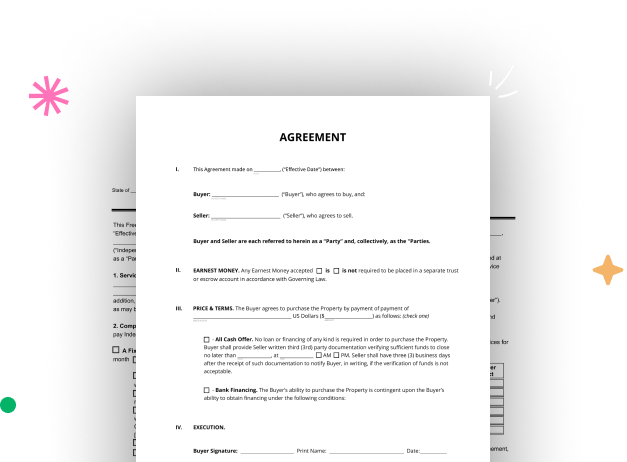




Create your Commercial Law Form from scratch

Start Building Now
Title decoration

Here's how it works

01. Start with a blank Commercial Law Form
Open the blank document in the editor, set the document view, and add extra pages if applicable.
02. Add and configure fillable fields
Use the top toolbar to insert fields like text and signature boxes, radio buttons, checkboxes, and more. Assign users to fields.
03. Distribute your form
Share your Commercial Law Form in seconds via email or a link. You can also download it, export it, or print it out.

A detailed walkthrough of how to design your Commercial Law Form online

Form edit decoration

Step 1: Start with DocHub's free trial.

Visit the DocHub website and sign up for the free trial. This provides access to every feature you’ll need to build your Commercial Law Form with no upfront cost.

Step 2: Navigate to your dashboard.

Sign in to your DocHub account and navigate to the dashboard.

Step 3: Initiate a new document.

Hit New Document in your dashboard, and choose Create Blank Document to craft your Commercial Law Form from scratch.

Step 4: Utilize editing tools.

Insert different fields such as text boxes, radio buttons, icons, signatures, etc. Organize these fields to match the layout of your document and designate them to recipients if needed.

Step 5: Modify the form layout.

Rearrange your document easily by adding, repositioning, deleting, or merging pages with just a few clicks.

Step 6: Create the Commercial Law Form template.

Convert your freshly crafted form into a template if you need to send many copies of the same document repeatedly.

Step 7: Save, export, or distribute the form.

Send the form via email, distribute a public link, or even publish it online if you aim to collect responses from more recipients.


be ready to get more

Build your Commercial Law Form in minutes

Start creating now

Got questions?

We have answers to the most popular questions from our customers. If you can't find an answer to your question, please contact us.
Contact us
In addition to registering the name of your business, be sure to obtain any necessary state or local licenses required in your jurisdiction. This may include a certificate of authority and/or professional license. Additionally, many states require law firms to register with the State Bar Association.
A maximum of about 2 lakhs is sufficient to start a proper law office at home although this may vary depending upon the partners, functions, location, etc. The proprietor might do trademark registration of his/her firm in order to protect the name.
As a senior associate, you may earn anywhere between INR 25 and 35 lakh per year, sometimes even more. From their second year onward, senior associates in big or boutique law firms can earn more than INR 40 lakh. Principal associates make between INR 36 and 60 or 70 lakh per year.
Eligibility requirements for opening a law firm in India A person shall be at least 21 years old, The person shall hold a law degree from any University provided that it is recognised by Bar Council of India and; A person should be registered with any state Bar Council of India.
The Cost of Incorporation of a private limited Company would vary from Rs. 6,000 to Rs. 30,000/- depending upon the following: Number of Directors.
be ready to get more

Build your Commercial Law Form in minutes

Start creating now

Related Q&A to Commercial Law Form

Under the Law Society Act and its by-laws, you are permitted to set up your practice as a sole proprietorship, general partnership, limited liability partnership or a professional corporation. A sole proprietor or sole practitioner owns and operates his or her professional business alone.
However, there are several starts ups in India which start as a Partnership Firm, but after that, if the need arises, they form a Private Limited Company. A non-law graduate can become a partner in such firms based upon his area of interest and expertise and venture capacity in a particular area.
Under New York law, LLCs cannot provide professional services. Those wishing to provide services under their professional license can only operate as: Sole proprietorships. General partnerships.

Additional resources on building your forms