




01. Edit your form online
Type text, add images, blackout confidential details, add comments, highlights and more.

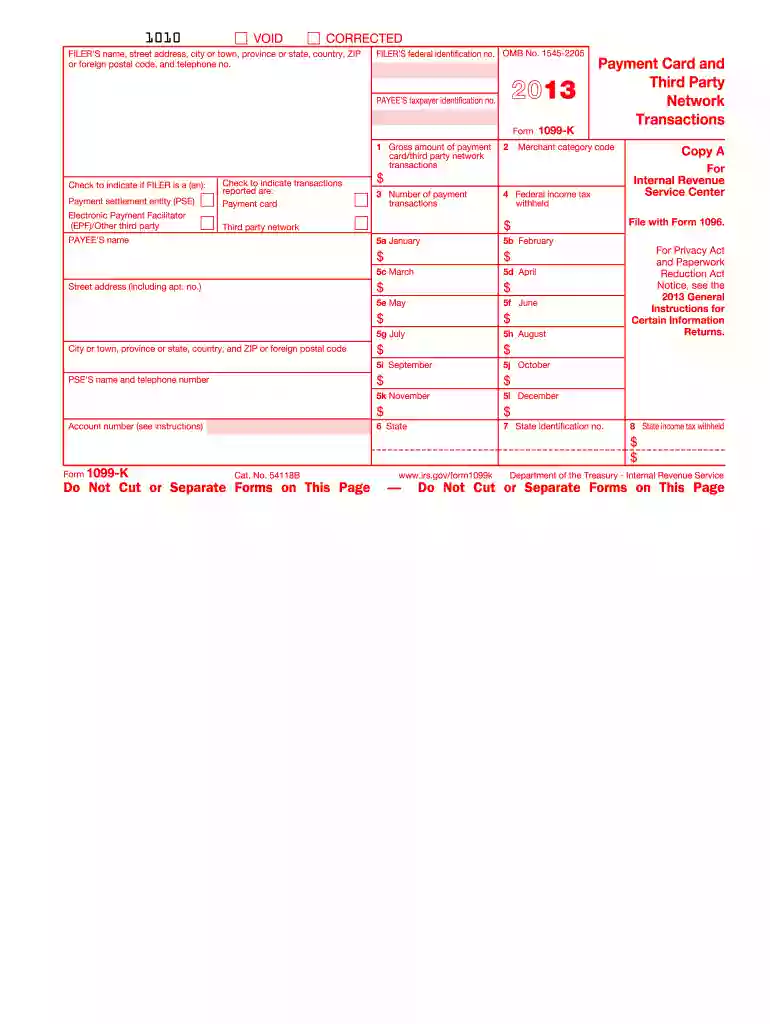
Type text, add images, blackout confidential details, add comments, highlights and more.

Draw your signature, type it, upload its image, or use your mobile device as a signature pad.

Send it via email, link, or fax. You can also download it, export it or print it out.
The 2013 Form 1099-K is a tax document used by payment settlement entities to report payment card and third-party network transactions to the Internal Revenue Service (IRS). This form helps the IRS track income reported by businesses and individuals who receive payments through credit cards and online payment platforms. The information captured includes the gross amount of all reportable payment card transactions for each month of the year, providing a comprehensive necessary for the taxpayer's income tax return.
Payment settlement entities, such as credit card companies and third-party processors like PayPal, are responsible for issuing the 2013 Form 1099-K to recipients. Taxpayers will typically receive this form by mail or through electronic delivery if they have opted for digital communication. It is important to ensure that your contact information is up to date with these entities to receive the form on time. Should you need a duplicate, the issuer can often provide a copy upon request.
The 2013 Form 1099-K is typically used by self-employed individuals, business entities such as LLCs and corporations, and service providers receiving payment through credit cards or third-party networks. It serves as an essential tool for ensuring that all income, whether from goods sold or services provided, is reported to the IRS. Additionally, gig economy workers and freelancers who receive payments through platforms like Uber or Etsy would also receive this form.


The form must be provided to recipients by January 31 following the end of the tax year. The payment settlement entity is also required to file the form with the IRS by the end of February if filing by paper, or by the end of March if filing electronically. It is crucial to comply with these deadlines to avoid penalties.
Failure to file Form 1099-K correctly or on time can lead to penalties imposed by the IRS. These penalties are typically based on the duration of the delay and can include additional fines for intentional disregard of filing requirements. It is crucial for both payment settlement entities and recipients to ensure timely and accurate filing to prevent avoidable penalties.
The 2013 Form 1099-K is available in both digital and paper formats, accommodating different preferences and accessibility needs. Digital versions allow for easier integration with tax preparation software, reducing manual entry errors, and facilitating a smoother filing process. However, traditional paper versions remain essential for those preferring tangible records or lacking digital access.
We've got more versions of the 2013 1099 k form form. Select the right 2013 1099 k form version from the list and start editing it straight away!
| Versions | Form popularity | Fillable & printable |
|---|---|---|
| 2024 | 4.6 Satisfied (25 Votes) | |
| 2022 | 4.6 Satisfied (21 Votes) | |
| 2021 | 4.8 Satisfied (180 Votes) | |
| 2020 | 4.3 Satisfied (77 Votes) | |
| 2019 | 4.3 Satisfied (216 Votes) | |
| 2018 | 4.3 Satisfied (82 Votes) | |
| 2017 | 4.4 Satisfied (966 Votes) | |
| 2016 | 4.4 Satisfied (348 Votes) | |
| 2015 | 3.9 Satisfied (53 Votes) | |
| 2014 | 4 Satisfied (29 Votes) | |
| 2013 | 4.2 Satisfied (29 Votes) | |
| 2012 | 4 Satisfied (69 Votes) | |
| 2011 | 4 Satisfied (33 Votes) |
At DocHub, your data security is our priority. We follow HIPAA, SOC2, GDPR, and other standards, so you can work on your documents with confidence.
Jan 2, 2014 If you received, repaid, or had tax withheld from the SSEB portion of tier 1 benefits during 2013, you will receive Form RRB-1099, Payments byRead more
You should use the 2013 General. Instructions for Certain Information Returns and the. 2013 Instructions for Form 1099-K to complete. Form 1099-K. A chart inRead more


