




01. Edit your 1099k online
Type text, add images, blackout confidential details, add comments, highlights and more.

Type text, add images, blackout confidential details, add comments, highlights and more.

Draw your signature, type it, upload its image, or use your mobile device as a signature pad.

Send it via email, link, or fax. You can also download it, export it or print it out.
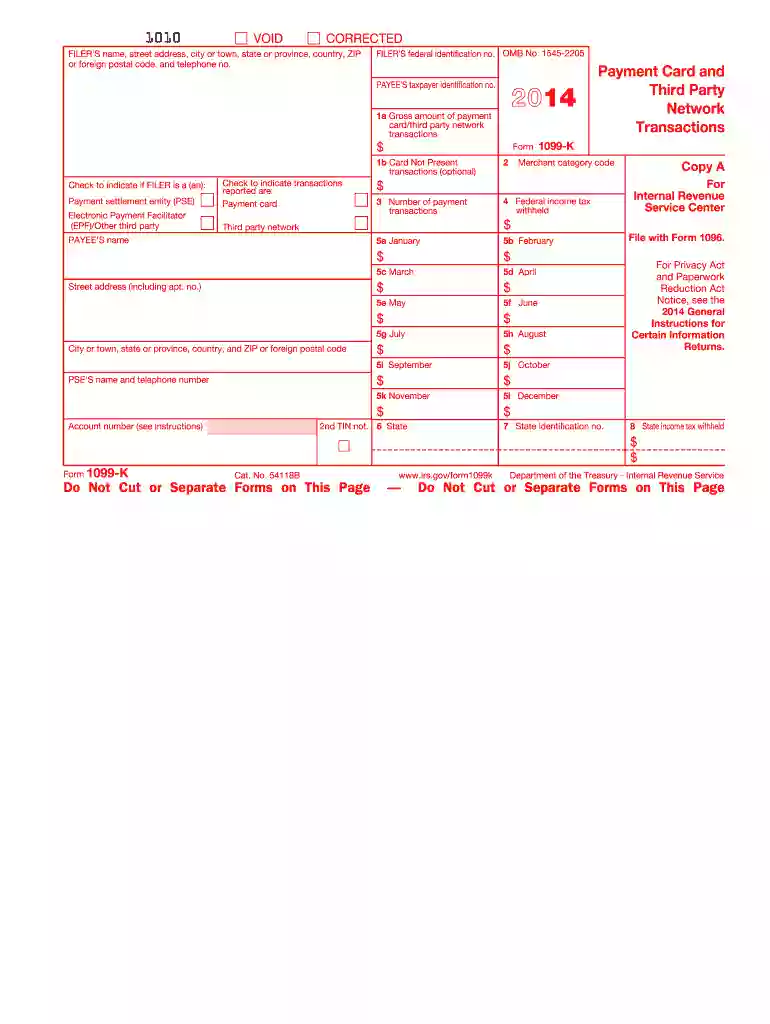
The 2014 Form 1099-K is a tax document used in the United States to report payments made via credit card transactions and third-party network transactions. It is a critical form for both the Internal Revenue Service (IRS) and taxpayers, because it ensures that all transactions are accurately reported for tax purposes. The form captures the gross amount of reportable transactions, which includes all payments processed by the payment settlement entity (PSE).
Understanding these elements is essential for ensuring that the form is completed correctly and that all IRS reporting requirements are met.
Using the 2014 Form 1099-K involves several steps to ensure that all required information is collected and reported accurately.
The 2014 Form 1099-K is utilized mainly by businesses and individuals who process a substantial volume of payments through third-party networks or credit card transactions.
Understanding who needs to file this form helps ensure compliance and avoid penalties.
Compliance with deadlines is crucial for the 2014 Form 1099-K.
Meeting these deadlines is critical to avoid late fees and ensure smooth processing by the IRS.
There are several ways to obtain the 2014 Form 1099-K, depending on your preference for digital or paper formats.
These sources can provide the form required for accurate reporting.
The IRS has specific guidelines for the use and completion of Form 1099-K to ensure accurate tax reporting.
Following these guidelines helps in avoiding fines or audits from the IRS.
Filing the Form 1099-K accurately and timely is critical to avoid penalties set by the IRS for non-compliance.
Adhering to compliance standards is crucial for minimizing financial consequences.
The 2014 Form 1099-K can be filed both digitally or through traditional paper methods, each with its own set of advantages and considerations.
Choosing the appropriate filing method can impact both ease and processing speed of the form.
We've got more versions of the 1099k form. Select the right 1099k version from the list and start editing it straight away!
| Versions | Form popularity | Fillable & printable |
|---|---|---|
| 2024 | 4.6 Satisfied (25 Votes) | |
| 2022 | 4.6 Satisfied (21 Votes) | |
| 2021 | 4.8 Satisfied (180 Votes) | |
| 2020 | 4.3 Satisfied (77 Votes) | |
| 2019 | 4.3 Satisfied (216 Votes) | |
| 2018 | 4.3 Satisfied (82 Votes) | |
| 2017 | 4.4 Satisfied (966 Votes) | |
| 2016 | 4.4 Satisfied (348 Votes) | |
| 2015 | 3.9 Satisfied (53 Votes) | |
| 2014 | 4 Satisfied (29 Votes) | |
| 2013 | 4.2 Satisfied (29 Votes) | |
| 2012 | 4 Satisfied (69 Votes) | |
| 2011 | 4 Satisfied (33 Votes) |
At DocHub, your data security is our priority. We follow HIPAA, SOC2, GDPR, and other standards, so you can work on your documents with confidence.
1099-MISC is issued by the University to individuals reflecting cumulative payments for services, or awards totaling $600 or more for the calendar year,Read more
To complete Form 1099-K, use: the 2014 General Instructions for Certain Information. Returns, and. the 2014 Instructions for Form 1099-K. To order theseRead more
Also see the new Form 8995 and Form 8995-A required to be attached to the 2019 return when claiming the QBI deduction. . Separate lines were added for theRead more


