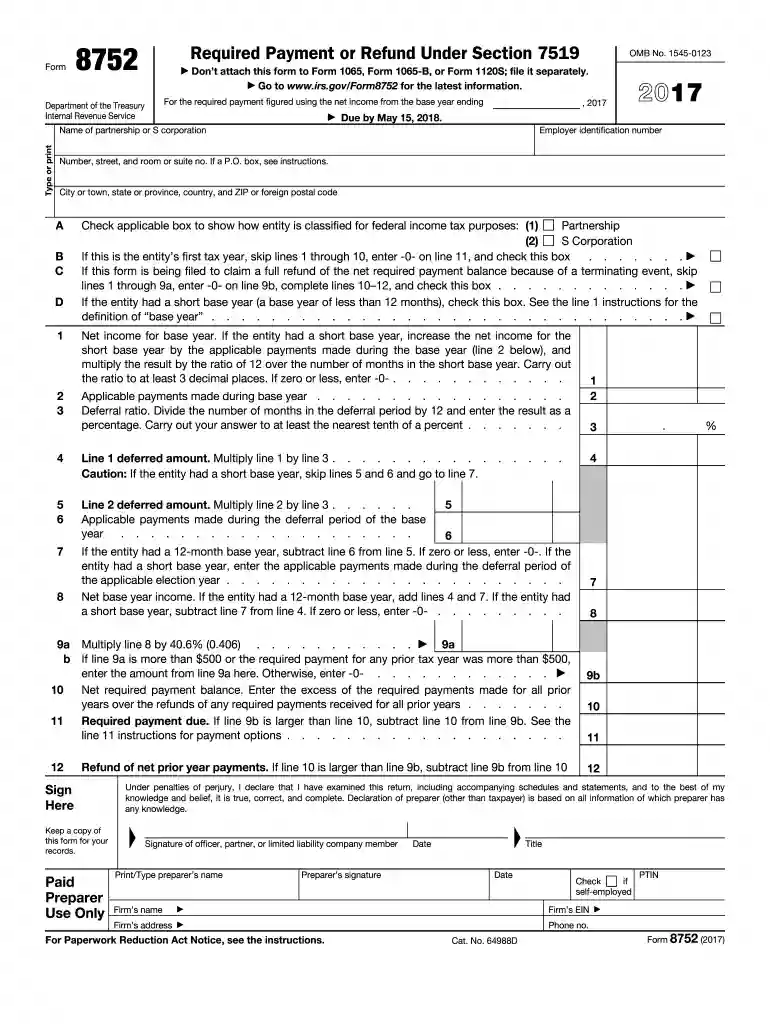
Understanding Form 8752 for Partnerships and S Corporations
Form 8752, used by partnerships and S corporations, is essential for calculating and reporting required payments under Section 7519. The form pertains specifically to fiscal entities that have elected a tax year different from the calendar year. Entities use this form to either make required payments or claim refunds from prior year payments.
How to Use Form 8752 Effectively
Input Necessary Information:
- Complete all sections requiring the reporting of net income, applicable payments, deferral ratios, and payment balances.
- Ensure accurate calculations to determine if any payment is required or if a refund is due.
Adjust for Different Tax Years:
- Remember that entities which have opted for a fiscal year rather than the calendar year must consider their specific timelines when filling out this form.
Steps to Complete Form 8752
- Gather Required Information: Collect data on net income, deferral periods, and any past payments.
- Complete Part I: This involves estimating the base amount or base year amount.
- Input in Part II: Calculate and input the required payment or refund amount for the deferred income.
- Submit by Deadline: Ensure the completed form is filed separately and complies with IRS deadlines.
Key Elements of Form 8752
- Required Payment Calculation: Calculate this carefully as it determines potential payments or refunds.
- Net Income Reporting: Precisely report net income for the fiscal year in question.
- Deferral Ratios: Accurately compute based on prior fiscal year data.
Who Typically Uses Form 8752?
- Partnerships and S Corporations: These entities that have chosen non-standard fiscal years rely on Form 8752 for tax regulation compliance.
- Entities with Deferral Years: Companies that defer income and incur taxes outside the calendar year.
Important Terms Associated with Form 8752
- Section 7519: Reference to the IRS code dictating the conditions for the tax payment deferral.
- Base Year Income: This is the income against which current year deferrals are measured.
- Refund Claim: If prior payments exceed current liabilities, a refund claim can be pursued.
IRS Guidelines for Submitting Form 8752
- Timeliness: Submit no later than three and a half months after the close of the fiscal year.
- Separate Filing: This form must be filed independently of other tax forms for precise processing.
Filing Deadlines for Form 8752
- Submission Date: Typically due March 15th for entities with December 31 fiscal year-ends.
- Extensions Not Applicable: No extensions are granted, stressing the importance of prompt filing.
Penalties for Non-Compliance
- Late Fees: Delays in submission may result in penalties and interest on unpaid taxes.
- Audits: Failure to report accurately could lead to IRS audits and potential further compliance issues.
Obtaining Form 8752
- Direct Download: Available from the IRS website in a fillable PDF format.
- Tax Preparation Software: Often included in tax software packages, such as TurboTax and QuickBooks, enhancing ease of use.
Examples of Using Form 8752
- Case Study - S Corporation: An S corporation with a fiscal year ending in September must defer income, prompting the use of Form 8752 to adjust for payment during the off-calendar period.
- Partnership Example: A partnership elects a June fiscal year-end, directly affecting the calculation of its deferral balances on Form 8752.
Understanding State-Specific Rules
- State Variations: Some states may have unique requirements for reporting deferred income that aligns with both federal and state tax regulations.
- Consult State Guidelines: Always refer to specific state requirements beyond federal obligations.
Business Types Benefiting Most from Form 8752
- Fiscal Year Adopters: Entities that do not conform to the calendar year for financial or operational reasons benefit notably.
- Growth Companies: Those experiencing rapid change and opting for fiscal flexibility also find Form 8752 advantageous.
Digital vs. Paper Submission Options
- Electronic Filing: Often reduces errors and accelerates IRS processing.
- Paper Filing: Accepted but requires careful mailing to ensure timely reception by the IRS.
By following the structured steps and understanding the comprehensive details provided, entities can effectively manage their tax deferral obligations using Form 8752.