




01. Edit your form 8752 instructions online
Type text, add images, blackout confidential details, add comments, highlights and more.

Type text, add images, blackout confidential details, add comments, highlights and more.

Draw your signature, type it, upload its image, or use your mobile device as a signature pad.

Send form payment refund via email, link, or fax. You can also download it, export it or print it out.
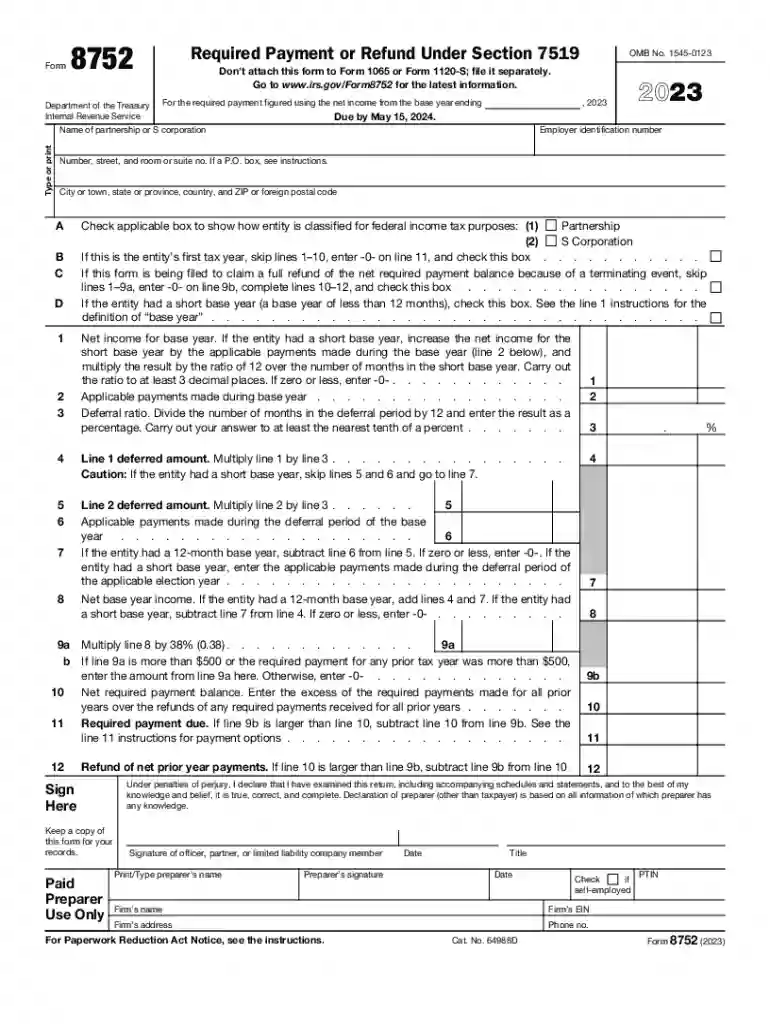
Form 8752, officially known as the "Required Payment or Refund Under Section 7519," serves an essential role for partnerships and S corporations. These entities typically use this form to calculate and report payments required under Section 7519 of the Internal Revenue Code. Specifically, it addresses entities that elect a fiscal tax year different from the calendar year. By utilizing this form, businesses can ensure they comply with IRS regulations concerning any adjustments to their tax payment schedules due to their chosen fiscal year.
The legal backdrop for Form 8752 originates from Section 7519, which mandates payments for certain fiscal year tax elections. This section intends to prevent tax deferral by ensuring businesses pay an equivalent sum to what would be due if they followed the calendar year. Such fiscal-year elections often require careful handling to meet tax obligations, which Form 8752 facilitates by calculating the differential in income reporting periods.
Primarily, Form 8752 is used by partnerships and S corporations that have made an election under Section 444 to adopt a fiscal year. This election allows these entities a fiscal year that does not coincide with the calendar year, becoming critical in managing tax liabilities and alignment with the operational cycles of such businesses. Understanding the requirements and application of this election is crucial for entities aiming to optimize their tax strategy.
Consider a mid-sized corporation engaged in seasonal business activities, where financial operations align better with a fiscal year ending in July. By using Form 8752, this corporation can file for the necessary payments or refunds related to their selective fiscal year, accommodating their cash flows more effectively.
Completing Form 8752 involves several critical steps that require attention to detail and accuracy:
Gather Necessary Financial Documents:
Calculate Net Income for Base Year:
Determine Required Payment or Refund:
Fill in the Form:
Review Compliance Options:
Submit the Form by the Due Date:
Maintain Copies:
For fiscal years beginning in 2023, the Form 8752 deadline is May 15, 2024. Timely submission is vital to avoid penalties and ensure compliance with IRS requirements. Understanding these deadlines in the context of a business’s financial cycles helps in effective fiscal management, optimizing both the preparation and strategic planning related to tax liabilities.
To accurately complete Form 8752, the following documents are essential:
These documents ensure that the details filled out are substantiated with accurate, verifiable information.
Understanding these core elements ensures the form is completed correctly, aiding compliance and minimizing the likelihood of penalties.
Non-compliance with the requirements of Form 8752 can result in significant penalties. These may include:
Choosing the appropriate method based on the entity’s resources and technology infrastructure can streamline and secure the filing process.
Meanwhile, opting for paper submission remains viable but may lack the instantaneous benefits of digital filing, requiring more manual oversight and longer processing periods.
We've got more versions of the form 8752 instructions form. Select the right form 8752 instructions version from the list and start editing it straight away!
| Versions | Form popularity | Fillable & printable |
|---|---|---|
| 2025 | 4.2 Satisfied (37 Votes) | |
| 2024 | 4.7 Satisfied (57 Votes) | |
| 2023 | 4.5 Satisfied (39 Votes) | |
| 2022 | 4.8 Satisfied (48 Votes) | |
| 2021 | 4.8 Satisfied (193 Votes) | |
| 2020 | 4.2 Satisfied (75 Votes) | |
| 2019 | 4.4 Satisfied (232 Votes) | |
| 2018 | 4.4 Satisfied (95 Votes) | |
| 2017 | 4.3 Satisfied (76 Votes) | |
| 2016 | 4.2 Satisfied (49 Votes) | |
| 2015 | 4 Satisfied (42 Votes) | |
| 2014 | 4.2 Satisfied (72 Votes) | |
| 2011 | 4.1 Satisfied (36 Votes) |
At DocHub, your data security is our priority. We follow HIPAA, SOC2, GDPR, and other standards, so you can work on your documents with confidence.
Form 8752, required payment or refund under section 7519. Available also on CD-ROM: United States. PDF format Online version of the print publication.
Partnerships and S corporations use this form: To figure and report the payment required under section 7519. To obtain a refund of net prior year payments.Read more


