




01. Edit your 8752 form online
Type text, add images, blackout confidential details, add comments, highlights and more.

Type text, add images, blackout confidential details, add comments, highlights and more.

Draw your signature, type it, upload its image, or use your mobile device as a signature pad.

Send form 8752 via email, link, or fax. You can also download it, export it or print it out.
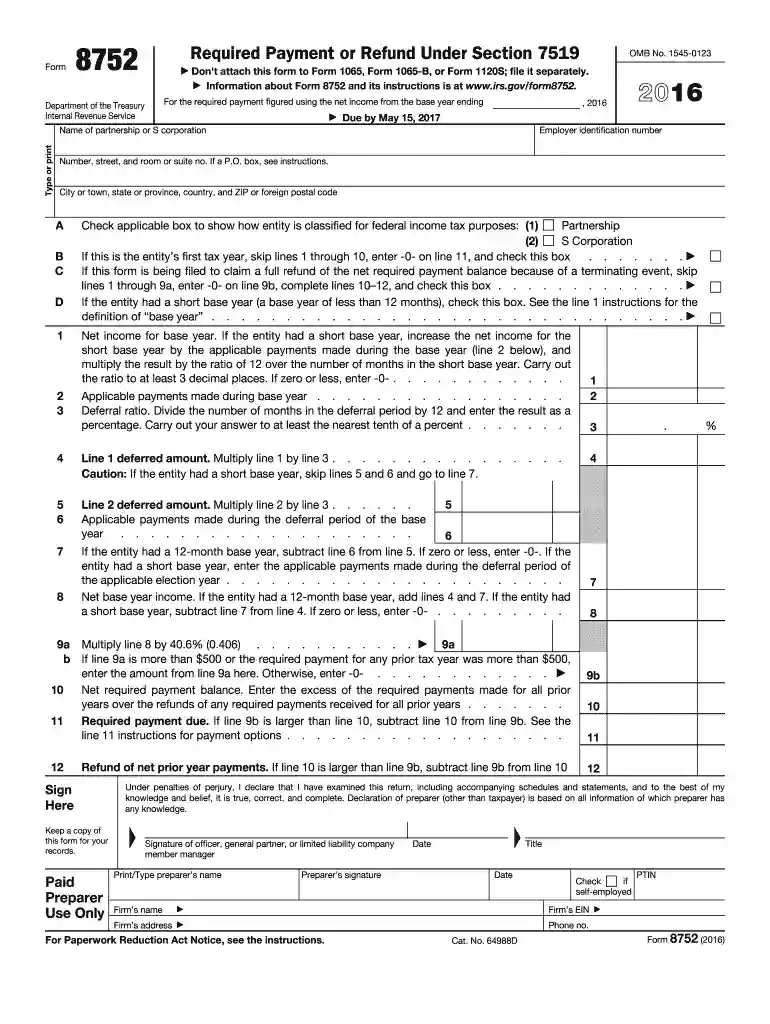
Form 8752, titled "Required Payment or Refund Under Section 7519," is a tax document used by partnerships and S corporations. Its primary purpose is to calculate and report any required payments under Section 7519 or to claim refunds for prior payments. This is essential for entities that have adopted a tax year that is not the standard calendar year, aligning financial reporting with their business operations more closely.
Gather Important Information: Before starting, collect detailed financial data from your partnership or S corporation, including net income details, tax credits, and previous payments.
Understand Key Sections: Familiarize yourself with the main sections of the form, which include calculating the base year income and determining the required payment or refund amount.
Calculate the Payment or Refund: Using the information from previous years, calculate the amount payable or the refund claimable. Accurate computations are crucial to avoid penalties or errors.
Fill Out the Form: Carefully input all required data into the correct fields. Double-check for accuracy to ensure compliance with IRS requirements.
Review and Submit: Once completed, review the form for any errors. Then, submit it according to IRS guidelines, keeping a copy for your records.
The 2016 Form 8752 had specific filing deadlines that businesses must adhere to. Typically, it must be filed by May 15th of the year following the calendar year in which the short tax year ends. Failing to file by the due date can result in penalties, so timely submission is crucial.
To accurately complete Form 8752, ensure you have the necessary documents:
Having these documents handy will streamline the completion process and reduce the risk of oversight.
There are potential penalties for failing to comply with the filing and payment requirements associated with Form 8752. These may include late payment fees, interest on unpaid amounts, and other financial penalties as determined by the IRS. Understanding these potential repercussions underscores the importance of accurate and timely filing.
The IRS provides comprehensive instructions for completing Form 8752. These guidelines cover eligibility, calculation methods, and submission processes. Adhering closely to IRS directives ensures compliance and minimizes the risk of errors, penalties, or audits.
Form 8752 specifically targets partnerships and S corporations. These entities may choose a fiscal year for their accounting periods, potentially leading to a required payment under Section 7519. Understanding the unique filing requirements for these business types is essential for proper tax management.
Software solutions like TurboTax and QuickBooks can assist businesses in preparing Form 8752. These programs offer tools to manage financial data, calculate tax liabilities, and streamline the filing process. Leveraging software ensures accuracy and efficiency, especially for businesses managing complex accounting records and multiple deadlines.
An S corporation adopting a fiscal year-end in September must file Form 8752 by May 15th of the following year. For instance, if their net income calculations differ from previous estimates, this form allows them to rectify any required payments or claim refunds effectively. Understanding real-world scenarios helps illustrate the form's practical application and importance in business tax compliance.
We've got more versions of the 8752 form form. Select the right 8752 form version from the list and start editing it straight away!
| Versions | Form popularity | Fillable & printable |
|---|---|---|
| 2025 | 4.2 Satisfied (37 Votes) | |
| 2024 | 4.7 Satisfied (57 Votes) | |
| 2023 | 4.5 Satisfied (39 Votes) | |
| 2022 | 4.8 Satisfied (48 Votes) | |
| 2021 | 4.8 Satisfied (193 Votes) | |
| 2020 | 4.2 Satisfied (75 Votes) | |
| 2019 | 4.4 Satisfied (232 Votes) | |
| 2018 | 4.4 Satisfied (95 Votes) | |
| 2017 | 4.3 Satisfied (76 Votes) | |
| 2016 | 4.2 Satisfied (49 Votes) | |
| 2015 | 4 Satisfied (42 Votes) | |
| 2014 | 4.2 Satisfied (72 Votes) | |
| 2011 | 4.1 Satisfied (36 Votes) |
At DocHub, your data security is our priority. We follow HIPAA, SOC2, GDPR, and other standards, so you can work on your documents with confidence.
3.24.249.2 (01-01-2016). Introduction. This IRM provides instructions for entering and verifying data from control documents and Form 8752, Required PaymentRead more
If transfering to a different department, approval from the other department is required. 12, **Please email expenditure transfer (in excel format) andRead more


