







Definition & Meaning
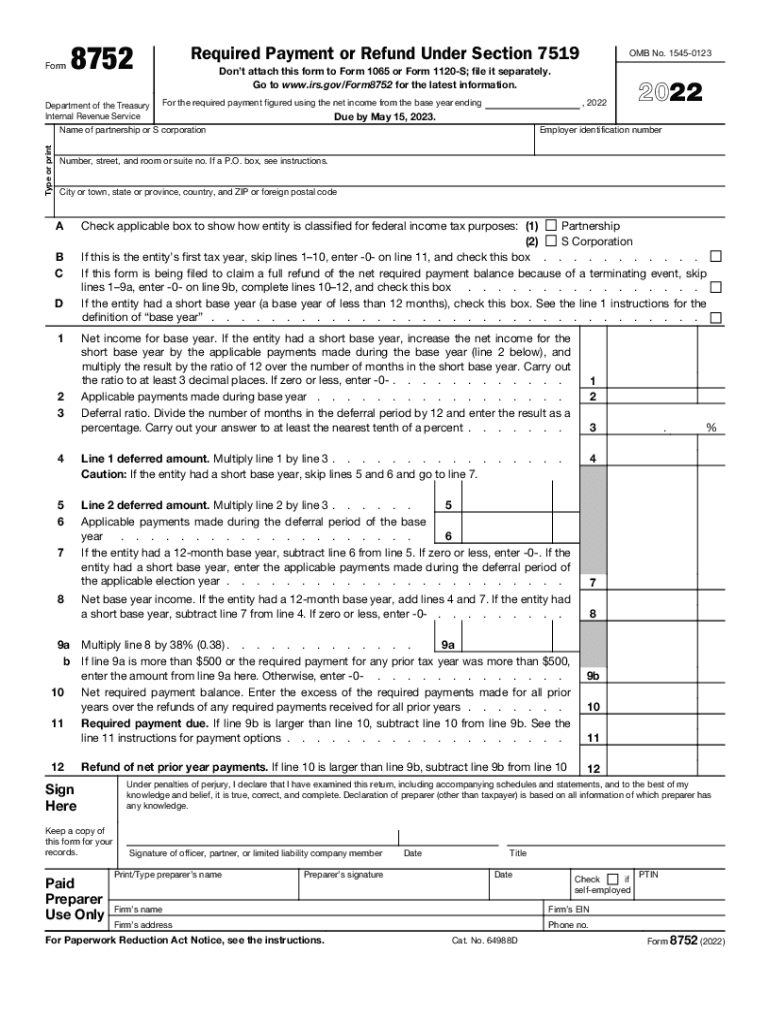
Form 8752, officially titled as "Required Payment or Refund Under Section 7519," serves a specific accounting purpose for business entities like partnerships and S corporations. These entities use Form 8752 to make necessary tax payments when they elect a tax year different from the required calendar year. This adjustment ensures that any tax deferral benefits are balanced out via section 7519 of the Internal Revenue Code. The form accounts for net income and calculates whether a payment to the IRS or a refund is due, based on the applicable tax year.
Key Elements of the Form
Key elements of Form 8752 include detailed sections for calculating tax deferral amounts:
- Entity Information: Businesses must provide specific details such as the entity's name, address, and the employer identification number (EIN).
- Payment Computation: Includes detailed lines for computing the required payment based on income deferral from the tax year.
- Refund Details: If a refund is due instead, the form captures all relevant data and instructions for claiming the refund based on prior payments.
- Signature Section: Without the proper signature of an authorized individual, the form submission is incomplete.
Understanding these elements ensures that the form is completed accurately, reducing the risk of penalties.
Steps to Complete the DocHub Form-LibrarytaxIRS 8-2022 - Fill and Sign Printable Template Online
- Access the Form: Begin by accessing the required form through DocHub's form library by searching for "IRS 8-2022."
- Fill in Entity Information: Enter the name, EIN, and address of the business.
- Calculate the Payment/Refund: Use financial records to complete the payment computation areas carefully.
- Review for Accuracy: Double-check entries for accuracy. Mistakes can lead to processing delays or additional taxes.
- Sign the Form: Apply a legally binding signature using one of DocHub's signature options.
- Submit via Preferred Method: Submit electronically through DocHub or print and mail as required by the IRS guidelines.
Legal Use of the Form
Form 8752 has legal implications due to its role in tax calculations under section 7519. Businesses must ensure compliance by filing accurate data, as incorrect submissions can lead to audits or penalties. Only authorized personnel should fill and submit the form. It is crucial for partnerships and S corporations to consult tax professionals if there is any uncertainty about the calculations or legal obligations tied to the form.
Filing Deadlines / Important Dates
For fiscal years overlapping 2021 and 2022, Form 8752 must be filed by May 15, 2023. Missing this deadline results in late fees and potential interest charges. Businesses should prioritize gathering required data early, ensuring timely submission.
Penalties for Non-Compliance
Non-compliance with Form 8752 guidelines can result in financial penalties or interest on unpaid amounts. The IRS may also impose additional assessments for significant underreporting or negligence. Accurate, timely filing mitigates exposure to these consequences, protecting the business from unnecessary costs.
Business Entity Types
Form 8752 pertains primarily to partnerships and S corporations. These entities benefit from elective tax years differing from the calendar year, but at the cost of adjusting for deferral through this form. Understanding these nuances ensures accurate financial management and tax reporting compliance for such organizations.
Software Compatibility (TurboTax, QuickBooks, etc.)
Business owners using software like TurboTax or QuickBooks can integrate these tools to streamline data management for Form 8752. These platforms simplify the process of retrieving financial information, ensuring calculations are both precise and efficient. Importing data directly into DocHub minimizes manual entry errors.


