




01. Edit your fl 320 attachment 10 online
Type text, add images, blackout confidential details, add comments, highlights and more.

Type text, add images, blackout confidential details, add comments, highlights and more.

Draw your signature, type it, upload its image, or use your mobile device as a signature pad.

Send fl 320 form download via email, link, or fax. You can also download it, export it or print it out.
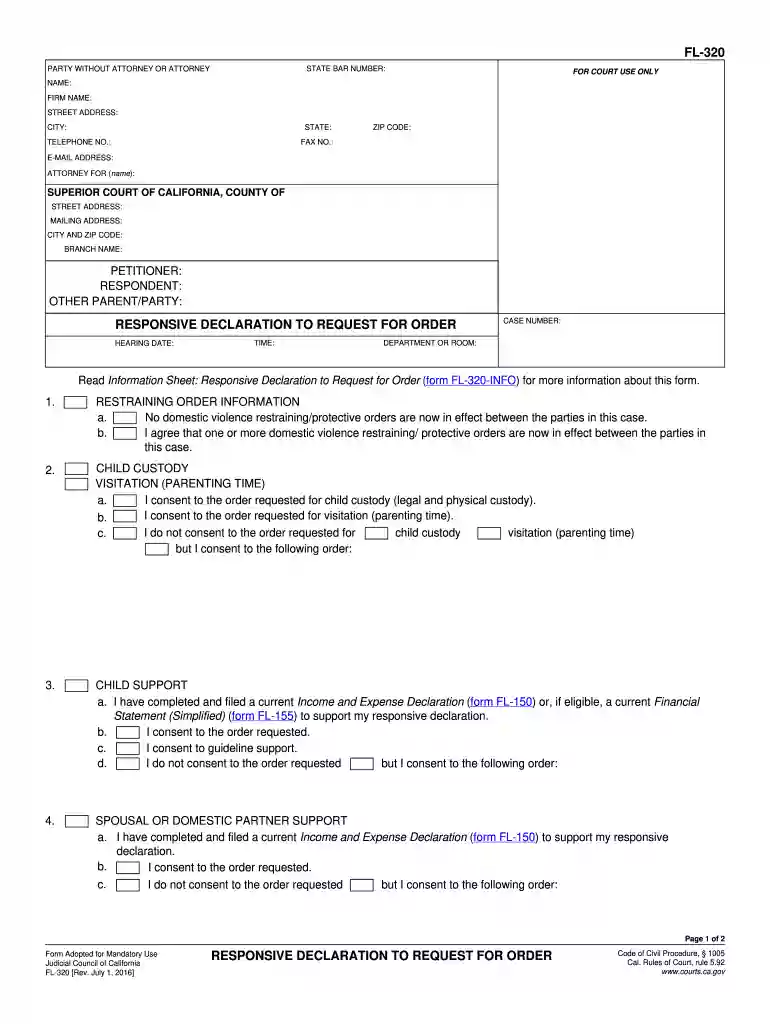
FL-320 is a crucial legal form utilized within California's family law cases. Primarily, it serves as a responsive declaration to a request for order. Parties involved in family legal proceedings use this form to express their stance on various orders. The orders may pertain to restraining orders, child custody, visitation rights, child support, spousal support, property control, attorney’s fees, and any other specific requests being addressed within the case.
To effectively utilize the FL-320 form, individuals must understand its detailed instructions and fill it out comprehensively. Begin by reviewing the request for order to which you are responding. Based on that, you will:
For instance, if you object to a proposed custody arrangement, explain why it is not suitable for your child's best interests, citing specific incidents or patterns that support your claim.
The FL-320 form can be obtained through several official channels, ensuring accessibility for all parties involved in family law cases:
Filling out the FL-320 requires attention to detail and accuracy. Follow these steps:
Ensure all fields are completed accurately, as any missing or incorrect information can lead to delays or even dismissal of your responses.
The FL-320 is essential in family law cases for several reasons:
A parent opposing a proposed change in child custody can officially record their objections and propose alternative arrangements through FL-320.
To accurately complete and understand the FL-320, familiarize yourself with these key terms:
The FL-320 is legally binding once completed and filed correctly. Its use is mandated within California family law to maintain an orderly judicial process. By using FL-320, individuals ensure compliance with state legal procedures and contribute to a fair decision-making process by the court.
Always consult with a legal professional when uncertain about any part of the form to ensure compliance and accuracy in your declarations.
Integral to the FL-320 are several components that determine its effectiveness:
Ensuring each element is complete allows for your response to be processed efficiently and considered by the court in the context of your family law case.
We've got more versions of the fl 320 attachment 10 form. Select the right fl 320 attachment 10 version from the list and start editing it straight away!
At DocHub, your data security is our priority. We follow HIPAA, SOC2, GDPR, and other standards, so you can work on your documents with confidence.


Projection Document Camera Lecture Capture Voice Amp Wireless Voice Amp Wireless Projection (POD) Host PC Wacom Touchscreen.Read more
Jul 1, 2025 CHILD CUSTODY. VISITATION (PARENTING TIME) a. I consent to the order requested for child custody (legal and physical custody).Read more
Jul 1, 2016 A blank Responsive Declaration to Request for Order (form FL-320). You can obtain these forms from the clerk of the court, your county lawRead more


