
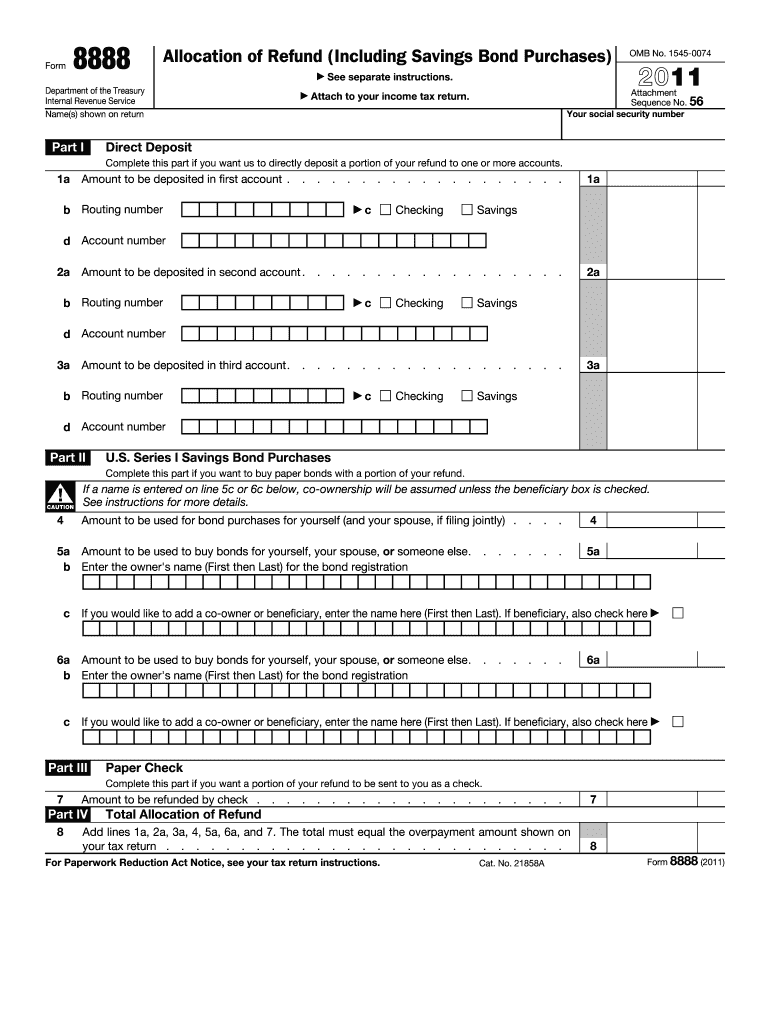







Definition & Meaning of the 8 Form
The Form 8888, officially titled the Allocation of Refund (Including Savings Bond Purchases), is used by taxpayers to allocate their federal tax refund into multiple accounts or to purchase U.S. Series I savings bonds. This form offers flexibility for those who prefer to manage their refund money by directing it into different financial purposes. The form allows people to specify precise amounts to be directly deposited into up to three accounts, purchased as savings bonds, or request a partial refund as a paper check.
How to Use the 8 Form
To use the Form 8888 effectively, follow these steps:
- Determine Allocation: Decide how you want to allocate your refund. You can split your refund by direct deposit into checking or savings accounts or purchase U.S. savings bonds.
- Prepare Information: Gather necessary details, such as routing numbers and account numbers for deposits, and select the amount for each allocation type.
- Complete the Form: Accurately fill in all sections. Ensure correct information is provided for each allocation.
- Attach to Tax Return: Submit Form 8888 along with your tax return. Double-check all data to avoid delays or errors.
Important Considerations
- Bank Information Accuracy: Double-check bank account and routing information to prevent failed deposits.
- Maximum Limits: Be aware of maximum limits for certain allocations, such as savings bond purchases.
Steps to Complete the 8 Form
Filling out the Form 8888 involves specific sections that require careful attention:
- Personal Information Section: Enter your name and Social Security Number or Taxpayer Identification Number.
- Direct Deposit Details: Provide the details for up to three direct deposits, including the type of account (checking or savings) and dollar amounts.
- Savings Bond Purchase: Specify the amount to be used for purchasing U.S. Series I savings bonds.
- Final Review: Verify all information to ensure accuracy.
Real-World Example
For instance, John Doe receives a $2,000 refund. He opts to deposit $1,000 into his checking account, $500 into savings, and use $500 to purchase savings bonds.
Who Typically Uses the 8 Form
The Form 8888 is commonly used by:
- General Taxpayers: Individuals who expect a refund and wish to distribute funds across multiple accounts.
- Investors: Taxpayers interested in using refunds to purchase savings bonds.
- Families and Individuals with Multiple Accounts: Those aiming to achieve various financial goals with their refund.


Special Scenarios
- Self-Employed Individuals: Can use the form to allocate refunds into business and personal accounts.
- Retirees or Students: May allocate refunds to savings, educational accounts, or investments.
Key Elements of the 8 Form
Critical elements of the form include:
- Direct Deposit Instructions: Details for accurate bank transfers.
- Savings Bond Allocation: Options for bond purchases, supporting financial growth.
- Refund Distribution Flexibility: Ability to choose how refund amounts are allocated and used.
Elements Breakdown
- Flexibility in Choice: Provides multiple options for refund distribution.
- Financial Management: Supports strategic financial planning.
Filing Deadlines / Important Dates
Timely filing of the Form 8888 is crucial:
- Tax Return Deadline: Submit the form with your tax return by the annual tax deadline (typically April 15, with extensions possible).
- Early Filing Considerations: Filing early allows more time to correct errors if any are detected.
Deadline Exceptions
- Extensions: Taxpayers with approved extensions must ensure Form 8888 is filed with their extended returns.
Required Documents for the 8 Form
To complete this form, gather:
- Routing and Account Numbers: For all accounts receiving direct deposits.
- Tax Return Documentation: Your completed tax return, to be filed alongside the form.
- Identification Details: Valid identification numbers for accurate processing.
Tips for Document Preparation
- Secure Online Banking Information: Ensure online account details are protected and accurate.
- Accurate IRS Forms: Verify that all tax documents are correctly filled and current.
Form Submission Methods (Online / Mail / In-Person)
Form 8888 can be submitted through various channels:
- Online: Include with electronic tax return submissions via tax software.
- By Mail: Print and mail the completed form with your physical tax return.
- In-Person: If using a tax preparer, ensure they include the form with electronic or paper submissions.
Considerations for Submission
- Electronic Filing: Often results in quicker processing and refund receipt.
- Mail Delays: Be aware of potential postal delays and plan accordingly.
IRS Guidelines for the 8 Form
The IRS provides specific guidelines:
- Form Accuracy: Ensure all sections are completed accurately to avoid processing delays.
- Identification Matching: Personal information must match IRS records exactly.
- Allocation Limits: Adhere to allocation limits for error-free processing.
Adherence to IRS Instructions
- Utilize IRS Resources: Refer to IRS publications and online resources for further guidance on completing Form 8888 accurately.




