




01. Edit your 2010 8888 online
Type text, add images, blackout confidential details, add comments, highlights and more.

Type text, add images, blackout confidential details, add comments, highlights and more.

Draw your signature, type it, upload its image, or use your mobile device as a signature pad.

Send it via email, link, or fax. You can also download it, export it or print it out.
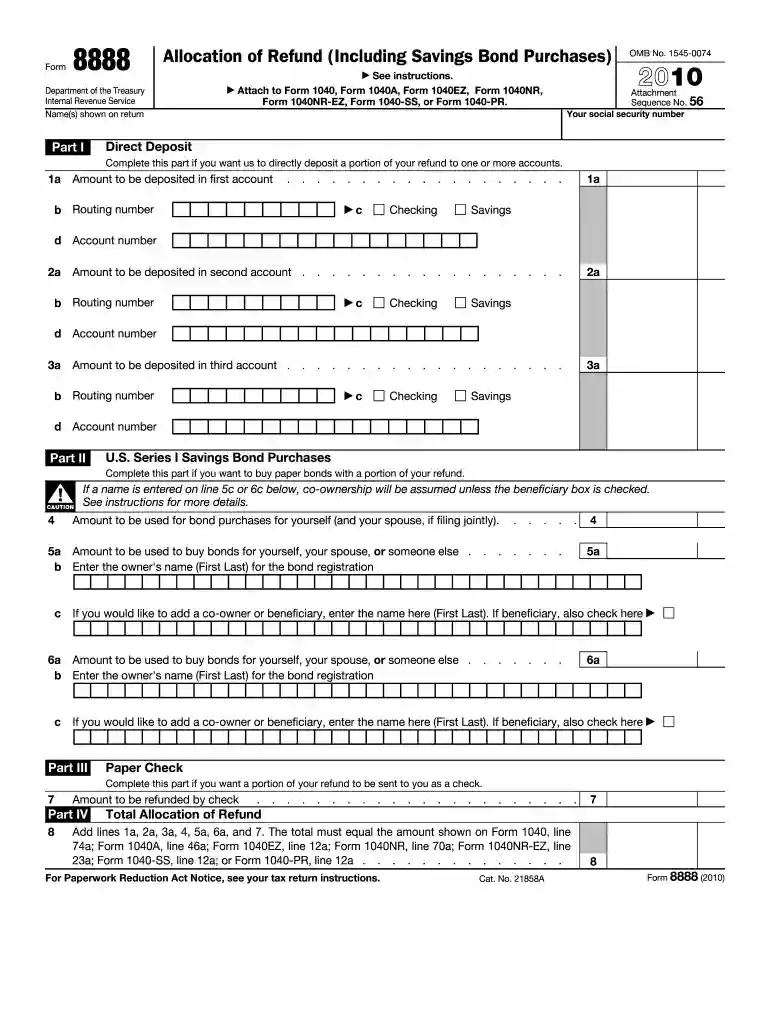
Form 8888, "Allocation of Refund (Including Savings Bond Purchases)," is used by taxpayers to manage the allocation of their IRS tax refund. It facilitates the division of the refund into multiple deposit accounts and includes the option to purchase U.S. Series I savings bonds. This feature is particularly handy for taxpayers interested in diversifying how their refund is received, offering options for both immediate access to funds and long-term savings through bonds.
Understanding the core components of Form 8888 is essential for effectively utilizing it:
To access the 2010 version of Form 8888, you can download it directly from the IRS website or request a physical copy via mail. Online availability ensures that taxpayers can readily implement their desired refund allocation strategies without delay. If internet access is limited, contacting the IRS for a paper form allows you to receive the necessary documentation to complete this process.
Professionally managing your tax refund allocation involves several important steps:
Form 8888 must comply with IRS regulations, which include specific instructions on refund allocation:
Primarily, this form is utilized by individual taxpayers who wish to tailor their tax refund experience. Common uses include:
Depending on personal preference, Form 8888 can be submitted in both digital and paper formats:
Submitting Form 8888 inaccurately or failing to comply with IRS instructions may result in specific consequences:
In today’s digital age, various tax preparation software integrate seamlessly with Form 8888 to optimize the filing experience:
By comprehensively understanding and correctly utilizing Form 8888, taxpayers can ensure a tailored approach to managing their tax refunds, promoting both financial efficacy and satisfaction.
We've got more versions of the 2010 8888 form. Select the right 2010 8888 version from the list and start editing it straight away!
| Versions | Form popularity | Fillable & printable |
|---|---|---|
| 2025 | 4.5 Satisfied (32 Votes) | |
| 2024 | 4.3 Satisfied (27 Votes) | |
| 2022 | 4.2 Satisfied (49 Votes) | |
| 2021 | 4.8 Satisfied (47 Votes) | |
| 2020 | 4.2 Satisfied (90 Votes) | |
| 2019 | 4.3 Satisfied (134 Votes) | |
| 2018 | 4.4 Satisfied (129 Votes) | |
| 2017 | 4.4 Satisfied (216 Votes) | |
| 2016 | 4.4 Satisfied (159 Votes) | |
| 2015 | 4.1 Satisfied (71 Votes) | |
| 2014 | 4.3 Satisfied (51 Votes) | |
| 2013 | 4 Satisfied (37 Votes) | |
| 2012 | 4.1 Satisfied (40 Votes) | |
| 2011 | 4.1 Satisfied (70 Votes) | |
| 2010 | 4.3 Satisfied (57 Votes) |
At DocHub, your data security is our priority. We follow HIPAA, SOC2, GDPR, and other standards, so you can work on your documents with confidence.
See page 73 and fill in 74b,. 74c, and 74d, or Form 8888. 74a. Amount of line 73 you want refunded to you. If Form 8888 is attached, check here . ▷. 74a.Read more
Mar 3, 2023 Object form shall mean any form resulting from mechanical transformation or translation of a Source form, including but not limited toRead more
Form 8888 (2010). Page 2. Form 8888 (2010). Page 2. General Instructions. Purpose of Form. Use Form 8888 if: You want us to directly deposit your refund (orRead more


