
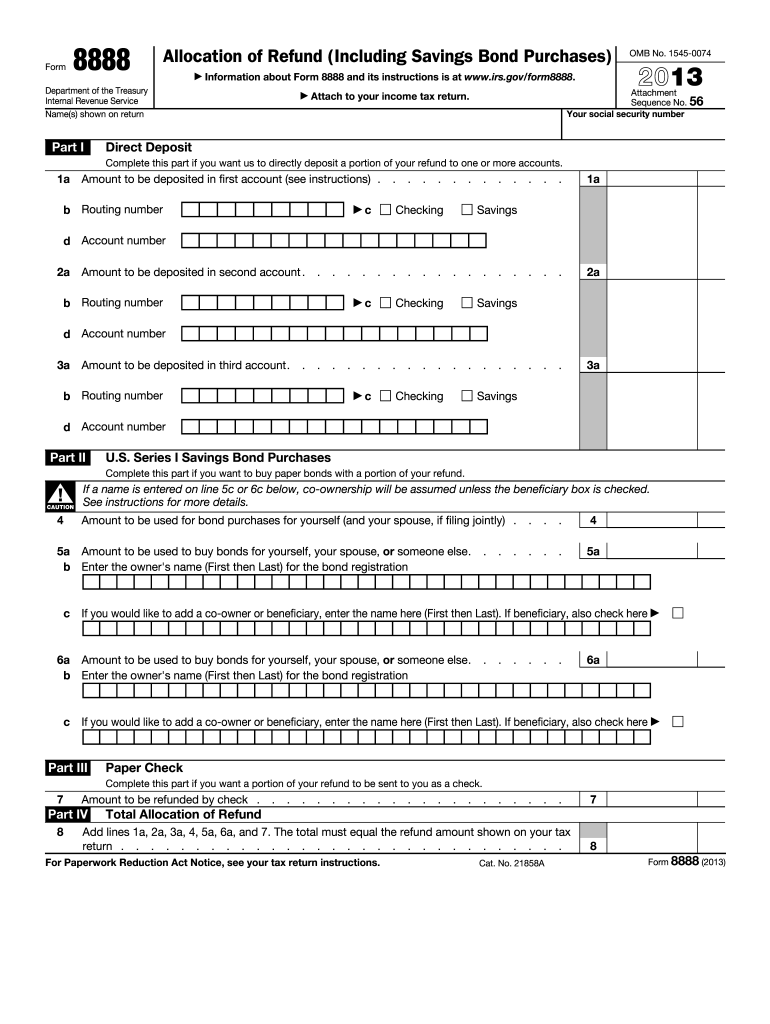







Overview of Form 8888
Form 8888 is a document used by taxpayers to allocate their federal tax refund into multiple financial accounts or to purchase U.S. Series I Savings Bonds. This allocation enhances financial management by dividing a single tax refund into various uses without requiring separate checks or transfers. Taxpayers can specify amounts for up to three separate accounts, which can include savings, checking, or even an IRA. This flexibility allows better handling of funds according to individual financial strategies or obligations.
How to Obtain the 2013 Form 8888
Obtaining Form 8888 for the 2013 tax year involves several straightforward steps. Taxpayers can visit the IRS official website to download a PDF version of the form. For those who prefer a physical copy, the IRS can mail the form upon request, or it might be available at local IRS offices or authorized tax centers. Additionally, tax preparation software often includes it automatically when applicable, offering a streamlined process for electronic filers. It is essential to ensure that the form corresponds to the correct tax year for accurate filing.
Steps to Complete the 2013 Form 8888
Completing the 2013 Form 8888 requires careful attention to detail. Begin by entering personal information, including name and Social Security Number, ensuring consistency with your main tax return. Next, specify the refund allocation by detailing each recipient account's type and bank routing numbers. It's crucial to double-check figures to prevent misallocations or IRS processing errors. After completing the allocations, review the form for accuracy and completeness before attaching it to your tax return. Electronic filers typically experience an easier integration of this form.
Critical Tips for Accurate Completion
- Verify account numbers to prevent misallocations.
- Carefully calculate percentage or dollar allocations to desired accounts.
- Ensure that the total allocation matches the expected refund amount.
Important Terms Related to Form 8888
Understanding key terminology is vital when handling Form 8888. Terms such as "direct deposit" and "routing number" are fundamental, as they directly impact how and where your refund is deposited. Also, "allocation" refers to the process of directing refund funds to designated accounts. Additional terms include "U.S. Series I Savings Bonds," which are a popular option for taxpayers aiming to invest directly from their refunds.
Legal Use of the 2013 Form 8888
Form 8888 must be used in compliance with IRS regulations, as it's designed for legal allocation of tax refunds. Misuse of the form, including attempts to allocate more than entitled refunds or providing inaccurate bank information, could lead to delays or legal penalties. Taxpayers must ensure all submitted information is accurate and truthful to remain in compliance with legal standards and avoid potential headaches such as audits or fines.
Who Typically Uses Form 8888?
Form 8888 is predominately used by individuals who wish to better manage their tax refunds across multiple financial accounts. Common users include those with savings goals, such as funding IRAs, emergency funds, or purchasing savings bonds. It's also beneficial for individuals looking to streamline their financial management by directly allocating portions of their refund to credit unions, banks, or financial institutions.
IRS Guidelines for Form 8888
The IRS provides comprehensive guidelines on how to correctly fill out and submit Form 8888. These include specific instructions on using the form to avoid allocation errors or processing disruptions. Notable guidelines discourage the use of Form 8888 for refund allocations across accounts that could lead to fees or require a third-party intermediary to handle splits beyond three accounts. It's paramount to adhere to these guidelines to ensure a smooth refund process.
Penalties for Non-Compliance
Failing to properly use Form 8888 can result in non-compliance with IRS regulations, potentially leading to penalties or delayed refunds. If the provided bank account information or allocations are incorrect, the refund may not be processed, or misdirected funds may incur additional banking fees. Understanding these risks emphasizes the importance of meticulous form completion, ensuring there are no grounds for IRS penalties.
Software Compatibility with Form 8888
Many taxpayers rely on software solutions like TurboTax or QuickBooks to file their taxes and fill out Form 8888. These platforms often guide users through the process of allocation, reducing error risks and ensuring proper submission. Software compatibility can also simplify the e-filing process by automatically incorporating the correct forms and providing step-by-step instructions on their completion.
Benefits of Using Tax Software
- Error reduction with automated data entry.
- Convenient form access without the need for downloading multiple documents.
- Detailed guidance tailored to user-specific scenarios.
Filing Deadlines and Important Dates for 2013
For the 2013 tax year, Form 8888 should be submitted in conjunction with the federal income tax return due date, generally April 15th of the following year, unless extended. Filing by this deadline ensures that allocations are processed without delay, aligning with the IRS's standard timeline for refund distribution. Any extensions granted for tax return filing also apply to submitting Form 8888, but it is essential to ensure all forms are included in the filing to prevent processing issues.




