






Definition & Meaning
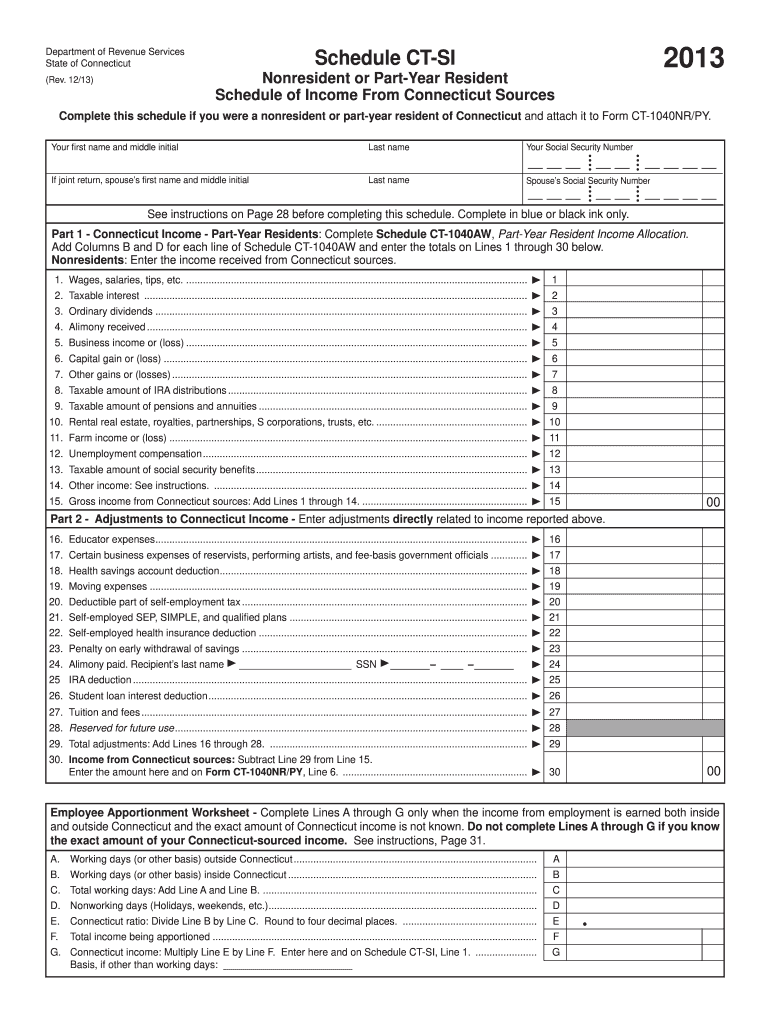
The 2013 Connecticut Schedule CT-SI is specifically designed for nonresidents or part-year residents of Connecticut. It is used to report income that has been sourced from Connecticut, ensuring accurate state tax assessment. This form helps in delineating various income types, making necessary adjustments, and supplying instructions to complete the form with accuracy and compliance. Its primary function is to confirm that the taxation is accurately levied based on the income that is attributable to the state.
Key Elements of the 2013 Connecticut Schedule Form
Key components of the Schedule CT-SI include sections for reporting different types of income, adjustments, and specific instructions to fill out the form accurately. The form categorizes income into tiered sections such as wages, dividends, business income, and other relevant income streams. Adjustments to income can be made to reflect items such as deductions or other credits, which may reduce the taxable amount.
- Income Categories: Clearly defines categories for wages, dividends, and other income.
- Adjustments: Considerations for deductions or credits.
- Instructions: Step-by-step directions for accurate completion.
How to Use the 2013 Connecticut Schedule Form
To complete the Schedule CT-SI form, begin by collecting all necessary income documentation relevant to Connecticut. You must accurately fill out each section that applies to your income categories. Ensure all income sourced from Connecticut is reported, making any necessary adjustments where applicable.
- Collect Documentation: Gather all income proofs including W-2s, 1099s, etc.
- Complete Sections: Follow instructions to enter data for each income type.
- Adjustments: Make deductions or credits adjustments as needed.
- Review: Ensure all information is accurate before submission.
Steps to Complete the 2013 Connecticut Schedule Form
Completing the Schedule CT-SI involves several detailed steps to ensure compliance:
- Begin with personal identification information, including name, address, and identification number.
- Enter total income earned, focusing on ensuring only Connecticut-sourced income is entered.
- Adjust the reported income by subtracting allowable deductions and credits.
- Consolidate the adjusted total and insert it into the appropriate section of the form.
- Review each section meticulously to confirm accuracy and completeness.
- Save a copy of the completed form for personal records.
Legal Use of the 2013 Connecticut Schedule Form
The legal framework surrounding the Schedule CT-SI is crucial. This form serves as a legal document to substantiate income from Connecticut sources, ensuring transparency in tax reporting for nonresidents or part-year residents. The accurate completion of this form helps avoid legal complications or penalties due to non-compliance.
- Compliance with state tax obligations.
- Validation of income reported solely from Connecticut sources.
- Supports claims for deductions or credits legally permissible.
Filing Deadlines / Important Dates
Adhering to the filing deadlines is vital for the 2013 Connecticut Schedule CT-SI. Typically, the deadline aligns with the state tax filing deadline, which is usually the same as the federal deadline, on or around April 15th. Extensions might be available, and timely submissions are crucial to avoid penalties.
- Standard Deadline: Approximately April 15th of the following year.
- Possible Extensions: Available under certain conditions.
- Penalties: Apply for late or incorrect submissions.
Required Documents
To complete the Schedule CT-SI efficiently, prepare specific documents ahead of time. Necessary documentation includes:
- W-2 Forms: To report all earned wages.
- 1099 Forms: For various types of income.
- Proof of Deductions: Documents supporting any deductions claimed.
These documents ensure that all income reported and adjustments made are clear, justified, and accurate.
IRS Guidelines
While the Schedule CT-SI is a state form, IRS guidelines influence its use, especially regarding income classification and adjustments. Alignment with federal regulations guarantees state compliance and minimizes discrepancies or inaccuracies.
- Income Classification: Must align with federal standards.
- Adjustment Criteria: Must comply with both state and federal guidelines.
- Consistency: Use of consistent definitions across different forms.
Who Typically Uses the 2013 Connecticut Schedule Form
The typical users of the Connecticut Schedule CT-SI form include nonresidents and part-year residents who earn income from Connecticut sources. This form is particularly vital for individuals who might be working, investing, or having business engagements within Connecticut.
- Nonresidents: Those living outside Connecticut but earning income within.
- Part-Year Residents: Individuals who lived in Connecticut for part of the year.
- Business Entities: Those with income arising from Connecticut ventures or investments.
These blocks collectively provide a complete, structured understanding of the 2013 Connecticut Schedule CT-SI, ensuring effective utilization and compliance in routine tax scenarios.