




01. Edit your form online
Type text, add images, blackout confidential details, add comments, highlights and more.

Type text, add images, blackout confidential details, add comments, highlights and more.

Draw your signature, type it, upload its image, or use your mobile device as a signature pad.

Send it via email, link, or fax. You can also download it, export it or print it out.
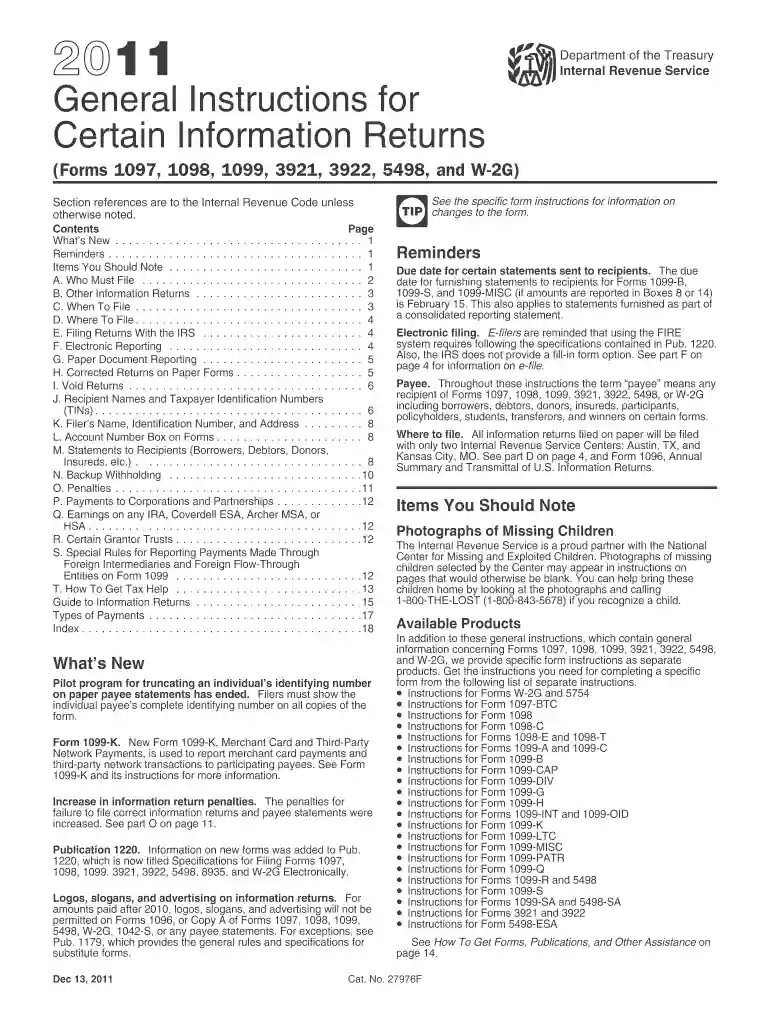
The general instructions for certain information returns for 2011 serve as comprehensive guidelines issued by the IRS, covering a variety of forms necessary for information reporting. These forms include 1097, 1098, 1099, 3921, 3922, 5498, and W-2G, which are essential for reporting different types of financial transactions. The instructions provide detailed explanations on who needs to file these forms, the processes involved, and the repercussions for non-compliance. Taxpayers and businesses must adhere to these guidelines to ensure accurate information reporting and compliance with IRS regulations.
Accessing the instructions for certain information returns from 2011 is straightforward. These documents can typically be found on the IRS official website as downloadable PDFs. Alternatively, they can be obtained through certified tax professionals or accounting software platforms that maintain historical tax forms and instructions. Ensuring you have the correct version of the instructions is crucial, as updates or changes in tax laws could result in discrepancies if using outdated guidelines.
Identify the Required Form: Determine which specific form(s) are applicable to your situation based on the types of transactions or payments made.
Gather Necessary Information: Collect all relevant financial data, including payer and recipient details and the amounts involved in the transaction.
Complete Required Sections: Fill in all applicable sections of the form, ensuring accuracy in entering information to avoid penalties.
Review and Verification: Double-check the completed form for any errors or omissions. Utilize the instructions to cross-reference and ensure compliance.
Submit by Deadline: File the completed forms by the designated IRS deadlines through the appropriate submission method (mail or electronic filing).
Completing the general instructions for certain information returns is crucial for both individuals and businesses engaged in reportable financial transactions. Compliance ensures that tax obligations are met and reduces the risk of audits or subsequent penalties issued by the IRS. The instructions serve as a structured guide to understanding the complexities of tax reporting, aiding in accurate and timely submissions.
The primary users of these forms and instructions include financial institutions, businesses, and individuals responsible for reporting various transactions, such as mortgage interest, dividends, or educational expenses. Tax professionals also frequently reference these instructions to assist clients in compliance with IRS regulations. Additionally, companies employing independent contractors or involved in stock options typically rely on these forms to document reportable payments accurately.


The IRS provides specific guidelines within these instructions regarding the submission process, method of filing, and requirements for both electronic and paper submissions. Details about backup withholding, electronic filing mandates, and the need for accurate data reporting are thoroughly explained. Taxpayers must familiarize themselves with these guidelines to ensure full compliance and to prevent errors that could lead to penalties.
Each form covered in the general instructions for 2011 has its own IRS-mandated filing deadlines. Typically, forms are due either by the end of January or March of the following year, depending on the method of filing (paper or electronic) and specific regulatory requirements. Understanding these deadlines is crucial for timely submissions. Missed deadlines can lead to penalties, so it is advisable to maintain a well-structured filing calendar to keep track of these important dates.
Non-compliance with the instructions for information returns may result in significant penalties. The IRS imposes penalties for late filing, incorrect data, and failure to furnish recipient statements. These penalties can accumulate, increasing the financial burden on individuals or businesses. The instructions provide a breakdown of potential penalties and offer guidance on steps to rectify issues to mitigate financial liabilities.
The instructions detail several crucial components necessary for successful form completion:
Who Must File: Clarity on which entities are responsible for filing specific forms.
Filing Requirements: Guidelines on the data required, including thresholds and specific transaction types.
Submission Options: Various ways to submit forms, including traditional mail and electronic filing options.
Recipient Statements: Instructions on issuing statements to those receiving payments, ensuring they have accurate information for their tax records.
Corrections Process: Protocols for rectifying errors in already submitted forms to align with IRS standards.
These elements are essential for understanding and fulfilling tax obligations efficiently and correctly.
We've got more versions of the gen instr for certain info returns 2011 form form. Select the right gen instr for certain info returns 2011 form version from the list and start editing it straight away!
| Versions | Form popularity | Fillable & printable |
|---|---|---|
| 2025 | 4.1 Satisfied (34 Votes) | |
| 2024 | 4.2 Satisfied (34 Votes) | |
| 2023 | 4.2 Satisfied (28 Votes) | |
| 2022 | 4.6 Satisfied (34 Votes) | |
| 2021 | 4.8 Satisfied (33 Votes) | |
| 2020 | 4.4 Satisfied (90 Votes) | |
| 2019 | 4.4 Satisfied (130 Votes) | |
| 2018 | 4.4 Satisfied (166 Votes) | |
| 2017 | 4.3 Satisfied (270 Votes) | |
| 2016 | 4.4 Satisfied (138 Votes) | |
| 2015 | 4.4 Satisfied (147 Votes) | |
| 2014 | 4 Satisfied (45 Votes) | |
| 2011 | 4.2 Satisfied (87 Votes) |
At DocHub, your data security is our priority. We follow HIPAA, SOC2, GDPR, and other standards, so you can work on your documents with confidence.
Send the entire page of Copy A of your information returns with Form 1096 to the IRS even if some of the forms are blank or void. Do not use staples on anyRead more
RECIPIENT INFORMATION. 22. General Instructions for Certain Information Returns. 2011 Federal Tax Fundamentals. Copyrighted by the Board of Trustees of theRead more


