
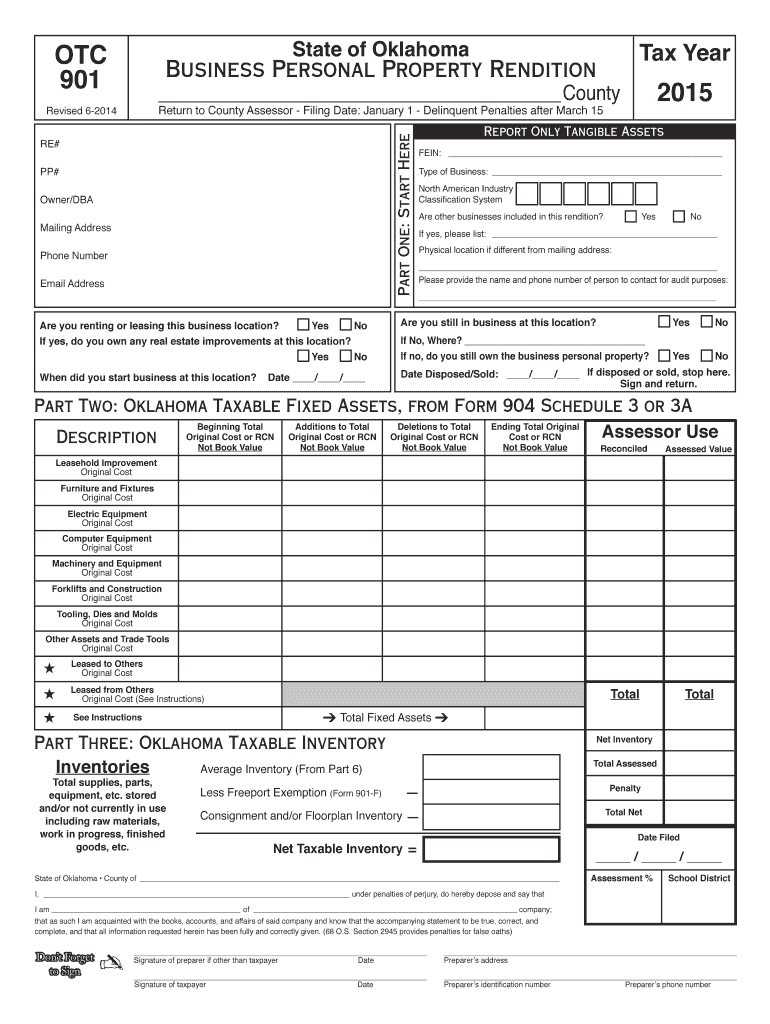







Definition & Purpose of the OTC Form
The OTC form is utilized by the Oklahoma Tax Commission to collect information on the business personal property of entities operating within the state. Businesses must report tangible assets, such as machinery, equipment, and inventory, to comply with state tax regulations. This form ensures accurate assessment of property taxes according to the business's asset valuation, helping the Oklahoma Tax Commission maintain transparency and precision in tax administration.
Key Features
- Reporting Requirements: Businesses must provide detailed inventories of all tangible personal property.
- Asset Categories: Includes machinery, equipment, and operational inventory.
- Valuation Method: Used by the Commission to determine applicable taxes.
How to Use the OTC Form
Completing the OTC form involves accurately listing all business-owned personal property and classifying them correctly under designated categories. It is critical for ensuring compliance and accurate tax calculation.
Steps Involved
- Gather Information: Collect detailed records of all business personal property.
- Classify Assets: Divide assets into categories such as machinery or inventory.
- Complete Form: Fill in relevant sections on the form with comprehensive asset details.
- Review for Accuracy: Make sure all data is complete and accurate to avoid legal complications.
Obtaining the OTC Form
The form can be acquired through the Oklahoma Tax Commission's official website or local tax offices. Understanding how to obtain it quickly is essential for meeting submission deadlines.
Methods to Access
- Online Download: Visit the Oklahoma Tax Commission’s website for a downloadable PDF.
- In-Person Collection: Available at local tax commission offices in Oklahoma.
Steps to Complete the OTC Form
Filling out this form correctly requires attention to detail and understanding of business inventory and assets. Here is a comprehensive guide on how to proceed:
- Read Instructions: Carefully review the guidelines provided with the form.
- Inventory Listing: List all business personal property with description and value.
- Asset Valuation: Provide the current value of each asset as per guidelines.
- Final Review: Double-check for completeness and correctness.
- Submission: Submit the form through the preferred method (online or by mail).
Importance of Filing the OTC Form
Failure to file accurately can lead to legal issues and financial penalties. It is essential for businesses in Oklahoma to understand the necessity of this form for compliance and to avoid punitive measures.
Benefits of Filing
- Tax Compliance: Ensures adherence to Oklahoma's tax laws.
- Penalty Avoidance: Avoids penalties associated with non-compliance or delays.
- Accurate Tax Calculation: Aids in accurate and fair property tax assessments.
Penalties for Non-Compliance
Being late or inaccurate in filing can result in significant penalties, emphasizing the importance of prompt and precise submission.
Penalty Details
- Late Filing Fees: Subject to additional charges for delayed submission.
- Interest Accrued: On unpaid taxes if the form is submitted late.
- Legal Repercussions: Potential legal actions for non-compliance.
Form Submission Methods
Understanding how to submit the form correctly is crucial for compliance. Businesses can choose the method that best suits their operational needs.
Options Available
- Online Submission: Via the Oklahoma Tax Commission’s electronic filing system.
- Mail Submission: Sending a completed form to the appropriate tax office.
- In-Person Submission: Dropping off at designated tax commission locations.
Business Types Benefiting Most from the OTC Form
Certain business entities find this form more applicable due to their structure and asset types.
Ideal Business Entities
- Manufacturing Units: With significant machinery and equipment investment.
- Retail Businesses: Managing large inventories requiring precise reporting.
- Small Enterprises: Needing to maintain detailed asset records for tax purposes.




