




01. Edit your form online
Type text, add images, blackout confidential details, add comments, highlights and more.

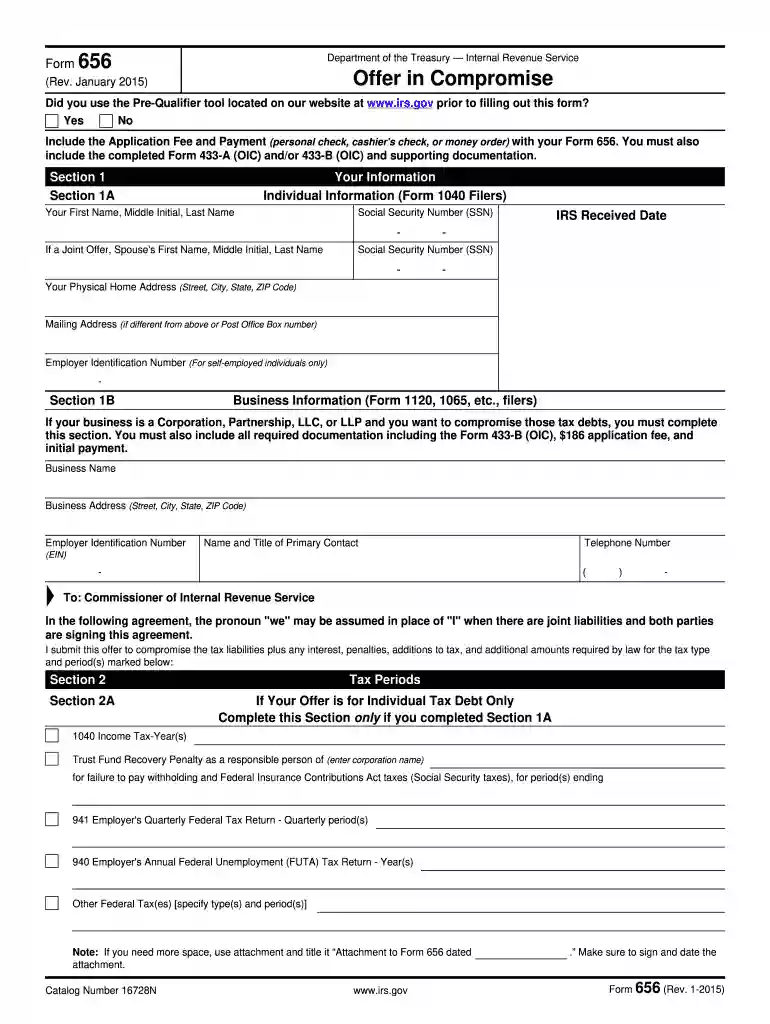
Type text, add images, blackout confidential details, add comments, highlights and more.

Draw your signature, type it, upload its image, or use your mobile device as a signature pad.

Send it via email, link, or fax. You can also download it, export it or print it out.
Form 656, known in its 2015 iteration as the " form," is utilized by taxpayers in the United States to submit an Offer in Compromise (OIC) to the Internal Revenue Service (IRS). An OIC is a proposal to settle one's tax debt for less than the full amount owed, typically used in cases of financial hardship or doubt about the collectibility of the tax debt. The form acts as an agreement between the taxpayer and the IRS, outlining the terms of the settlement. Proper use of the form can relieve taxpayers from overwhelming financial liabilities, allowing them to make manageable payments toward their debt.
To effectively use the form, taxpayers need to understand the contexts in which it is applicable. Primarily, the form is used in situations where paying the full tax liability would cause financial hardship or where the taxpayer can prove that the tax debt is unlikely to be collectable. Using the form involves compiling detailed financial documentation to support the OIC request, including income statements, asset declarations, and liabilities. After completing the form, it is submitted alongside a non-refundable application fee and an initial bid for the settlement offer. If the IRS accepts the proposal, the taxpayer must fulfill the terms laid out in the agreement, which might include installment payments or lump-sum settlements.
Completing the form accurately is crucial, as errors or omissions can result in delays or rejections.
The form consists of several critical components that require careful attention:
Understanding these elements ensures correct form completion and increases the likelihood of acceptance.
Familiarity with specific terms is essential when navigating the form:
Comprehending these terms aids in accurately interpreting the form's requirements.
The IRS sets forth strict guidelines for using Form 656, specifically regarding eligibility and documentation:
Following these guidelines is vital to achieve a successful submission.
Failure to comply with the terms outlined in the form can lead to significant repercussions:
These consequences underline the importance of adhering strictly to the agreement terms.
To qualify for submitting Form 656, certain criteria must be met:
Understanding these criteria is critical for determining eligibility and preparing a successful application.


We've got more versions of the 656 2015 form form. Select the right 656 2015 form version from the list and start editing it straight away!
| Versions | Form popularity | Fillable & printable |
|---|---|---|
| 2024 | 4.4 Satisfied (43 Votes) | |
| 2023 | 4.6 Satisfied (44 Votes) | |
| 2022 | 4.4 Satisfied (51 Votes) | |
| 2021 | 4.8 Satisfied (103 Votes) | |
| 2020 | 4.4 Satisfied (171 Votes) | |
| 2019 | 4.3 Satisfied (48 Votes) | |
| 2018 | 4.1 Satisfied (40 Votes) | |
| 2017 | 4.3 Satisfied (121 Votes) | |
| 2016 | 4.4 Satisfied (815 Votes) | |
| 2015 | 4.4 Satisfied (321 Votes) | |
| 2012 | 4.3 Satisfied (38 Votes) | |
| 2011 | 4.2 Satisfied (37 Votes) |
At DocHub, your data security is our priority. We follow HIPAA, SOC2, GDPR, and other standards, so you can work on your documents with confidence.
The following bill formatting information applies to the 2015-2016 session: New language in an amendatory bill will be shown in BOLD AND UPPERCASE; Language toRead more
Modifies the proposed changes to Section 4 of SL 2015-245, as amended, concerning services covered by PHPs, to exclude Medicaid services covered by the LME/MCORead more


