




01. Edit your form online
Type text, add images, blackout confidential details, add comments, highlights and more.

Type text, add images, blackout confidential details, add comments, highlights and more.

Draw your signature, type it, upload its image, or use your mobile device as a signature pad.

Send it via email, link, or fax. You can also download it, export it or print it out.
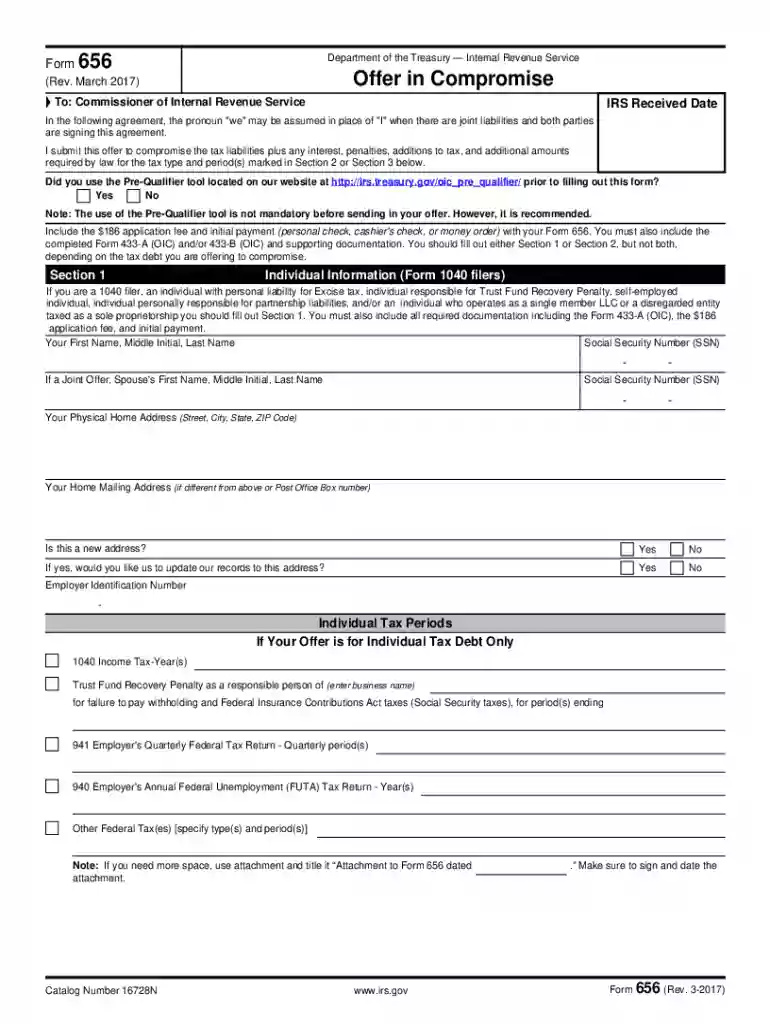
IRS Form 656, known as Offer in Compromise, is a document used by taxpayers seeking to settle their tax liabilities with the Internal Revenue Service for less than the full amount owed. The 2017 version of Form 656 is specifically aligned with the guidelines and tax regulations applicable to that year. It is an essential tool for taxpayers who are financially unable to pay their full tax debt. The form outlines the taxpayer's proposal to the IRS to pay a reduced amount, presenting reasons and financial evidence to support their offer.
Taxpayers submit this form in situations where paying the full tax debt would create a financial hardship, or when doubt exists regarding the amount owed. It requires detailed financial documentation to demonstrate the inability to pay, making it a critical instrument in negotiating tax liability reductions.
Using IRS Form 656 involves several steps and careful preparation. Taxpayers must first assess their eligibility, as not everyone qualifies for an Offer in Compromise. The IRS considers factors like income, expenses, asset equity, and overall financial situation.
Review Financial Information: Begin by gathering all necessary financial documents, such as income statements, bank account details, and details on assets and liabilities.
Determine Offer Amount: Calculate a reasonable offer amount that reflects the maximum the taxpayer can feasibly pay, either in a lump sum or through a payment plan.
Complete the Form: Fill out Form 656 accurately, ensuring all sections are completed with precise details about personal and financial circumstances.
Submit Additional Documentation: Provide supporting documents, including Form 433-A (OIC) for individuals or Form 433-B (OIC) for businesses, to illustrate financial status.
Pay the Application Fee: Include the nonrefundable fee with the submission, unless eligible for a low-income waiver.
Completing IRS Form 656 requires attention to detail to avoid processing delays. The key steps are:
Personal Information: Enter the taxpayer’s personal data such as name, address, and Social Security Number.
Tax Liability Details: Include information about the type of tax, tax periods involved, and the total amount owed.
Offer Amount: Specify the amount being offered and the terms of the proposed payment, whether lump sum or periodic payments.
Reason for Offer: Clearly state the basis for the offer, whether it’s due to financial hardship, doubt as to collectability, or doubt as to liability.
Sign and Submit: Ensure the form is signed and dated before submission. Submit the form along with supporting documentation to the appropriate IRS address listed in the instructions.
Understanding specific terms related to IRS Form 656 is crucial:
Submitting Form 656 requires several additional documents to support the taxpayer’s offer and financial claim:
The IRS sets stringent eligibility criteria for accepting an Offer in Compromise. Taxpayers should consider the following:


The IRS provides guidance on offers in compromise through detailed instructions that accompany Form 656. Key points include:
Non-compliance with IRS regulations when submitting an Offer in Compromise can lead to severe consequences:
For taxpayers and tax professionals, thorough understanding and meticulous preparation are critical in successfully submitting an IRS Form 656 Offer in Compromise for the 2017 tax year.
We've got more versions of the irs form 656 2017 form. Select the right irs form 656 2017 version from the list and start editing it straight away!
| Versions | Form popularity | Fillable & printable |
|---|---|---|
| 2024 | 4.4 Satisfied (43 Votes) | |
| 2023 | 4.6 Satisfied (44 Votes) | |
| 2022 | 4.4 Satisfied (51 Votes) | |
| 2021 | 4.8 Satisfied (103 Votes) | |
| 2020 | 4.4 Satisfied (171 Votes) | |
| 2019 | 4.3 Satisfied (48 Votes) | |
| 2018 | 4.1 Satisfied (40 Votes) | |
| 2017 | 4.3 Satisfied (121 Votes) | |
| 2016 | 4.4 Satisfied (815 Votes) | |
| 2015 | 4.4 Satisfied (321 Votes) | |
| 2012 | 4.3 Satisfied (38 Votes) | |
| 2011 | 4.2 Satisfied (37 Votes) |
At DocHub, your data security is our priority. We follow HIPAA, SOC2, GDPR, and other standards, so you can work on your documents with confidence.
A material advisor shall, with respect to a Colorado Listed Transaction, file a Material Advisors Disclosure Statement, which shall include the following:Read more
If your offer is accepted You must meet all the offer terms listed in Section 7 of Form 656, including filing all required tax returns and making all payments.Read more
Oct 30, 2018 The statements should be read in conjunction with the audited financial statements and related notes included in the 2017 Form 10-. K.Read more


