




01. Edit your form online
Type text, add images, blackout confidential details, add comments, highlights and more.

Type text, add images, blackout confidential details, add comments, highlights and more.

Draw your signature, type it, upload its image, or use your mobile device as a signature pad.

Send it via email, link, or fax. You can also download it, export it or print it out.
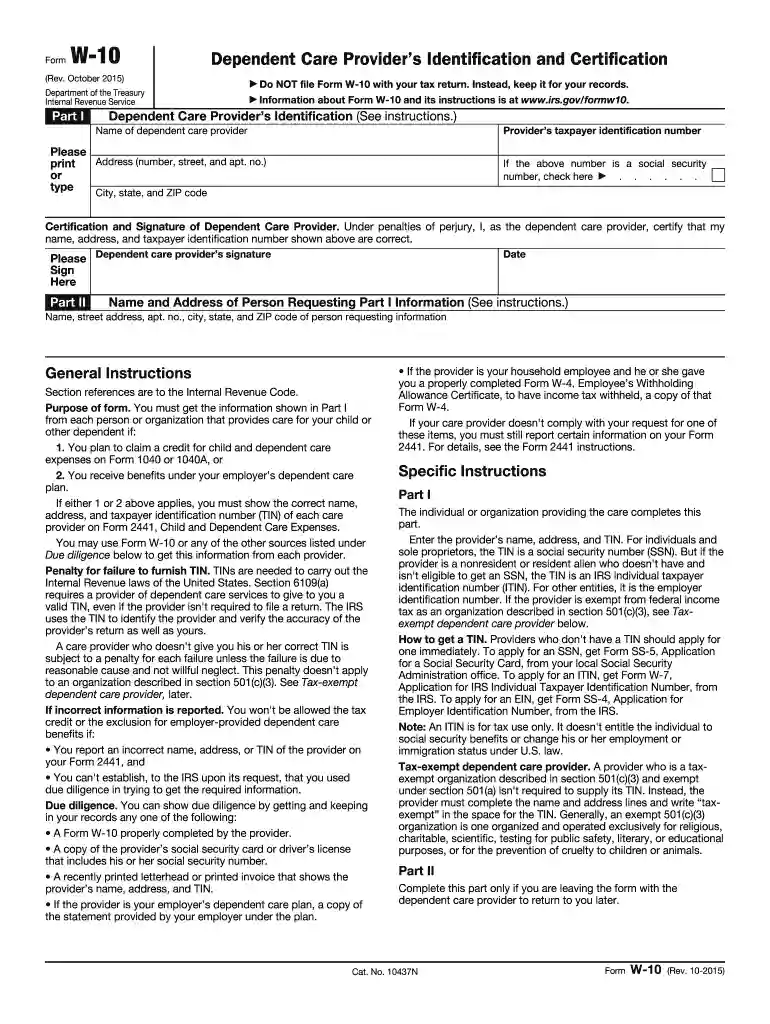
The 2015 W-10 Form, known as the "Dependent Care Provider's Identification and Certification," is a critical document used by individuals for tax purposes in the United States. It serves to collect essential information from dependent care service providers, such as taxpayer identification numbers (TINs), names, and addresses. By certifying the accuracy of the information provided under the penalties of perjury, the form supports taxpayers in claiming child and dependent care expenses on their tax returns or when utilizing employer-provided dependent care benefits.
Using the 2015 W-10 Form requires understanding its role in accurately reporting dependent care expenses. Taxpayers should:
Filling out the 2015 W-10 Form involves several straightforward steps:
Understanding the essential parts of the 2015 W-10 Form is vital for its proper handling:
The 2015 W-10 Form holds legal significance in documenting dependent care payments:
Failing to complete or inaccurately filing the 2015 W-10 Form can result in severe consequences:
Taxpayers should adhere to relevant deadlines to ensure compliance:
Practical scenarios where the 2015 W-10 Form is beneficial:
Using these detailed elements ensures a comprehensive understanding and accurate handling of the 2015 W-10 Form, facilitating proper credit claims and maintaining IRS compliance.
We've got more versions of the 2015 w 10 form form. Select the right 2015 w 10 form version from the list and start editing it straight away!
At DocHub, your data security is our priority. We follow HIPAA, SOC2, GDPR, and other standards, so you can work on your documents with confidence.
Mar 1, 2018 provider to fill out IRS Form W-10. Taxpayers then provide the information to the IRS by filling out the Form 2441, which is used to claimRead more
Earned income credit (EIC). You may be able to take the EIC for 2015 if your adjusted gross income (AGI) is less than a certain amount.Read more


