
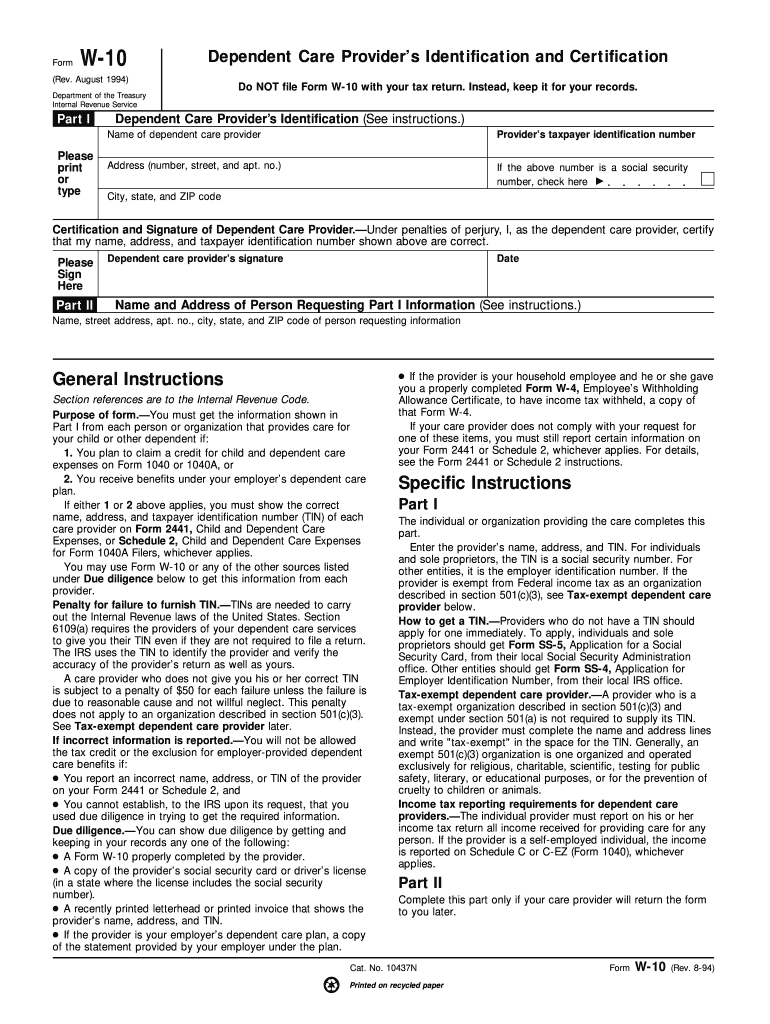







Definition and Purpose of Form W-10
Form W-10, officially titled the "Dependent Care Provider's Identification and Certification," is pivotal for collecting essential identification and certification details from dependent care providers. Its primary function is to facilitate taxpayers in claiming the Child and Dependent Care Credit on their tax returns. By obtaining accurate information, including the provider's name, taxpayer identification number (TIN), and address, taxpayers can ensure they're eligible for applicable tax credits while avoiding potential IRS penalties associated with incorrect or incomplete data.
How to Use Form W-10
Form W-10 should be used by individuals or entities who intend to claim expenses related to child and dependent care on their tax returns. The form assists in verifying the identity of care providers, which is critical for tax compliance. Taxpayers should request this form from each of their dependent care providers, complete the necessary sections, and maintain it in their records. Even though Form W-10 isn't submitted directly to the IRS with tax filings, it should be duly completed and kept as part of personal records to substantiate claims if needed.
Steps to Complete the Form W-10
- Requester Information: Start by filling out your name and address in the designated section to clearly identify yourself as the person requesting information.
- Provider's Details: Collect the dependent care provider's full legal name and address.
- Taxpayer Identification Number (TIN): Ensure the provider's TIN or social security number is accurately recorded. This number is crucial for IRS reporting and validation.
- Certification: The provider must sign the form, certifying the accuracy of the information provided, acknowledging the perjury penalties for false information.
- Record Keeping: Safely store the completed form for your records. It is significant for future reference, particularly if discrepancies arise during tax assessments.
Examples of Using the Form W-10
Form W-10 is commonly used by working parents who pay for child care services so they can work or search for employment. For instance, an employed single parent might use it to document expenses paid to a daycare center. Similarly, a family employing a nanny should have the nanny complete the form to ensure that these expenses can be appropriately claimed when tax season arrives. Such documentation supports claims for the Child and Dependent Care Credit, potentially reducing the overall tax burden.
Key Elements of the Form W-10
- Care Provider’s Identity: Full legal name and the service address are crucial components for accurate identification.
- Tax Identification: Essential for confirming the provider’s legitimacy and ensuring compliance with IRS requirements.
- Signature Requirement: The provider's certified signature confirms the authenticity of the provided details and establishes accountability under penalty of perjury.
- Usage Purpose: While not submitted with tax returns, it serves as proof when claiming care-related tax credits.
IRS Guidelines on Form W-10 Use
According to IRS guidelines, while taxpayers complete their returns, they should input the care provider’s information into Form 2441: Child and Dependent Care Expenses, used with Form 1040. The IRS advises accurately recording the information as any discrepancy could lead to delayed processing or denial of the associated credit. Further, keeping readily accessible records of Form W-10 can expedite resolution of any issues or inquiries that might arise during tax processing.
Penalties for Non-Compliance
Failing to obtain or accurately document provider information on Form W-10 can lead to several negative consequences. Taxpayers may face delays in processing claims for the Child and Dependent Care Credit. An inaccurate TIN may incur penalties, reducing eligibility for credits. Moreover, complications may arise if the IRS audits and requests evidence to validate the claims as compliant with tax guidelines.
Who Typically Uses Form W-10
Form W-10 is predominantly used by taxpayers who incur dependent care expenses for children or other dependents, enabling them to work or seek employment. This includes employed individuals, self-employed taxpayers, and even small business owners who use qualified care services. Additionally, employers providing dependent care benefits may require this form to ensure those benefits align with tax compliance requirements, benefiting both the organization and its employees.
Digital vs. Paper Version of Form W-10
With the growing emphasis on technological integrations, forms like the W-10 can be maintained digitally. Platforms like DocHub offer tools to complete and store such forms securely in digital format. This method allows for safer records management, with SSL encryption protecting data integrity and availability. While traditional paper forms are still valid, transitioning to digital documentation offers the advantage of easier management and retrieval, particularly during electronic tax filing processes.




