




01. Edit your form 433 d online
Type text, add images, blackout confidential details, add comments, highlights and more.

Type text, add images, blackout confidential details, add comments, highlights and more.

Draw your signature, type it, upload its image, or use your mobile device as a signature pad.

Send form 433 d instructions via email, link, or fax. You can also download it, export it or print it out.
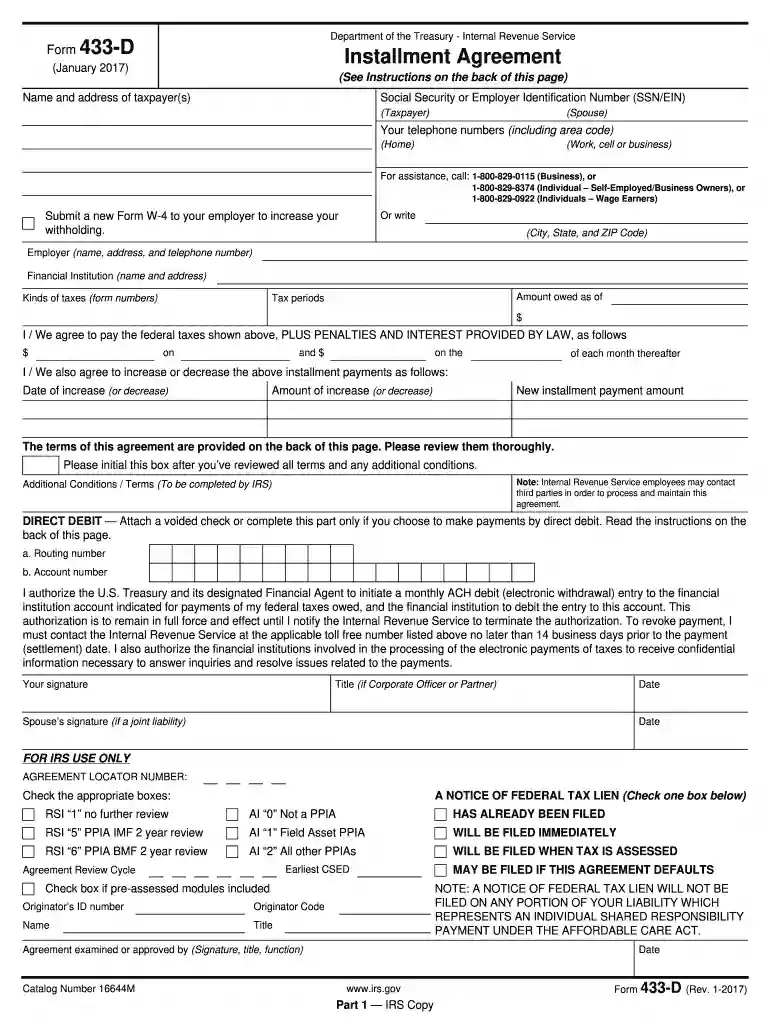
Form 433-D, also known as the Installment Agreement, is a document utilized by the Department of the Treasury - Internal Revenue Service (IRS) to aid taxpayers in settling their federal tax liabilities through periodic payments. This form is crucial for individuals who cannot pay their taxes in full by the due date. By filing Form 433-D, a taxpayer agrees to a structured payment plan, which helps them manage their financial obligations while staying compliant with IRS requirements. The agreement specifies the payment amount, frequency, and several conditions that both parties must adhere to, ensuring that the taxpayer can meet their tax responsibilities without immediate financial strain.
Using Form 433-D requires filling out several sections that detail your personal and financial information. It is vital to provide accurate and complete data to avoid delays in processing. Here's how to effectively use the form:
Taxpayer Information: Start by filling out your name, Social Security number, and address. Ensure this information matches your previous tax filings for consistency.
Payment Arrangement Details: Specify the proposed monthly payment amount. The IRS requires this to assess the feasibility of the agreement. Consider factors like your income, expenses, and any other financial obligations to determine a realistic payment amount.
Direct Debit Authorization: If you opt for automatic payments, complete the direct debit authorization section. This involves providing your bank account and routing numbers for seamless automatic withdrawals.
Signature and Date: Both you and an IRS representative must sign and date the form to validate the agreement.
Using Form 433-D not only eases the tax burden by allowing you to pay over time but also eliminates potential penalties and interest accumulation that occur when taxes remain unpaid.
Filling out Form 433-D involves a series of steps to ensure accuracy and compliance:
Gather Required Information: Before you begin, collect all necessary details, including your financial statements, tax returns, and any relevant documentation.
Complete Personal Information: Fill in your full name, Social Security number, and address in the top section of the form.
Propose Payment Terms:
Authorize Direct Debit (Optional):
Review and Sign: Verify the information entered for accuracy. Sign and date the form to confirm your commitment to the payment plan.
Submit the Form: Once complete, send the form to the appropriate IRS address, which can be found in the IRS instructions related to Form 433-D.
Completing these steps accurately is vital. If any part of the form is filled inaccurately, it may be returned or rejected, delaying the installment agreement approval.
The IRS provides specific guidelines for using Form 433-D, which are important to ensure compliance and the successful establishment of an installment agreement. Here are key points from these guidelines:
Familiarizing yourself with these guidelines helps secure timely processing and avoids potential complications with your installment agreement.
Non-compliance with the terms of the Form 433-D can result in severe consequences:
It is crucial to adhere to the agreed terms and notify the IRS promptly if you anticipate any difficulties in making payments.
Understanding key terms in Form 433-D is essential for clarity and successful completion:
Knowing these terms helps in navigating the form accurately and understanding the implications of the agreement.
Form 433-D is applicable in various taxpayer scenarios, which helps tailor the installment agreements to individual financial circumstances:
By matching the form's application to life situations, taxpayers can efficiently manage their tax liabilities within their financial limitations.


While Form 433-D itself does not have a specific filing deadline, it is associated with other tax-related due dates:
Remaining mindful of these dates ensures that taxpayers stay compliant with IRS timelines and obligations related to their installment agreements.
We've got more versions of the form 433 d form. Select the right form 433 d version from the list and start editing it straight away!
| Versions | Form popularity | Fillable & printable |
|---|---|---|
| 2024 | 4.9 Satisfied (54 Votes) | |
| 2022 | 4.8 Satisfied (43 Votes) | |
| 2020 | 4.8 Satisfied (53 Votes) | |
| 2018 | 4.4 Satisfied (134 Votes) | |
| 2017 | 4.4 Satisfied (469 Votes) | |
| 2015 | 4.2 Satisfied (56 Votes) | |
| 2013 | 4.3 Satisfied (50 Votes) | |
| 2012 | 4 Satisfied (42 Votes) | |
| 2010 | 4 Satisfied (40 Votes) | |
| 2007 | 4 Satisfied (32 Votes) |
At DocHub, your data security is our priority. We follow HIPAA, SOC2, GDPR, and other standards, so you can work on your documents with confidence.

In working with your client concerning a collection matter, it is recommended that you ask the client to complete either a Form 433 A or 433 F (the simplifiedRead more
Product Number Form 433-D Title Installment Agreement, Revision Date Jul 2024 ; Product Number Form 433-D (sp) Title Installment Agreement (Spanish version)Read more
Form. 433-D. (Rev. 1-2017). Part 1. IRS Copy. Form. 433-D. (January 2017). Department of the Treasury - Internal Revenue Service. Installment Agreement. (See


