




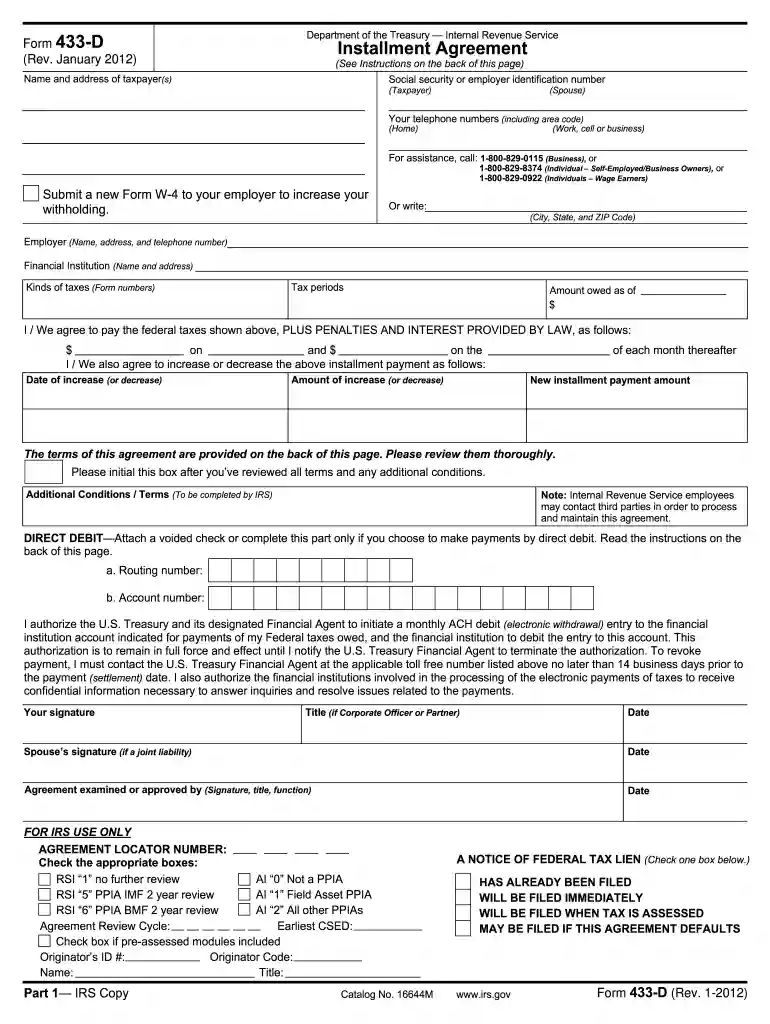
01. Edit your where to send form 433 d to irs online
Type text, add images, blackout confidential details, add comments, highlights and more.

Type text, add images, blackout confidential details, add comments, highlights and more.

Draw your signature, type it, upload its image, or use your mobile device as a signature pad.

Send where do i mail my irs installment agreement form 433 d via email, link, or fax. You can also download it, export it or print it out.
IRS Form 433-D, also referring to the specific 2012 version, is an installment agreement form utilized by taxpayers to establish a payment plan for settling federal tax debts, including penalties and interest. This form allows individuals to spread their tax payments over time, alleviating the burden of paying a lump sum. Taxpayers must provide personal information, details about their financial status, and agree to terms concerning their repayment schedule.
Filling out IRS Form 433-D meticulously is crucial to ensure timely processing and acceptance by the IRS.
Personal Information
Financial Details
Bank Account Information for Direct Debit
Agreement and Authorization
Submission
Understanding the major components of Form 433-D ensures that taxpayers fill out the necessary details accurately.
The IRS provides detailed guidelines to assist taxpayers in understanding and completing Form 433-D effectively.
Timeliness is essential when dealing with IRS forms to avoid additional penalties or interest charges.
Familiarizing oneself with critical terms aids in comprehension and compliance.
When preparing to fill out Form 433-D, gather all necessary supporting documents.
Taxpayers can choose between digital or paper submission methods for IRS Form 433-D.
Digital Version:
Paper Version:
Failing to comply with the agreed installment plan can lead to significant repercussions.
We've got more versions of the where to send form 433 d to irs form. Select the right where to send form 433 d to irs version from the list and start editing it straight away!
| Versions | Form popularity | Fillable & printable |
|---|---|---|
| 2024 | 4.9 Satisfied (54 Votes) | |
| 2022 | 4.8 Satisfied (43 Votes) | |
| 2020 | 4.8 Satisfied (53 Votes) | |
| 2018 | 4.4 Satisfied (134 Votes) | |
| 2017 | 4.4 Satisfied (469 Votes) | |
| 2015 | 4.2 Satisfied (56 Votes) | |
| 2013 | 4.3 Satisfied (50 Votes) | |
| 2012 | 4 Satisfied (42 Votes) | |
| 2010 | 4 Satisfied (40 Votes) | |
| 2007 | 4 Satisfied (32 Votes) |
At DocHub, your data security is our priority. We follow HIPAA, SOC2, GDPR, and other standards, so you can work on your documents with confidence.




May 12, 2021 Any free writing prospectus that the Company is required to file pursuant to Rule 433(d) under the Securities Act has been, or will be, filedRead more
Form 433-D (Rev. 1-2012). Part 3 Taxpayers Copy. Form 433-D. (Rev. January 2012). 1. 2. 1. 1. 1. Page 5. INSTRUCTIONS TO TAXPAYER. If not already completedRead more
Product Number Form 433-D (sp) ; Title Installment Agreement (Spanish version) ; Revision Date Jul 2024 ; Posted Date 08/07/2024.Read more


