




01. Edit your 2018 1099 sa online
Type text, add images, blackout confidential details, add comments, highlights and more.

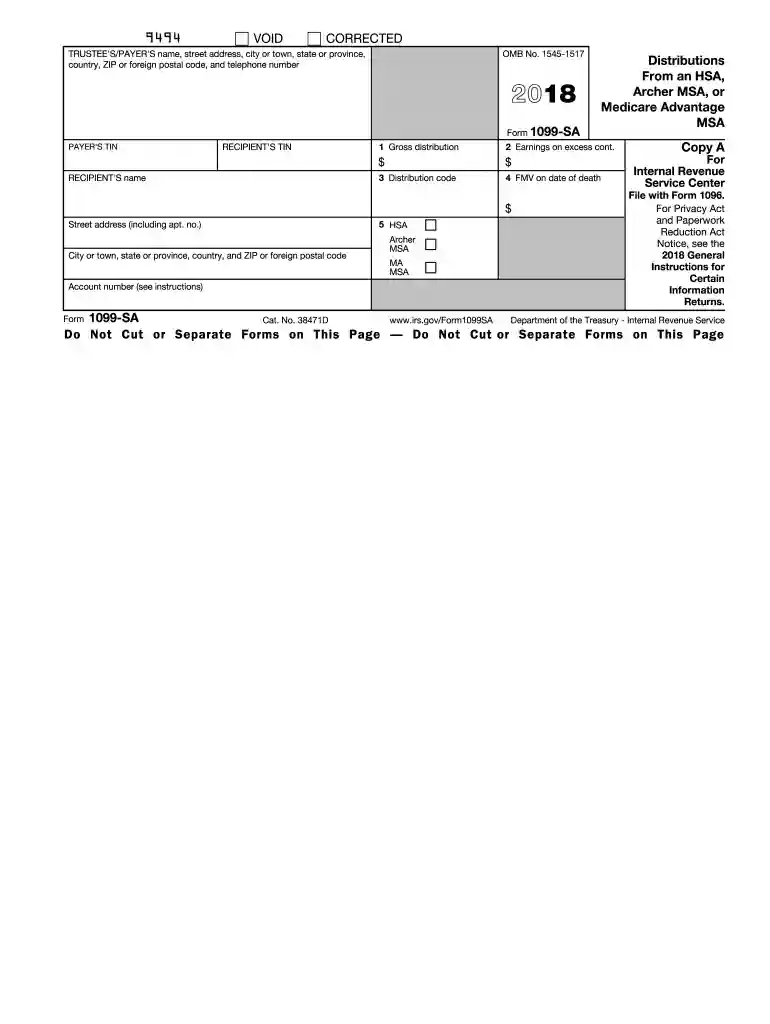
Type text, add images, blackout confidential details, add comments, highlights and more.

Draw your signature, type it, upload its image, or use your mobile device as a signature pad.

Send 1099 msa via email, link, or fax. You can also download it, export it or print it out.
Form 1099-SA, issued by the IRS, is a document used to report distributions from Health Savings Accounts (HSAs), Archer Medical Savings Accounts (MSAs), or Medicare Advantage MSAs. It is critical for individuals and trustees to understand the purpose of this form, as it delineates which portions of distributions are taxable and which are not. Distributions for qualified medical expenses remain tax-free, whereas non-qualified distributions may be subject to income tax and penalties.
To accurately report Form 1099-SA distributions on Form 1040, account holders must first ascertain whether their distributions were used for qualified medical expenses. Here’s a step-by-step process:
Correctly filling out the relevant sections of Form 1040 demands careful attention to detail:
Several key terms arise when dealing with Form 1099-SA:
Adhering to IRS guidelines ensures full compliance and avoids unnecessary penalties:
Timeliness is essential in the tax filing process:
Form 1099-SA is issued by the trustees or custodians of an HSA, Archer MSA, or Medicare Advantage MSA. Compliance with issuer obligations is just as vital as the recipient’s responsibility, ensuring all parties accurately fulfill their IRS requirements to avoid penalties and ensure proper taxation legislations are followed.
We've got more versions of the 2018 1099 sa form. Select the right 2018 1099 sa version from the list and start editing it straight away!
| Versions | Form popularity | Fillable & printable |
|---|---|---|
| 2019 | 4.8 Satisfied (185 Votes) | |
| 2018 | 4.2 Satisfied (85 Votes) | |
| 2017 | 4.3 Satisfied (226 Votes) | |
| 2016 | 4.3 Satisfied (143 Votes) | |
| 2015 | 4 Satisfied (59 Votes) | |
| 2014 | 4.2 Satisfied (58 Votes) | |
| 2013 | 4.3 Satisfied (42 Votes) | |
| 2012 | 4.3 Satisfied (27 Votes) | |
| 2011 | 4.3 Satisfied (62 Votes) | |
| 2010 | 4 Satisfied (26 Votes) |
At DocHub, your data security is our priority. We follow HIPAA, SOC2, GDPR, and other standards, so you can work on your documents with confidence.
Feb 17, 2017 S. Securities and Exchange Commission within 120 days after the end of the fiscal year to which this report relates.Read more
Health Savings Account (HSA) contributions are reported to the account owner on Form 5498-SA. This form is issued by the financial institution.Read more
File Form 1099-SA, Distributions From an HSA, Archer MSA, or Medicare Advantage MSA, to report distributions made from a health savings account (HSA).Read more


