




01. Edit your form online
Type text, add images, blackout confidential details, add comments, highlights and more.

Type text, add images, blackout confidential details, add comments, highlights and more.

Draw your signature, type it, upload its image, or use your mobile device as a signature pad.

Send it via email, link, or fax. You can also download it, export it or print it out.
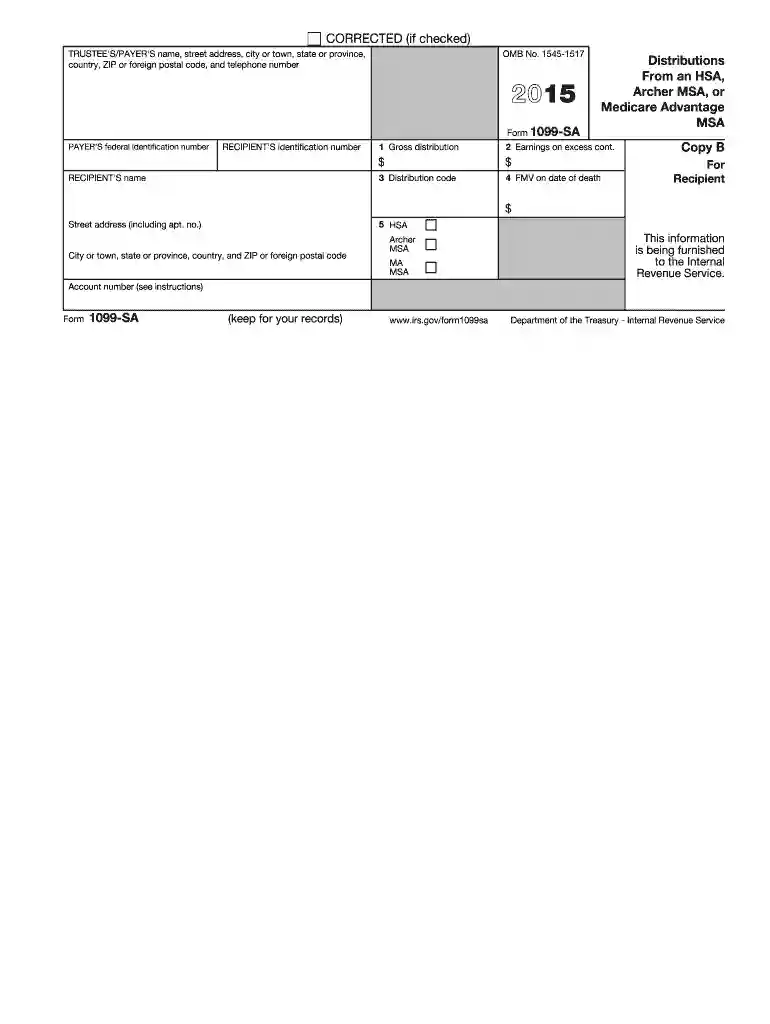
The 2-SA form is a crucial tax document used to report distributions from Health Savings Accounts (HSAs), Archer Medical Savings Accounts (MSAs), and Medicare Advantage MSAs. These accounts are designed to provide tax-advantaged savings for medical expenses. Understanding this form is essential for accurately reporting these distributions to the IRS, as they can have implications on taxable income and potential penalties if not reported correctly. The document is not intended to be filed with the IRS; rather, it provides necessary information for taxpayers to accurately complete their income tax returns.
The IRS provides specific guidelines on how to interpret and use the information from the 1099-SA form. Key instructions relate to recognizing different types of distributions and understanding their implications on taxable income. Taxpayers should consult the IRS instructions for Form 8889 for detailed guidance on reporting distributions from HSAs and MSAs.
Failure to appropriately report distributions from HSAs or MSAs can result in penalties. Unreported distributions may be subject to income tax, and non-qualified distributions can incur additional penalties. It's crucial to ensure all distributions are accurately documented and reported in compliance with IRS regulations.
The 1099-SA form is predominantly used by individuals with HSAs, MSAs, or Medicare Advantage MSAs. This includes self-employed individuals, employees with high-deductible health plans, and retirees using these accounts for medical expenses. It's also used by trustees and custodians responsible for managing these accounts and ensuring compliant distribution reporting.


These sections provide a comprehensive guide to the 2-SA Form, aiding recipients in properly managing their tax liabilities related to distributions from applicable savings accounts.
We've got more versions of the 2015 1099 sa form form. Select the right 2015 1099 sa form version from the list and start editing it straight away!
| Versions | Form popularity | Fillable & printable |
|---|---|---|
| 2019 | 4.8 Satisfied (185 Votes) | |
| 2018 | 4.2 Satisfied (85 Votes) | |
| 2017 | 4.3 Satisfied (226 Votes) | |
| 2016 | 4.3 Satisfied (143 Votes) | |
| 2015 | 4 Satisfied (59 Votes) | |
| 2014 | 4.2 Satisfied (58 Votes) | |
| 2013 | 4.3 Satisfied (42 Votes) | |
| 2012 | 4.3 Satisfied (27 Votes) | |
| 2011 | 4.3 Satisfied (62 Votes) | |
| 2010 | 4 Satisfied (26 Votes) |
Sure, electronically drawing your signature is appropriate, but only if you use a tool that complies with industry regulations and policies. Consider DocHub, which ensures eSignature validity under ESIGN and UETA requirements. All you need to approve your 2015 1099 sa form electronically is an account with DocHub and an internet connection. After you open your file in our editor, click Sign and choose the Draw option.
With a swift editing system like DocHub, you do not require anything but a web browser and internet connection to modify your 2015 1099 sa form on the internet easily. Add your file or find the relevant form in DocHub’s catalog, open our editor with one click, and complete it digitally. To edit your forms at any time, sign up a free account with DocHub.
At DocHub, your data security is our priority. We follow HIPAA, SOC2, GDPR, and other standards, so you can work on your documents with confidence.
To complete Form 1099-SA, use: the 2015 General Instructions for Certain Information. Returns, and. the 2015 Instructions for Forms 1099-SA and 5498-SA.Read more
Form 1099-SA. Youll receive Form 1099-SA from. HealthEquity to report total distributions from your HSA in 2014. Enter the distributions shown in Box 1 on Form.Read more


