1099 saDocHubcom 2017 form-2026

Get Form
payer name cont'd Preview on Page 1

Here's how it works

01. Edit your payer name cont'd online
Type text, add images, blackout confidential details, add comments, highlights and more.

02. Sign it in a few clicks
Draw your signature, type it, upload its image, or use your mobile device as a signature pad.

03. Share your form with others
Send payer name cont'd 1099 sa via email, link, or fax. You can also download it, export it or print it out.

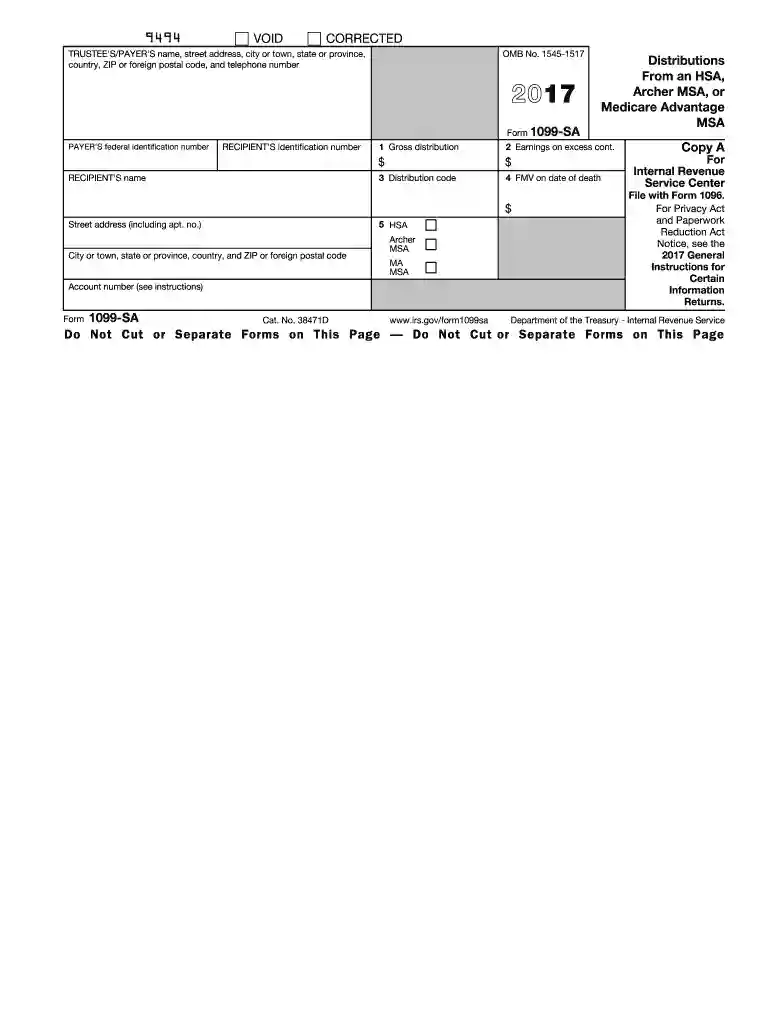
Definition and Meaning of Form 1099-SA

The 2017 Form 1099-SA is a tax document utilized for reporting distributions from Health Savings Accounts (HSA), Archer Medical Savings Accounts (MSA), or Medicare Advantage MSAs. The form plays a critical role in tracking tax liabilities associated with these accounts, especially when the funds are used for healthcare expenses. Understanding the meaning and implications of this form is essential for both account holders and tax preparers.

  • Distributions: A distribution, as indicated on Form 1099-SA, refers to any withdrawal or usage of funds from the tax-advantaged savings account. It includes cash payouts and payments made directly to medical providers.
  • Tax Implications: The form specifies whether the distributions are qualified expenses, which are generally tax-free if used for eligible medical costs, or non-qualified, which may incur taxes and penalties.
  • Payer Responsibilities: Institutions or individuals handling these HSAs or MSAs must report distributions accurately to the IRS and provide copies to account holders, highlighting their responsibility for tax compliance.

How to Obtain the 1099-SA Form

Obtaining the 2017 Form 1099-SA can be done through several straightforward methods. Each option ensures you have the correct documentation to report your medical distributions for the year.

  1. From Your HSA or MSA Provider: Financial institutions managing health accounts commonly send Form 1099-SA to account holders if distributions were made during the year. If you do not receive it, contact your provider to request a copy.
  2. IRS Website: You can also download the 1099-SA form directly from the IRS website. However, ensure you select the version pertinent to the tax year 2017 for accurate reporting.
  3. Tax Preparation Software: If you are using tax software such as TurboTax or QuickBooks, you may find the form available within the software's suite of tools, facilitating smoother tax filing.
  4. Professional Tax Preparer: If you work with a tax professional, they can help you retrieve the form as part of your tax filing process.

Steps to Complete the 1099-SA Form

Completing the 2017 Form 1099-SA requires careful attention to detail to ensure compliance with IRS regulations. Here are the essential steps involved in filling out this form accurately.

  1. Payer Information: Enter the payer's name, address, and taxpayer identification number (TIN) in the appropriate fields.
  2. Recipient Information: Fill out the recipient's name, address, and TIN. This information must be accurate, as the IRS uses it to identify both parties correctly.
  3. Distribution Information: Here, input the total gross distribution from the account. This amount must reflect all withdrawals reported for the calendar year.
  4. Taxable Amount: Specify the amount of the distribution that qualifies for tax exemption versus the amount liable for taxes. This distinction is crucial for determining tax obligations.
  5. Box Selections: Mark the appropriate boxes that indicate whether the distribution was a normal payment, a death benefit, or for other specified reasons.
  6. Issuer Signature: Ensure the form is signed and dated by the issuer or an authorized representative to validate the information.

Important Terms Related to Form 1099-SA

Understanding key terminology associated with Form 1099-SA helps clarify its usage and significance in tax reporting.

  • Gross Distribution: This is the total amount taken from the account during the reporting year before any adjustments or tax considerations.
  • Qualified Medical Expenses: Expenses that meet the IRS criteria for being covered under HSAs or MSAs, typically including costs for prescriptions, co-payments, and certain medical services.
  • Recipient: The individual or entity receiving the distribution, who is responsible for reporting the income on their tax return.
  • Payer Name Cont’d: This refers to continuing fields on the form where additional payer information is provided if the payer operates under multiple legal names or accounts.

Legal Use of the 1099-SA Form

The 2017 Form 1099-SA must be employed in a legally compliant manner to fulfill IRS requirements for tax reporting and documentation.

  • Tax Reporting Requirement: All distributions from HSA or MSA accounts must be reported accurately, which helps the IRS track tax liabilities more efficiently.
  • Timeliness: The form should be filed by the deadline set forth by the IRS, usually by the end of January following the tax year, to avoid penalties.
  • Penalties for Misreporting: Failure to accurately report distributions may result in financial penalties for both the payer and the recipient. It is crucial that both parties review the form for accuracy before submission.

Filing Deadlines and Important Dates

Filing deadlines for Form 1099-SA are critical in ensuring compliance with IRS regulations. Awareness of these dates allows both payers and recipients to manage their tax obligations effectively.

  • Form Distribution Deadline: The 2017 Form 1099-SA must be sent to recipients by January 31, 2018.
  • IRS Submission Deadline: The form must be filed with the IRS by February 28, 2018, if submitting by mail, or by March 31, 2018, if filing electronically.
  • Penalties: Missing these deadlines can subject you to potential penalties, which can accumulate per form not filed on time.

Examples of Using the 1099-SA Form

The practical application of the 2017 Form 1099-SA comes into play in various scenarios depending on the account holder's circumstances.

  • Medical Expenses Usage: If an individual withdrew money from their HSA to pay for a qualified medical expense, they would use the form to report this transaction on their tax return to avoid tax penalties.
  • Non-Qualified Expenses: Conversely, if the funds were used for non-qualified medical expenses or personal use, the recipients must indicate this on their tax return, incurring tax implications.
  • Multiple Distributions: In situations where multiple withdrawals occurred throughout the year, the total would be lumped together on the form to simplify tax reporting.

By understanding these key components of the 1099-SA form, account holders can adeptly navigate their tax reporting responsibilities while maximizing their compliance with IRS guidelines.

See more 1099 saDocHubcom 2017 form versions

We've got more versions of the 1099 saDocHubcom 2017 form form. Select the right 1099 saDocHubcom 2017 form version from the list and start editing it straight away!
Versions Form popularity Fillable & printable
2019 4.8 Satisfied (185 Votes)
2018 4.2 Satisfied (85 Votes)
2017 4.3 Satisfied (226 Votes)
2016 4.3 Satisfied (143 Votes)
2015 4 Satisfied (59 Votes)
2014 4.2 Satisfied (58 Votes)
2013 4.3 Satisfied (42 Votes)
2012 4.3 Satisfied (27 Votes)
2011 4.3 Satisfied (62 Votes)
2010 4 Satisfied (26 Votes)
be ready to get more

Complete this form in 5 minutes or less

Get form

Got questions?

We have answers to the most popular questions from our customers. If you can't find an answer to your question, please contact us.
Contact us
Phone. Call our automated Self-Service Line at 1-866-333-4606 and follow the instructions to get your Form 1099G information or to request that your Form 1099G be mailed to you. This option is available 24 hours a day, 7 days a week.
A: Form 1099-R reports distributions taken from your IRA, Roth IRA, SEP, SIMPLE, or 403(b) account during 2017. This includes IRA distributions that were taken as a rollover. Trustee-to-trustee transfers are not considered distributions and therefore are not reportable to the IRS.
Often, the IRS will recalculate your tax return by including the missing income and determining the amount of tax they think that you owe. This can include penalties and interest.
Taxpayers should first contact the employer, payer or issuing agency directly for copies. Taxpayers who havent received a W-2 or Form 1099 should contact the employer, payer or issuing agency and request a copy of the missing document or a corrected document.
So just open up the Form 1099-NEC from the IRS website, and start filling it in on your browser. (Already downloaded the form? You can open it in a browser by right-clicking on the file and selecting Open with) Once youve filled out your information, you can print the document the same way you would any other file.
be ready to get more

Complete this form in 5 minutes or less

Get form

People also ask

Sign in to your account. Download your 1099 or 1042S tax form in your Social Security account. If you live outside the United States and cant access your form online, contact a Federal Benefits Unit for help.
Obtain a copy of Form 1099-S from the Internal Revenue Service (IRS) website or from an authorized vendor. The form is available in PDF format, which you can either print and fill out manually or complete electronically using appropriate software.
Dont worrythere are easy ways you can retrieve the forms you need to file. If you worked as an independent contractor or received any other payment that needs to be reported on a 1099, then you should docHub out to the person or business that paid you. The payer should send you a copy of your 1099 by January 31st.