




01. Edit your form online
Type text, add images, blackout confidential details, add comments, highlights and more.

Type text, add images, blackout confidential details, add comments, highlights and more.

Draw your signature, type it, upload its image, or use your mobile device as a signature pad.

Send it via email, link, or fax. You can also download it, export it or print it out.
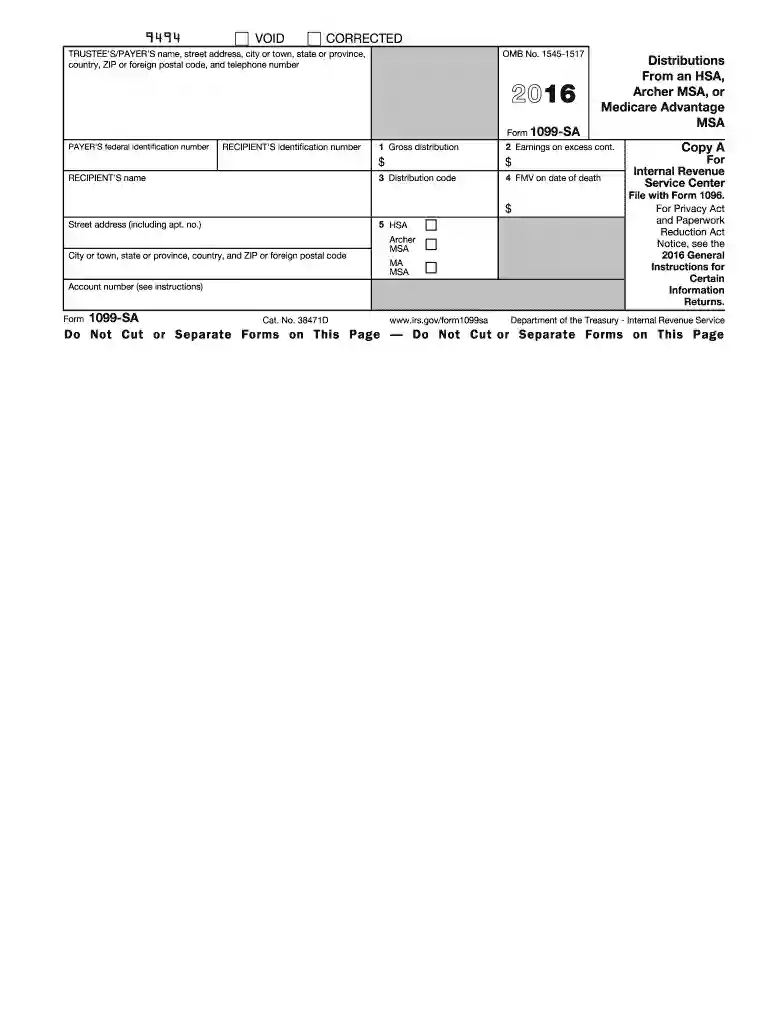
The 2016 Form 1099-SA is designed to report distributions from Health Savings Accounts (HSA), Archer Medical Savings Accounts (MSA), or Medicare Advantage MSAs. These forms serve as documentation both for the payer, typically a financial institution, and the recipient, who may be an individual with an HSA or similar account. The key role of this form is to inform recipients about the total distributions received during the year, which must be reported on their tax returns.
This form specifies whether distributions were used for qualified medical expenses and may indicate taxable amounts. If the distributions were not used for eligible expenses, they could be subject to taxes or penalties. Another critical aspect of the 1099-SA is to provide guidance for tax reporting, making it a vital component of tax compliance for individuals with specific savings accounts designed for medical expenses.
The 2016 Form 1099-SA contains several crucial components:
Box 1: Gross Distribution - This shows the total amount distributed from the savings account during the year.
Box 2: Earnings on Excess Contributions - Reflects any gains resulting from excess contributions, which are taxable.
Box 3: Distribution Code - This code explains the nature of the distribution. Codes include details, such as normal distributions, excess contributions, or disability-related distributions.
Box 4: Fair Market Value at the End of the Year - Offers a snapshot of the account's balance and helps track the total value for the year.
Box 5: Type of Account - Differentiates between HSAs, MSAs, or Medicare Advantage MSAs. This categorization is essential as different rules and limits apply to each account type.
Each of these elements ensures that both the IRS and the taxpayer understand the amounts distributed and the reasons behind them, all crucial for accurate tax reporting.
Completing the 2016 Form 1099-SA involves multiple straightforward steps:
Gather Information - Collect all details regarding distributions from your health savings account, including dates, amounts, and corresponding expenses.
Determine Distribution Codes - Use the distribution codes to classify each distribution type, which might require reviewing account statements or consulting a tax advisor.
Calculate Total Distributions - Sum all distributions over the year for reporting in Box 1.
Review Account Type - Different types of accounts are reported separately; confirm whether your account is an HSA, MSA, or Medicare Advantage MSA.
Assess Tax Obligations - Consult IRS guidelines to understand if any distributions are taxable or need reporting in additional forms such as Form 8889 with your tax return.
Ensuring accuracy in these steps is vital to prevent issues with tax returns, which could result in penalties or additional taxes owed later.
The primary users of Form 1099-SA are:
Account Trustees/Payers - Typically banks or financial institutions responsible for issuing the form.
Individual Account Holders - Anyone with distributions from an HSA, MSA, or Medicare Advantage MSA needs this form for tax filing.
Tax Professionals - They assist clients in ensuring all distributions are accurately reported and compliant with IRS rules.
Recipients should keep the form handy, as it's directly relevant to their annual tax filing responsibilities, particularly those involving medical and healthcare expenses deducted on Form 1040.


Realizing the legal use of Form 1099-SA entails understanding its role in tax compliance. The form is mandated by the IRS to ensure that taxpayers who have received distributions from health-related savings accounts accurately report this information on their annual tax returns.
Distributions used for qualifying medical expenses are not taxed, per IRS regulations. However, non-qualified distributions require taxpayers to include the amounts in their income, possibly subjecting them to taxes and additional penalties. Filing this form correctly ensures adherence to federal tax laws and monetarily benefits compliant taxpayers by avoiding inadvertent fines or interest on underreported income.
The IRS provides specific guidelines regarding the use and filing of Form 1099-SA:
Deadlines - Payers must furnish it to taxpayers by January 31 and to the IRS by the end of February if filing in paper format or by the end of March if filed electronically.
Corrections - If errors are found, corrected forms should be issued promptly to avoid penalties for incorrect filings.
Exceptions and Special Situations - Detailed in IRS publications, such as cases involving overcontributions or accounts held by deceased individuals.
Adhering to these guidelines ensures compliance and reduces the likelihood of audit or penalty.
January 31 - The deadline for the payer to furnish Form 1099-SA to the account holder.
February 28 - Deadline to file with the IRS in paper form.
March 31 - Deadline for electronic filing with the IRS.
Failure to meet these deadlines can lead to penalties for the payer, emphasizing the importance of timely and accurate completion.
Penalties related to non-compliance with Form 1099-SA requirements can originate from incorrect reporting, delays in furnishing forms, or inaccuracies in tax filing:
Late Filing Penalties - Starting at $50 per form for filings delinquent by up to 30 days and escalating with further delays.
Inaccuracy Penalties - Cover substantial underreporting of distributions or misuse of distribution codes without adequate justification.
Achieving compliance means diligently meeting deadlines and ensuring every report's accuracy, which effectively prevents costly and avoidable penalties.
We've got more versions of the 1099 saDocHubcom 2016 form form. Select the right 1099 saDocHubcom 2016 form version from the list and start editing it straight away!
| Versions | Form popularity | Fillable & printable |
|---|---|---|
| 2019 | 4.8 Satisfied (185 Votes) | |
| 2018 | 4.2 Satisfied (85 Votes) | |
| 2017 | 4.3 Satisfied (226 Votes) | |
| 2016 | 4.3 Satisfied (143 Votes) | |
| 2015 | 4 Satisfied (59 Votes) | |
| 2014 | 4.2 Satisfied (58 Votes) | |
| 2013 | 4.3 Satisfied (42 Votes) | |
| 2012 | 4.3 Satisfied (27 Votes) | |
| 2011 | 4.3 Satisfied (62 Votes) | |
| 2010 | 4 Satisfied (26 Votes) |
At DocHub, your data security is our priority. We follow HIPAA, SOC2, GDPR, and other standards, so you can work on your documents with confidence.
THIS PUBLICATION MAY BE CITED AS: Ray Jauny and John Parsons (2017). Delirium assessment and management: A qualitative study on aged-care nurses' experiences.
Forms. Individuals · Businesses · Order Paper Forms. Public Records Requests. Public Records Request Form · Certification for Free or Reduced Copy Fee Form.


