




01. Edit your form 4506 t 2011 online
Type text, add images, blackout confidential details, add comments, highlights and more.

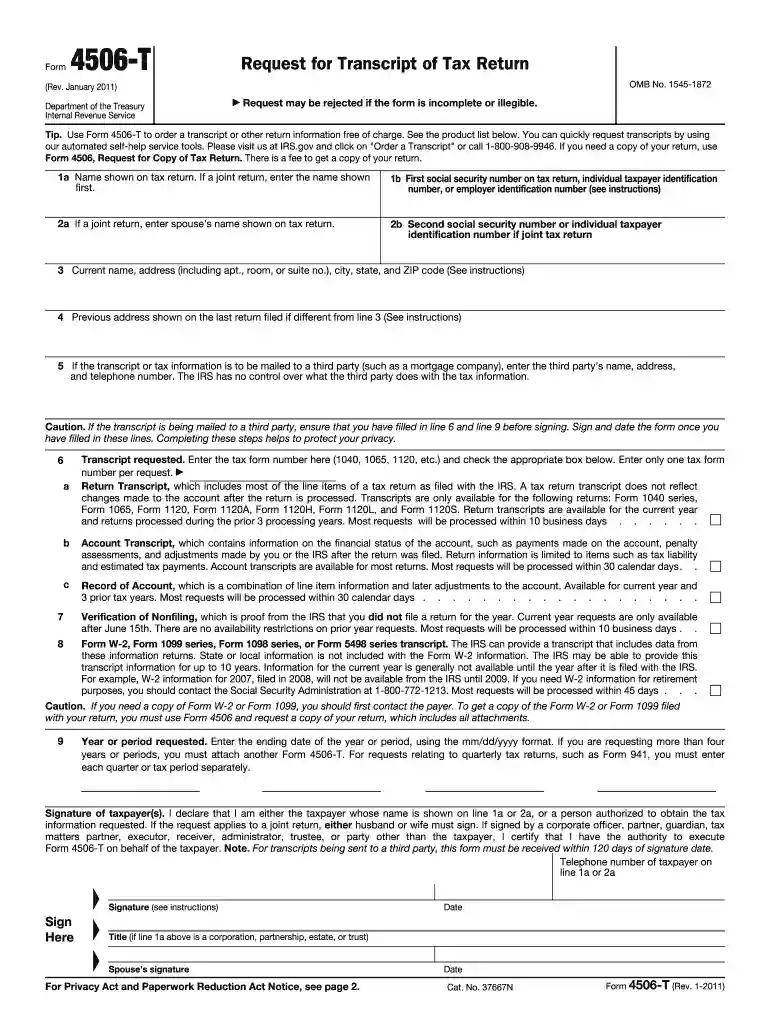
Type text, add images, blackout confidential details, add comments, highlights and more.

Draw your signature, type it, upload its image, or use your mobile device as a signature pad.

Send 2011 tax return transcript via email, link, or fax. You can also download it, export it or print it out.
The 2 form, officially recognized by the IRS, is used by taxpayers to request a copy of their tax return transcript from a previous year. This form is particularly instrumental for financial audits, loan applications, or verification of past income details. The transcript requested can include various types of documents, such as the tax return transcript, which summarizes the return, and the account transcript, detailing financial transactions related to the taxpayer's account.
The 2 form is utilized when individuals or businesses need documentation of their filed tax returns. This form is often used before taking out a mortgage or student loan, as lenders usually require evidence of income verification.
Acquiring the 2 form can be done through several methods, ensuring ease of access for taxpayers.
Filling out the 2 form requires attention to detail to ensure accuracy and prevent processing delays.
Understanding the essential components of the 2 form is crucial for accurate completion and submission.
The 2 form is primarily designed to obtain official copies of tax filings, serving various legal and financial purposes.
IRS regulations and guidelines surrounding the use of the 2 form ensure standardized application and processing.
While the 2 form does not have a strict filing deadline, understanding the timeframes associated with its processing is vital.
We've got more versions of the form 4506 t 2011 form. Select the right form 4506 t 2011 version from the list and start editing it straight away!
| Versions | Form popularity | Fillable & printable |
|---|---|---|
| 2025 | 4.7 Satisfied (37 Votes) | |
| 2024 | 4.4 Satisfied (60 Votes) | |
| 2023 | 4.1 Satisfied (50 Votes) | |
| 2023 | 4.6 Satisfied (56 Votes) | |
| 2021 | 4.3 Satisfied (201 Votes) | |
| 2021 | 4.9 Satisfied (27 Votes) | |
| 2019 | 4.2 Satisfied (35 Votes) | |
| 2019 | 4.2 Satisfied (39 Votes) | |
| 2018 | 4.3 Satisfied (77 Votes) | |
| 2017 | 4.4 Satisfied (112 Votes) | |
| 2015 | 4.4 Satisfied (315 Votes) | |
| 2014 | 4.3 Satisfied (107 Votes) | |
| 2013 | 4 Satisfied (58 Votes) | |
| 2012 | 4.4 Satisfied (69 Votes) | |
| 2011 | 4 Satisfied (59 Votes) |
At DocHub, your data security is our priority. We follow HIPAA, SOC2, GDPR, and other standards, so you can work on your documents with confidence.
IC22. Income. IRS Form 4506 or Form 8821 required, but missing, inaccurate or incomplete. IC30. Income. Stability of income insufficient and/orRead more
To get a copy of the Form W-2 or Form 1099 filed with your return, you must use Form 4506 and request a copy of your return, which includes all attachments.Read more
Use Form 4506-T, Request for Transcript of. Tax Return, to request tax return transcripts, tax account information, W-2 information, 1099 information,Read more


