




01. Edit your 14039 form online
Type text, add images, blackout confidential details, add comments, highlights and more.

Type text, add images, blackout confidential details, add comments, highlights and more.

Draw your signature, type it, upload its image, or use your mobile device as a signature pad.

Send 14039 via email, link, or fax. You can also download it, export it or print it out.
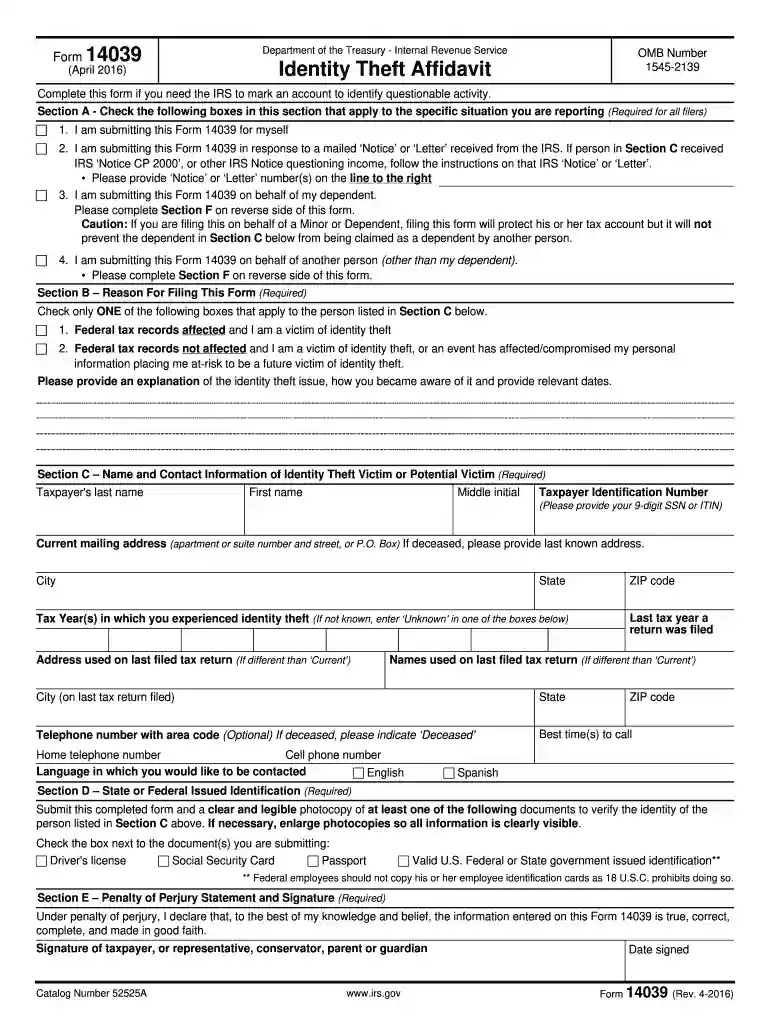
IRS Form 14039, known as the Identity Theft Affidavit, is utilized to alert the IRS that your personal information may be compromised and used for fraudulent tax filing. It's a critical tool for individuals suspecting identity theft affecting their tax status. The form also supports requests to place an alert on your IRS account, aiming to prevent further unauthorized activity.
IRS Form 14039 is essential for protecting taxpayers from identity theft repercussions. Filing this form is crucial for individuals who've had their Social Security numbers misused or have experienced other identity theft forms impacting their federal tax records. Once submitted, it helps the IRS take necessary steps to secure your tax account and investigate suspicious activities.
The Identity Theft Affidavit can be downloaded directly from the IRS website. This ensures you are accessing the most current version without potential third-party inaccuracies.
Additionally, you can request the form by contacting the IRS Identity Protection Specialized Unit. They can provide guidance and ensure you receive the correct form version tailored to your situation.
Personal Information: Provide your name, last four digits of your Social Security number, and contact details.
Identity Theft Details: Explain the specific identity theft issue, such as unauthorized tax returns filed under your Social Security number.
Supporting Documentation: Attach copies of valid identification, such as your passport or driver's license, to confirm your identity.
Submission: Complete and sign the form, then mail or fax it to the IRS as instructed on the form. Follow up if you do not receive a response within the expected timeframe.
The form is primarily used by:
Attach copies of government-issued identification documents to validate your identity. This supports the IRS's measures in authenticating and rectifying your situation.
It's vital to adhere to IRS instructions for accurately completing and submitting the form. Failure to comply might delay the resolution of identity theft issues or lead to further complications.
While there are no direct penalties for failing to file Form 14039, neglecting to address identity theft promptly can lead to tax discrepancies and potential legal issues.
Consider hypothetical scenarios:
Case Study 1: Jane Doe receives a notice from the IRS about multiple tax returns filed under her Social Security number. She uses Form 14039 to report this discrepancy and prevent further fraudulent filings.
Case Study 2: John Smith discovers tax records under his dependent's Social Security number that he did not authorize. By submitting the form on behalf of his child, he aims to protect their identity and correct the records.
There is no strict deadline for filing IRS Form 14039; however, it is essential to submit the form promptly once identity theft is suspected to prevent further unauthorized tax activity. Immediate action facilitates quicker resolution and protection of your tax records.
We've got more versions of the 14039 form form. Select the right 14039 form version from the list and start editing it straight away!
| Versions | Form popularity | Fillable & printable |
|---|---|---|
| 2024 | 4.4 Satisfied (34 Votes) | |
| 2023 | 4.1 Satisfied (26 Votes) | |
| 2022 | 4.4 Satisfied (50 Votes) | |
| 2022 | 4.8 Satisfied (43 Votes) | |
| 2021 | 4.9 Satisfied (42 Votes) | |
| 2020 | 4.4 Satisfied (128 Votes) | |
| 2017 | 4.1 Satisfied (52 Votes) | |
| 2016 | 4.3 Satisfied (174 Votes) | |
| 2014 | 4 Satisfied (36 Votes) | |
| 2012 | 4.4 Satisfied (32 Votes) | |
| 2011 | 4 Satisfied (56 Votes) | |
| 2009 | 4.4 Satisfied (63 Votes) |
At DocHub, your data security is our priority. We follow HIPAA, SOC2, GDPR, and other standards, so you can work on your documents with confidence.




A signed copy of the IRS Form 14039 Identity Theft Affidavit if one was submitted to the IRS. If the individual did not keep a copy of Form 14039 or the IRSRead more
Jan 19, 2017 Also, fill out and submit the IRS Form 14039, Identity Theft Affidavit. Please write legibly and follow the directions on the back of theRead more
This affidavit is for victims of identity theft. To avoid delays do not use this form if you have already filed a Form 14039 for this incident.Read more


