




01. Edit your form 14039 online
Type text, add images, blackout confidential details, add comments, highlights and more.

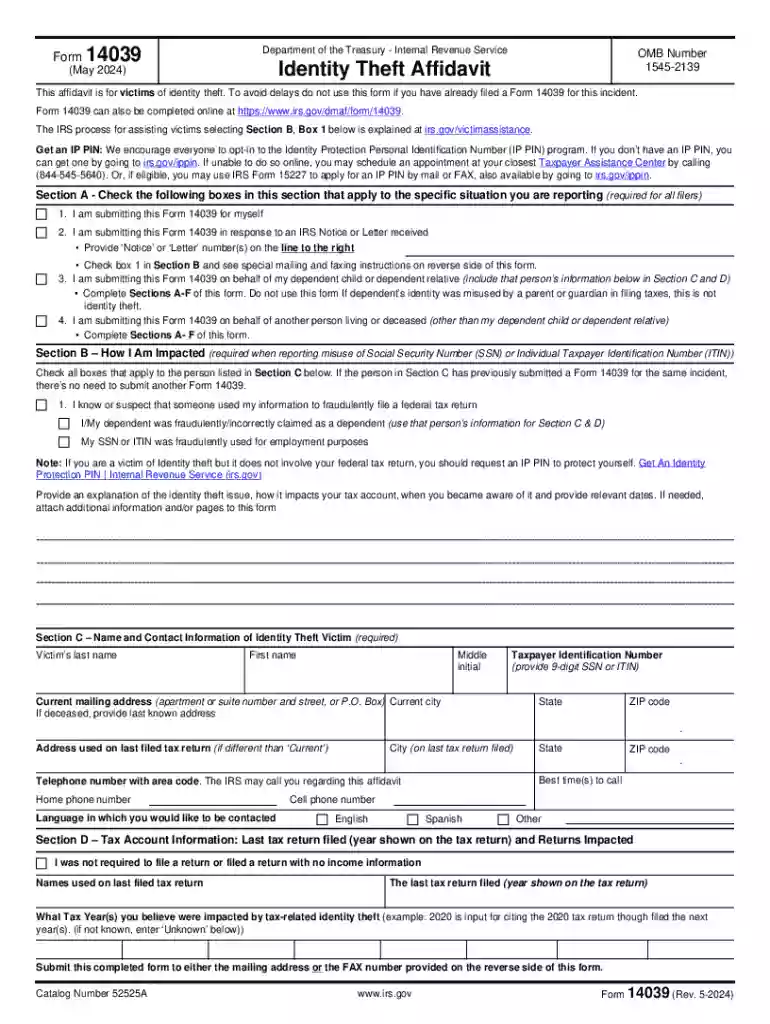
Type text, add images, blackout confidential details, add comments, highlights and more.

Draw your signature, type it, upload its image, or use your mobile device as a signature pad.

Send 14039 via email, link, or fax. You can also download it, export it or print it out.
IRS Form 14039, known as the Identity Theft Affidavit Form, serves as a critical document for taxpayers who have become victims of identity theft. It is specifically used to report incidents where an individual's Social Security Number (SSN) or Individual Taxpayer Identification Number (ITIN) has been misused. By submitting this form, individuals alert the IRS about unauthorized attempts to file a tax return or to collect a refund in their name. The form aids the IRS in documenting the identity theft case, allowing them to investigate the issue and adjust the taxpayer's account to reflect rightful tax liabilities.
Obtaining IRS Form 14039 is relatively straightforward, and it can be accessed through several channels:
Once the form is acquired, it is crucial to read through the instructions carefully to ensure a complete and accurate submission.
Completing Form 14039 involves a series of detailed steps to ensure that the report of identity theft is accurate and comprehensive:
There are several ways to submit IRS Form 14039, providing flexibility based on individual preferences:
The IRS provides comprehensive guidelines to assist taxpayers in accurately completing Form 14039. These guidelines include:
The guidelines are critical for ensuring that the form is filled out correctly and efficiently, minimizing delays in the IRS's response.
Form 14039 includes several key sections that cover a range of information necessary to process an identity theft claim:
Each section must be appropriately completed to ensure a valid submission.
Submitting Form 14039 requires specific supporting documentation to verify your identity and status as a victim of identity theft:
Gathering these documents beforehand accelerates the form submission process.
Failure to submit IRS Form 14039 when notified of identity theft can result in complications:
Addressing identity theft swiftly through Form 14039 helps mitigate these risks and facilitates the correction of affected tax records.
We've got more versions of the form 14039 form. Select the right form 14039 version from the list and start editing it straight away!
| Versions | Form popularity | Fillable & printable |
|---|---|---|
| 2024 | 4.4 Satisfied (34 Votes) | |
| 2023 | 4.1 Satisfied (26 Votes) | |
| 2022 | 4.4 Satisfied (50 Votes) | |
| 2022 | 4.8 Satisfied (43 Votes) | |
| 2021 | 4.9 Satisfied (42 Votes) | |
| 2020 | 4.4 Satisfied (128 Votes) | |
| 2017 | 4.1 Satisfied (52 Votes) | |
| 2016 | 4.3 Satisfied (174 Votes) | |
| 2014 | 4 Satisfied (36 Votes) | |
| 2012 | 4.4 Satisfied (32 Votes) | |
| 2011 | 4 Satisfied (56 Votes) | |
| 2009 | 4.4 Satisfied (63 Votes) |
At DocHub, your data security is our priority. We follow HIPAA, SOC2, GDPR, and other standards, so you can work on your documents with confidence.


