




01. Edit your form 14039 online
Type text, add images, blackout confidential details, add comments, highlights and more.

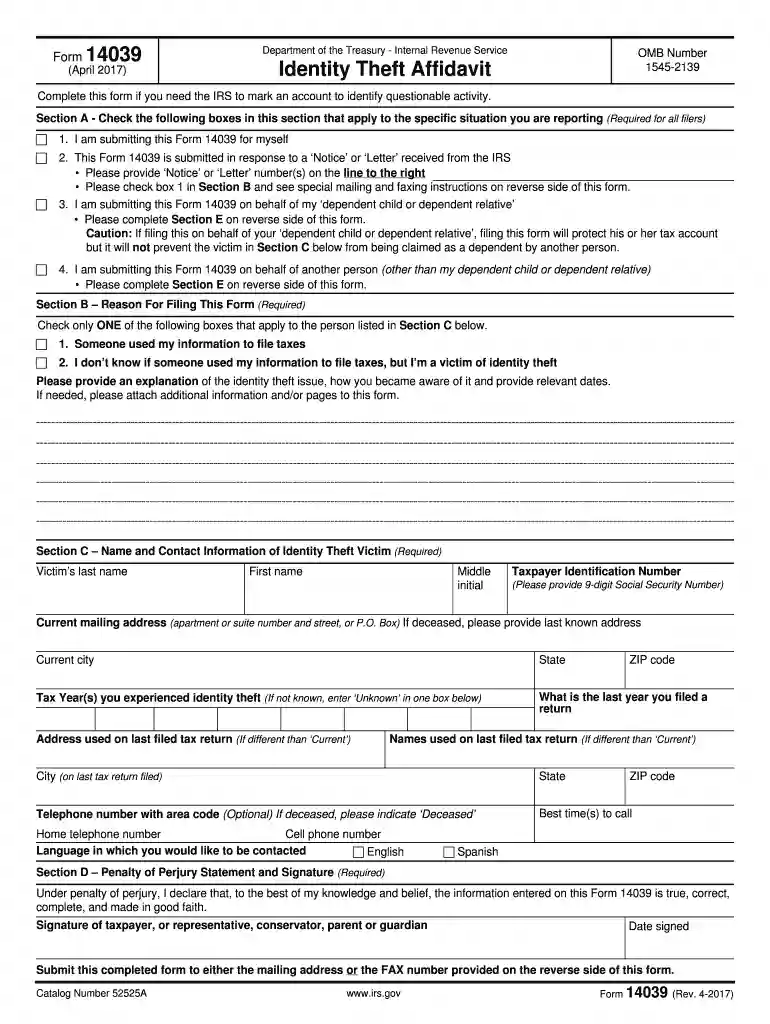
Type text, add images, blackout confidential details, add comments, highlights and more.

Draw your signature, type it, upload its image, or use your mobile device as a signature pad.

Send 14039 form via email, link, or fax. You can also download it, export it or print it out.
IRS Form 14039, known as the Identity Theft Affidavit, is a critical tool used by individuals to report potential identity theft related to tax filings. This form helps the IRS to start an investigation and take necessary measures to prevent further unauthorized use of a taxpayer's identity. When unauthorized individuals use your personal information to file a tax return or claim a refund, submitting Form 14039 signals to the IRS that they need to scrutinize the situation and prevent scammers from benefiting financially from this fraudulent activity. Ensuring you complete and submit this form correctly safeguards your tax account while assisting the IRS in documenting and resolving identity theft issues.
To complete IRS Form 14039 effectively, follow these detailed steps:
Gather Personal Information: Ensure you have all personal identifiers, such as Social Security Number (SSN) or Individual Taxpayer Identification Number (ITIN), on hand, as they are essential for filling out the form.
Specify the Type of Identity Theft: Clearly indicate whether you are a victim of identity theft with existing fraudulent activity or if you suspect that you will be a victim based on a stolen social security card or a breach.
Filling Out the Form:
Document Submission: Attach copies of any forms or correspondence you received from the IRS related to this issue and any documents that verify your identity, such as a passport or driver’s license.
Obtaining IRS Form 14039 can be done through multiple channels, ensuring accessibility for all users:
Once obtained, it’s essential to review the form thoroughly before filling it out to ensure compliance with the latest guidelines and regulatory requirements.
The IRS offers diverse submission methods to accommodate different taxpayer needs:
Using IRS Form 14039 helps protect your personal financial standing and tax history. Identity theft can lead to vast complications, such as incorrect tax assessments, delays in refunds, and unauthorized transactions under your identity. Therefore, timely submission of this form provides an official record of your proactive measures to address such issues. By doing so, you also partner with the IRS in combatting broader fraudulent activities, securing tax return integrity across the network.
Understanding associated terminologies enhances navigation through the form:
IRS guidelines on identity theft provide a framework to navigate recovery and prevent future thefts:
Real-world scenarios illustrating the use of IRS Form 14039:
By understanding these essential aspects and systematically addressing identity theft through IRS Form 14039, individuals can secure their financial identities and preserve their credibility with federal tax authorities.
We've got more versions of the form 14039 form. Select the right form 14039 version from the list and start editing it straight away!
| Versions | Form popularity | Fillable & printable |
|---|---|---|
| 2024 | 4.4 Satisfied (34 Votes) | |
| 2023 | 4.1 Satisfied (26 Votes) | |
| 2022 | 4.4 Satisfied (50 Votes) | |
| 2022 | 4.8 Satisfied (43 Votes) | |
| 2021 | 4.9 Satisfied (42 Votes) | |
| 2020 | 4.4 Satisfied (128 Votes) | |
| 2017 | 4.1 Satisfied (52 Votes) | |
| 2016 | 4.3 Satisfied (174 Votes) | |
| 2014 | 4 Satisfied (36 Votes) | |
| 2012 | 4.4 Satisfied (32 Votes) | |
| 2011 | 4 Satisfied (56 Votes) | |
| 2009 | 4.4 Satisfied (63 Votes) |
At DocHub, your data security is our priority. We follow HIPAA, SOC2, GDPR, and other standards, so you can work on your documents with confidence.



Mar 15, 2020 The Agreements include provisions regarding various matters including, but not limited to, the appointment of directors, procedures for.Read more
This affidavit is for victims of identity theft. To avoid delays do not use this form if you have already filed a Form 14039 for this incident.Read more


