




01. Edit your form online
Type text, add images, blackout confidential details, add comments, highlights and more.

Type text, add images, blackout confidential details, add comments, highlights and more.

Draw your signature, type it, upload its image, or use your mobile device as a signature pad.

Send it via email, link, or fax. You can also download it, export it or print it out.
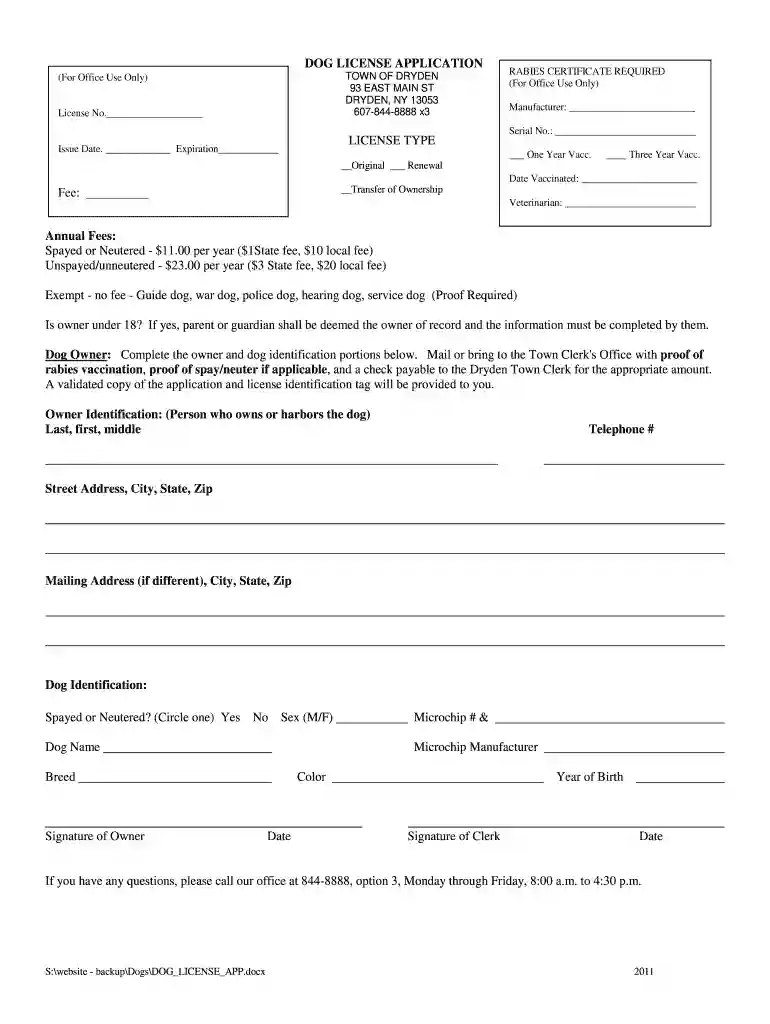
The "dog license application" is an official document required by many municipalities, including the Town of Dryden, New York, for registering a pet dog. The application serves as a record of the dog and its owner, helping local authorities manage animal control, public health, and safety. By registering their pets, owners offer proof of responsible pet ownership and comply with local laws. The application typically requires details about the dog, such as its name, breed, and proof of rabies vaccination, as well as owner information like contact details and address.
To obtain the dog license application, dog owners typically need to visit their local municipality's website or office. For instance, in the Town of Dryden, the application can be downloaded from the official town website or picked up at the Town Clerk's Office. Some municipalities may offer an online submission option, simplifying the process by allowing owners to complete and file the application digitally.
Filling out the dog license application involves several steps to ensure accuracy and compliance:
Collect Necessary Documents: Gather proof of rabies vaccination, spay/neuter status, and any prior licenses if applicable.
Fill in Owner Information: Provide accurate details such as name, address, and contact number.
Complete Dog Details: Include the dog's name, breed, age, and any distinguishing features.
Attach Required Proofs: Enclose documentation for vaccination and sterilization as these are often mandatory.
Review and Submit: Double-check the form for accuracy before submitting it to the Town Clerk's Office or via the designated online platform.
The dog license application helps municipalities keep track of pet populations, ensuring dogs are vaccinated against rabies to maintain public safety. Licensed dogs can be more easily reunited with their owners if lost, reducing the burden on animal shelters. Moreover, licensing fees often contribute to community services like dog parks and responsible pet ownership programs.
Typically, individuals who own dogs within a municipal jurisdiction are required to use this application. It is particularly relevant for new dog owners, those who have moved to a new area, or individuals whose dog's license is due for renewal. Ensuring compliance with local regulations about dog licensing is crucial for all pet owners.


Important components of the application usually include sections for dog and owner identification, proof of rabies vaccination, and payment information. Rabies vaccination certificates and proof of spaying/neutering are essential attachments, confirming the dog meets health standards and the owner qualifies for any reduced fees for altered pets. Payment options and instructions are also provided, detailing acceptable methods like checks or credit card payments.
While the basic structure of a dog license application is similar across different regions, state-specific laws can influence fees, submission methods, and renewal schedules. For example, the rabies vaccination validity period may differ, affecting how frequently an owner must update the license. It is crucial for dog owners to check local regulations to avoid non-compliance.
Dog licensing is legally mandated in most areas to promote public health and safety. Failure to comply with these regulations can result in fines or other penalties. The license acts as an official record proving the owner's adherence to vaccination laws, making it a critical aspect of owning a dog. Additionally, licensing contributes to the containment of disease outbreaks and supports community health initiatives.
In real-world scenarios, the dog license application might be used by a family that just adopted a new pet. They would complete the application as part of their responsibilities, register the dog with their local town, and ensure all vaccinations are up to date. Alternatively, someone moving to a new state would need to reapply for a new license in accordance with their new local laws. These examples illustrate the various contexts in which the dog license application is relevant.
We've got more versions of the dog license application form. Select the right dog license application version from the list and start editing it straight away!
| Versions | Form popularity | Fillable & printable |
|---|---|---|
| 2011 | 4.8 Satisfied (215 Votes) |
At DocHub, your data security is our priority. We follow HIPAA, SOC2, GDPR, and other standards, so you can work on your documents with confidence.
The owner of a dog 3 months of age or older may apply to the county treasurer or agent, on a form prescribed by the Department for a lifetime license.Read more
You must provide a copy of the rabies certificate to apply for a new dog license or to renew a dog license if the previous rabies certificate has expiredRead more


