







Definition & Meaning
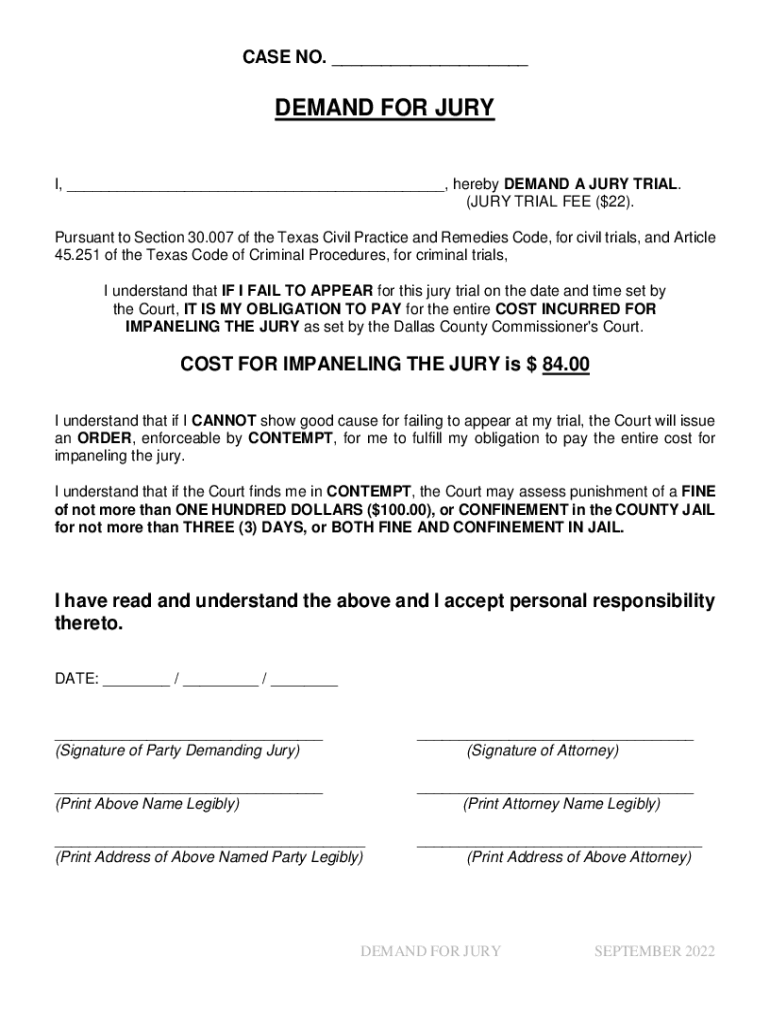
The Jury Demand Form - Goliad County is a legal document used to formally request a jury trial in Goliad County, Texas. This form signifies a party's desire to have their legal matter decided by a jury rather than a judge alone. This demand must be submitted following specific procedural guidelines outlined by Texas law. Understanding the precise definition and intended use of this form is essential for parties involved in litigation, as it impacts the trial proceedings.
How to Use the Jury Demand Form - Goliad County
To use the Jury Demand Form effectively, you must accurately complete and submit it within the legal framework established by Goliad County and the state of Texas. Here are the key steps:
-
Obtain the Form: Identify the correct version of the form applicable to your case from the Goliad County Clerk's Office.
-
Fill Out the Form: Enter your case details, including parties involved, case number, and court jurisdiction. Specify your request for a jury trial clearly.
-
Review and Confirm: Double-check all entries for accuracy and completeness, ensuring no required fields are left blank.
-
Submit the Form: File the completed form with the appropriate court clerk, either in person, by mail, or electronically if available.
-
Pay Any Fees: Be prepared to pay any associated fees as mandated by Goliad County for requesting a jury trial.
Steps to Complete the Jury Demand Form - Goliad County
Completing the Jury Demand Form requires careful attention to detail to avoid any procedural delays or rejections. Follow these steps diligently:
-
Gather Information: Collect all necessary details about your case, including the case number, the names of all involved parties, and the court where your case is being heard.
-
Fill in Personal and Case Details: Accurately input your personal information and pertinent case data.
-
Explicitly Request a Jury Trial: In the designated section, unambiguously state your intention to request a jury trial.
-
Seek Legal Counsel: If uncertain about any aspect of the form, consult with an attorney to ensure full compliance with legal requirements.
-
Verify and Sign: Check for any errors before signing. Missteps in this phase can lead to processing issues.
-
Submission: Choose the best method among online, mail, or in-person submissions, considering speed and convenience.
Who Typically Uses the Jury Demand Form - Goliad County
The form is primarily utilized by:
-
Litigants: Individuals directly involved in civil or criminal cases who desire a jury trial.
-
Attorneys: Legal representatives acting on behalf of their clients ensure proper filing within procedural timelines.
-
Legal Officials: Clerks and court officials who process these demands as part of the judicial workflow.


Important Terms Related to Jury Demand Form - Goliad County
Understanding specific terms associated with this form is vital:
-
Jury Trial: A legal proceeding where a jury makes a decision or findings of fact.
-
Contempt of Court: Possible consequence if the demanded jury trial is ignored or altered without legal authority.
-
Filing Fee: Mandatory payment required when submitting a jury demand.
Legal Use of the Jury Demand Form - Goliad County
This form's legal use is dictated by:
-
Texas Rules of Civil Procedure: They stipulate procedures and deadlines for demanding a jury trial.
-
Court Instructions: Guidelines provided by Goliad County courts that inform how to fill and file the form correctly.
-
Legal Representation: Recommended to understand nuanced legal strategies aligned with invoking a demand form.
State-Specific Rules for the Jury Demand Form - Goliad County
Goliad County's laws and regulations around jury demands encompass:
-
Timing Requirements: Define specific timeframes within which the jury demand must be submitted to be valid.
-
Fee Schedules: Detail the associated costs with making a jury demand.
-
Case Eligibility: Establish criteria related to the types of cases eligible for jury trials, varying between civil and criminal matters.
Examples of Using the Jury Demand Form - Goliad County
Consider these practical scenarios:
-
Civil Litigation: A plaintiff seeks a jury to decide on a compensation claim.
-
Criminal Defense: A defendant demands a jury under the belief it would offer a fairer trial than a judge alone.
-
Contract Disputes: A party wishes to resolve breaches involving complex issues suitable for jury deliberation.
In each case, the form acts as a central procedural tool ensuring the right to a jury trial is preserved.




