




01. Edit your form online
Type text, add images, blackout confidential details, add comments, highlights and more.

Type text, add images, blackout confidential details, add comments, highlights and more.

Draw your signature, type it, upload its image, or use your mobile device as a signature pad.

Send it via email, link, or fax. You can also download it, export it or print it out.
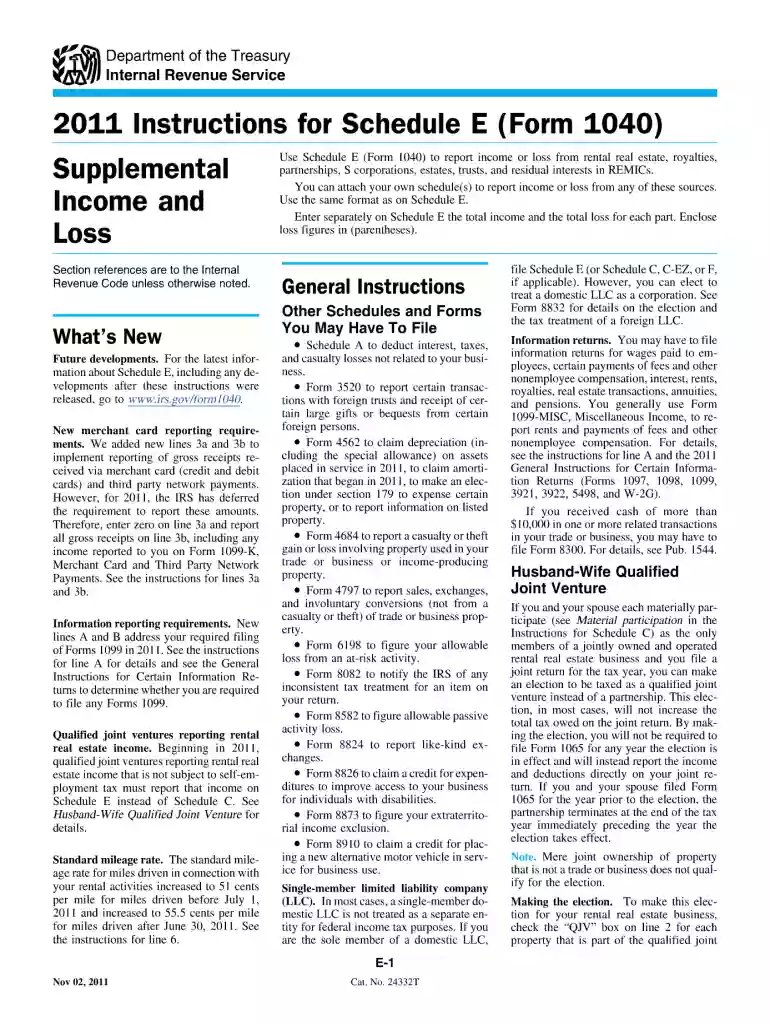
Schedule E (Form 1040) is used to report supplemental income or loss. This includes income from rental real estate, royalties, partnerships, S Corporations, and other entities like estates, trusts, and REMICs. It helps taxpayers calculate the appropriate tax liability for these supplemental income types. Understanding its specific purpose for the 2011 tax year is crucial due to any unique regulations or requirements applicable at that time.
The Schedule E for the 2011 tax year can be accessed through the IRS website in their forms archive section. Additionally, users may obtain it through tax preparation software that supports historical tax data, or by visiting local IRS offices. For those without internet access, contacting the IRS directly by telephone to request the form is another viable option.
The IRS provides comprehensive guidelines on how to accurately complete Schedule E. These include descriptions of acceptable expenses, examples of passive and non-passive activities, and instructions on how to report multiple properties or businesses.
Schedule E must be filed with Form 1040 by the tax return due date, typically April 15th, for individuals. Extensions may be available, but it is imperative to request them before the deadline to avoid penalties.
Failing to accurately report supplemental income or file Schedule E can result in penalties. These may include fines for underreporting income, interest on unpaid taxes, and potential audits by the IRS if discrepancies are noted.
Popular tax preparation software, such as TurboTax and QuickBooks, are compatible with completing Schedule E. These platforms often include guidance and automation to simplify the data entry process, ensuring compliance with all IRS requirements for the 2011 tax year.
We've got more versions of the schedule e 2011 form form. Select the right schedule e 2011 form version from the list and start editing it straight away!
| Versions | Form popularity | Fillable & printable |
|---|---|---|
| 2025 | 4.6 Satisfied (48 Votes) | |
| 2024 | 4.4 Satisfied (51 Votes) | |
| 2023 | 4.2 Satisfied (58 Votes) | |
| 2022 | 4.4 Satisfied (36 Votes) | |
| 2021 | 4.8 Satisfied (101 Votes) | |
| 2020 | 4.3 Satisfied (206 Votes) | |
| 2019 | 4.3 Satisfied (29 Votes) | |
| 2018 | 4.3 Satisfied (47 Votes) | |
| 2017 | 4.4 Satisfied (305 Votes) | |
| 2016 | 4.4 Satisfied (614 Votes) | |
| 2015 | 4 Satisfied (55 Votes) | |
| 2011 | 4.2 Satisfied (39 Votes) | |
| 2011 | 4.3 Satisfied (64 Votes) |
At DocHub, your data security is our priority. We follow HIPAA, SOC2, GDPR, and other standards, so you can work on your documents with confidence.
Schedule E (Form 1040) 2011. Attachment Sequence No. 13. Page 2. Name(s) shown on return. Do not enter name and social Schedule E (Form 1040) 2011.Read more
all tax return schedules, including but not limited to W-2s, Schedule E and any other schedules filed with the IRS.
(E) Schedule E The term Schedule E means a form or information filed by a taxpayer to report income from rental properties, royalties, partnerships, SRead more


