




01. Edit your 2014 w2c online
Type text, add images, blackout confidential details, add comments, highlights and more.

Type text, add images, blackout confidential details, add comments, highlights and more.

Draw your signature, type it, upload its image, or use your mobile device as a signature pad.

Send 2014 w2 fillable pdf via email, link, or fax. You can also download it, export it or print it out.
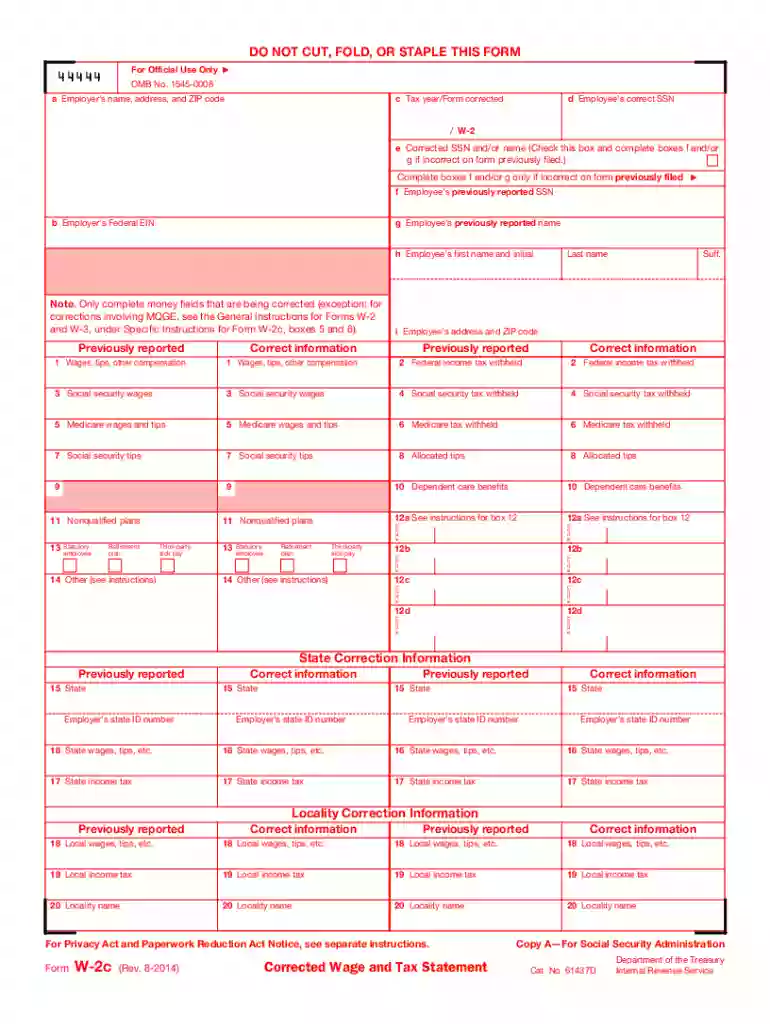
The Form W-2c, Corrected Wage and Tax Statement, is used to amend errors on previously filed W-2 forms. This form is essential when discrepancies are identified in the information initially reported to the IRS and the Social Security Administration (SSA). Common corrections made using this form include inaccurate employee names, incorrect Social Security numbers, or errors in wage or tax data.
Using the W-2c form involves a systematic process to ensure accurate correction of previously filed W-2 statements. Employers must fill out the form by entering the correct information alongside the data initially reported on the W-2 form. This parallel display clarifies the corrections made, aiding both the IRS and the SSA in updating their records efficiently.
The W-2c form can be obtained from the official IRS website, where it is available for download in a PDF format. Employers can also order physical copies of the form from the IRS by mail, though it is important to note that only the official IRS version of the form is scannable and acceptable for submission to the SSA.
Correcting inaccuracies in reported income and tax withholdings using the W-2c form is crucial to ensure the IRS and SSA have accurate records. Inaccurate wage data can lead to discrepancies in tax assessments for both the employee and employer. Additionally, it ensures employees' Social Security benefits are calculated on the correct earnings figure.
Employers who identify errors in previously filed W-2 forms typically use the W-2c form to rectify these mistakes. The form is also crucial for accounting departments responsible for ensuring accurate payroll and tax reporting. Employees may not directly use the W-2c but are affected by the changes it enacts on their records.


The IRS provides detailed instructions on how to properly complete and submit the W-2c form to correct previously reported wage and withholding details. Employers are advised to follow these guidelines to avoid penalties and ensure corrected data is recorded correctly with the SSA.
While there is no specific deadline for filing a W-2c, it is crucial to submit corrections as soon as errors are discovered. Timely submissions are necessary to avoid penalties for incorrect reporting and to ensure employee records are updated promptly, minimizing impacts on tax and Social Security benefits.
Employers must have the original W-2, accurate wage and tax details needing correction, and any supporting documentation that verifies the corrected information. This documentation ensures the process is transparent and verifiable by the IRS or SSA if required.
Employers who fail to file corrected W-2c forms when necessary may face penalties from the IRS. These penalties can arise from inaccuracies in tax reporting or delays in submitting corrected information, further underlining the importance of timeliness and accuracy in handling wage statements.
We've got more versions of the 2014 w2c form. Select the right 2014 w2c version from the list and start editing it straight away!
eSignatures are a perfect replacement for traditional signing, as they save time, effort, and costs people spend on printing, scanning, and paper delivery. You can eSign your w2c fillable form free using a trustworthy and powerful online document processing services like DocHub. It complies with major eSignature policies (ESIGN and UETA), so all documents approved there are legally binding and have the same validity as manually signed ones.
Apart from an extensive toolset for editing PDFs on mobile phones, DocHub enables you to sign your w2c fillable form along the way. Open our editor in your browser, make changes using DocHub’s toolset, and complete your editing by eSigning the finished form.
At DocHub, your data security is our priority. We follow HIPAA, SOC2, GDPR, and other standards, so you can work on your documents with confidence.




Sign Your Return . . . . . . . . . . . 22 Go to IRS.gov/Payments to see all your online payment options. You were a nonresident alien engaged in a trade or
File Forms W-2c (Corrected Wage and Tax Statement) and W-3c (Transmittal of Corrected Wage and Tax Statement) as soon as possible after you discover an error.
Mar 1, 2017 fill out. Beginning with your first payday Once you complete the online process, you Form W2c 48. Form W2G 14, 48. Form W4, Employees


