




01. Edit your 2021 form 4952 online
Type text, add images, blackout confidential details, add comments, highlights and more.

Type text, add images, blackout confidential details, add comments, highlights and more.

Draw your signature, type it, upload its image, or use your mobile device as a signature pad.

Send form 4952 via email, link, or fax. You can also download it, export it or print it out.
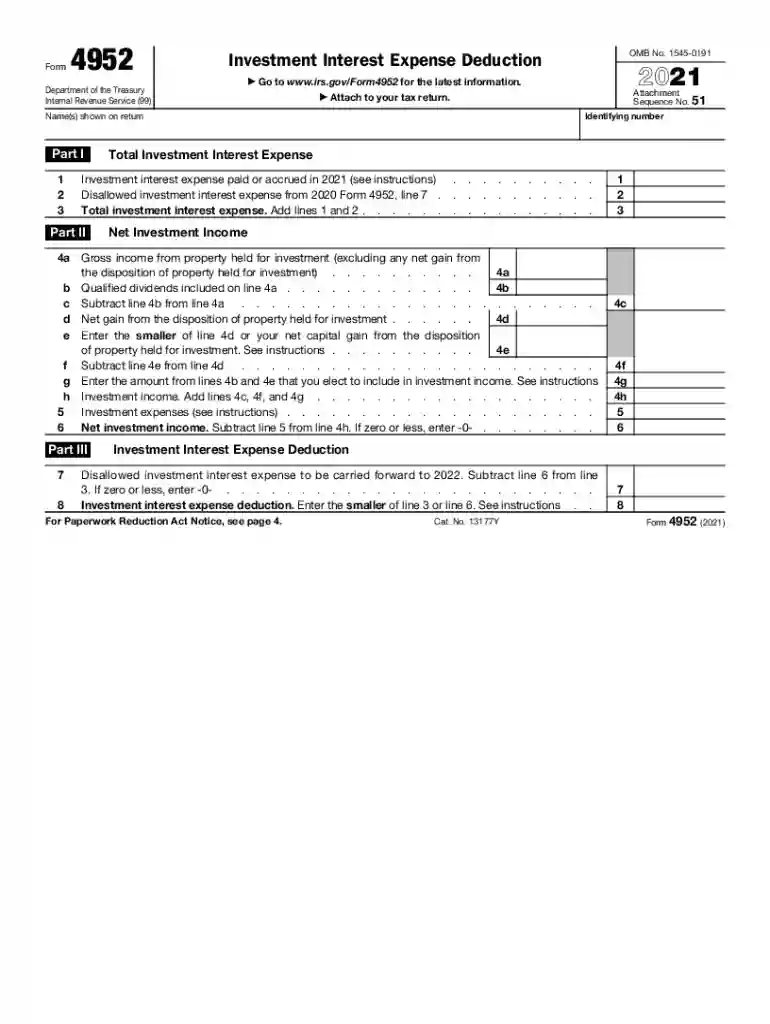
Form 4952, officially titled "Investment Interest Expense Deduction," is a tax document used by individuals, estates, and trusts to calculate the investment interest expense deduction for a given tax year. This form assists taxpayers in determining the allowable amount of investment interest expense they can deduct based on their net investment income. The deduction is crucial for those actively engaged in investment activities, as it can significantly impact the overall taxable income.
Completing Form 4952 requires careful attention to detail and an understanding of the different sections involved. Follow these steps for accurate completion:
Calculate Total Investment Interest Expenses:
Determine Net Investment Income:
Account for Disallowed Expenses:
Fill Out Sections Accordingly:
Review for Errors:
The IRS provides specific guidelines for using Form 4952, outlining the requirements for eligibility and instructions for filing. Understanding these guidelines is essential for proper compliance and maximizing deductions.
Understanding the terminology associated with Form 4952 aids in accurate completion and compliance. Here are some key terms:
Meeting deadlines for Form 4952 submission is critical to avoid penalties and ensure accurate deduction claims:
Gathering the necessary documentation before completing Form 4952 ensures accurate data entry and compliance:
Form 4952 is primarily utilized by taxpayers engaged in investment activities, aiming to optimize their deductions:


We've got more versions of the 2021 form 4952 form. Select the right 2021 form 4952 version from the list and start editing it straight away!
| Versions | Form popularity | Fillable & printable |
|---|---|---|
| 2025 | 4.7 Satisfied (57 Votes) | |
| 2024 | 4.3 Satisfied (34 Votes) | |
| 2023 | 4.6 Satisfied (51 Votes) | |
| 2022 | 4.8 Satisfied (28 Votes) | |
| 2021 | 4.8 Satisfied (149 Votes) | |
| 2020 | 4.3 Satisfied (110 Votes) | |
| 2019 | 4.2 Satisfied (32 Votes) | |
| 2018 | 4.3 Satisfied (229 Votes) | |
| 2017 | 4.4 Satisfied (182 Votes) | |
| 2016 | 4.3 Satisfied (189 Votes) | |
| 2015 | 4 Satisfied (34 Votes) | |
| 2012 | 3.9 Satisfied (48 Votes) |
At DocHub, your data security is our priority. We follow HIPAA, SOC2, GDPR, and other standards, so you can work on your documents with confidence.
Mar 30, 2026 Use this form to figure the amount of investment interest expense you can deduct for the current year and the amount you can carry forward to future years.Read more
Form 4952, investment interest expense deduction. Electronic coverage as of July 10, 2003: 1996- PDF format Online version of the print publication.


