




01. Edit your form 4952 online
Type text, add images, blackout confidential details, add comments, highlights and more.

Type text, add images, blackout confidential details, add comments, highlights and more.

Draw your signature, type it, upload its image, or use your mobile device as a signature pad.

Send it via email, link, or fax. You can also download it, export it or print it out.
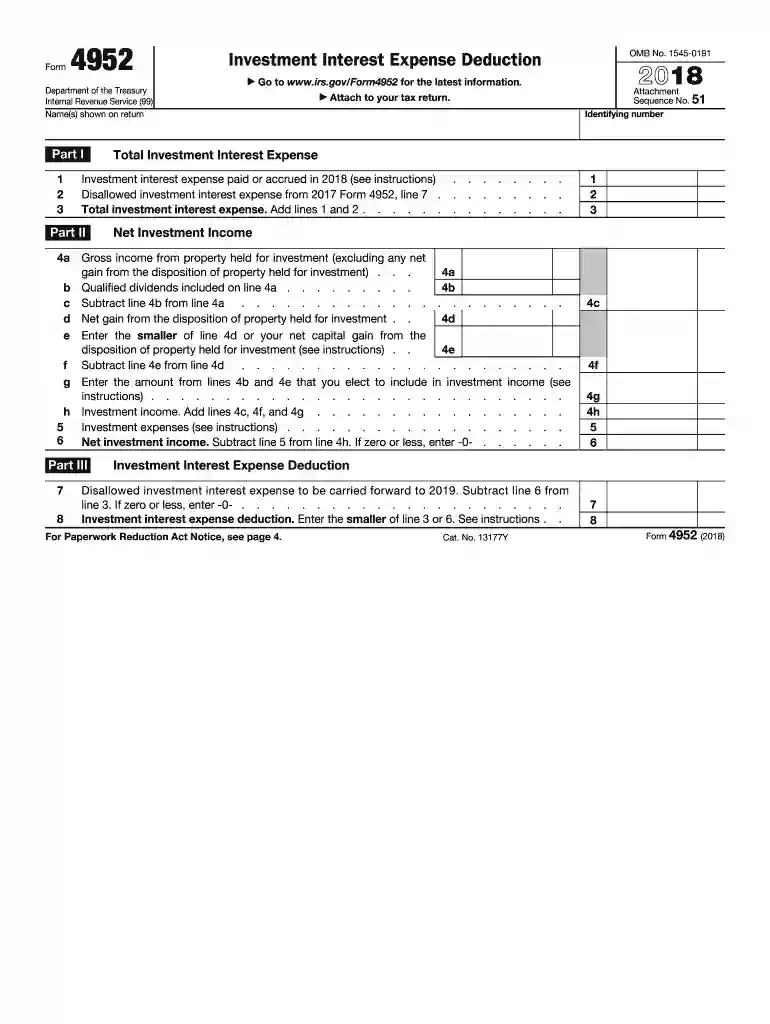
Form 4952, officially known as the "Investment Interest Expense Deduction," is a critical tax document used by individuals, estates, or trusts in the United States to determine the amount of deductible investment interest expenses for a tax year. The form is necessary to ensure that those with investment expenses can account for these with the IRS and potentially reduce their taxable income. Investment interest expense is the interest paid on loans that were used to purchase investment property which may include stocks, bonds, or real estate. By filing Form 4952, taxpayers determine how much of that interest can be deducted, based on their net investment income.
Filling out Form 4952 can be detailed, requiring several steps to ensure accuracy. Here's a streamlined approach:
Data Collection:
Calculate Total Investment Interest Expense:
Determine Net Investment Income:
Deductible Calculation:
Complete Filing:
Form 4952 can be acquired through several straightforward methods:
To fully grasp the intricacies of Form 4952, it's crucial to understand these terms:
Adherence to IRS guidelines ensures compliance and prevents errors:
Non-compliance or incorrect filing of Form 4952 can result in serious repercussions:
Form 4952 is applicable to various taxpayer scenarios:


Streamlining the completion of Form 4952 is often best achieved with reliable tax software:
We've got more versions of the form 4952 form. Select the right form 4952 version from the list and start editing it straight away!
| Versions | Form popularity | Fillable & printable |
|---|---|---|
| 2025 | 4.7 Satisfied (57 Votes) | |
| 2024 | 4.3 Satisfied (34 Votes) | |
| 2023 | 4.6 Satisfied (51 Votes) | |
| 2022 | 4.8 Satisfied (28 Votes) | |
| 2021 | 4.8 Satisfied (149 Votes) | |
| 2020 | 4.3 Satisfied (110 Votes) | |
| 2019 | 4.2 Satisfied (32 Votes) | |
| 2018 | 4.3 Satisfied (229 Votes) | |
| 2017 | 4.4 Satisfied (182 Votes) | |
| 2016 | 4.3 Satisfied (189 Votes) | |
| 2015 | 4 Satisfied (34 Votes) | |
| 2012 | 3.9 Satisfied (48 Votes) |
At DocHub, your data security is our priority. We follow HIPAA, SOC2, GDPR, and other standards, so you can work on your documents with confidence.
Mar 30, 2026 Use this form to figure the amount of investment interest expense you can deduct for the current year and the amount you can carry forwardRead more
Form 4952, investment interest expense deduction.-journal.


