



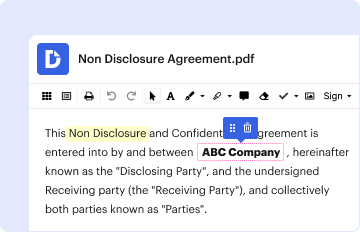
01. Edit your form 990 schedule e online
Type text, add images, blackout confidential details, add comments, highlights and more.

Type text, add images, blackout confidential details, add comments, highlights and more.
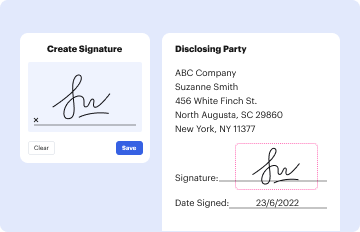
Draw your signature, type it, upload its image, or use your mobile device as a signature pad.
Send it via email, link, or fax. You can also download it, export it or print it out.
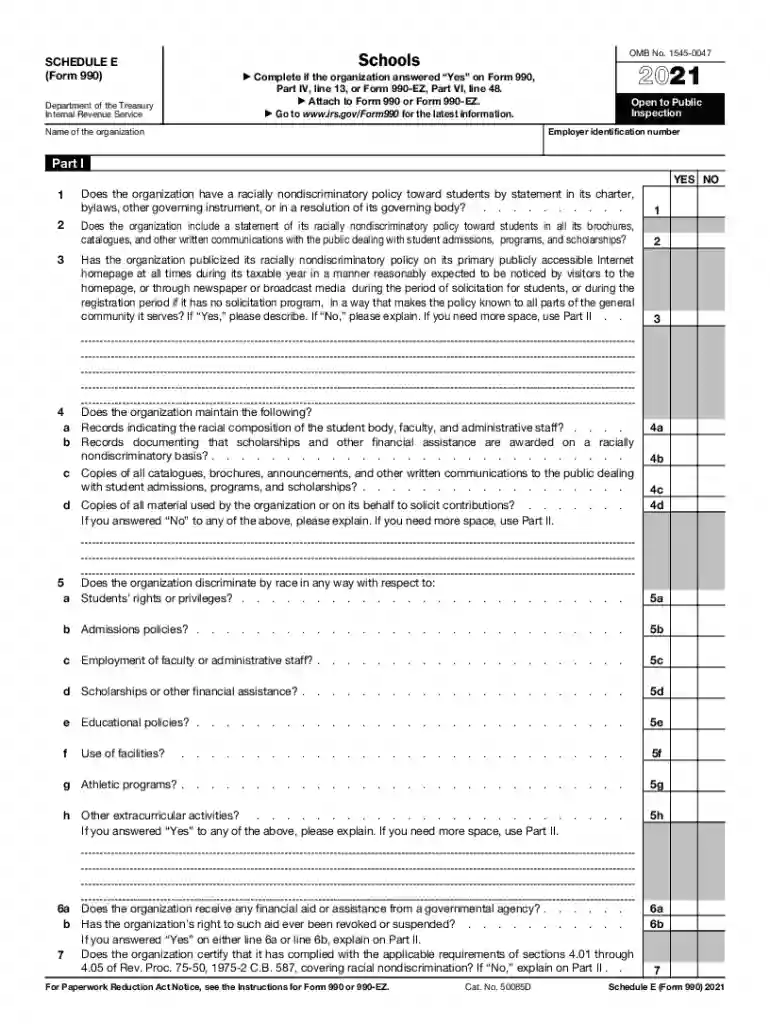
Form 990-EZ, Schedule E is an integral document for private schools, specifically targeting the adherence to nondiscriminatory policies. This schedule must be filed by organizations to showcase their compliance with federal regulations concerning racial equality in their operations. It ensures that schools maintain transparent and fair admissions processes and publicize their non-discriminatory practices. The document also mandates recordkeeping of the institution's racial composition, alongside the acknowledgment of scholarships and financial aid distributed without prejudice. This form acts as a critical compliance tool, safeguarding institutions against potential legal and financial repercussions associated with discriminatory practices.
To utilize the 990-EZ Schedule E effectively, institutions need a robust understanding of its components. The form is used in conjunction with Form 990-EZ, ensuring that the school's operations align with IRS regulations. Schools must answer specific questions that determine compliance with nondiscriminatory admissions. Proper use involves providing accurate responses and documentation for any claims, which includes detailed records of racial statistics and details of public notice of their non-discriminatory policies across various media. Institutions must carefully fill out each section to avoid discrepancies that could lead to further scrutiny or potential penalties.
Gather Necessary Information: Institutions should compile data regarding their student body's racial composition, details about their nondiscriminatory policies, and evidence of public notices such as advertisements or circulars.
Answer Compliance Questions: The form includes questions that schools need to answer regarding the publication of nondiscriminatory policies, the display of these policies in promotional material, and procedures for recordkeeping.
Provide Supporting Documentation: Attach records demonstrating adherence to these policies, such as samples of brochures or website screenshots that publicize the nondiscriminatory policies.
Review and Sign: Double-check all provided information for accuracy. An authorized official must sign the completed schedule before submission.
Primarily, private K-12 schools utilize Form 990-EZ Schedule E. Any private educational institution that receives tax-exemption under the IRS Section 501(c)(3) and is prompted to file a 990-EZ must complete Schedule E if they operate below a certain income threshold. Eligibility extends to any private school organization committed to racial nondiscriminatory practices, irrespective of its size or student capacity. This form ensures compliance across the board, providing a uniform standard for documentation.
The IRS mandates the filing of Schedule E to guarantee compliance with anti-discrimination laws under Section 501(c)(3). The guidelines direct schools to maintain transparency by publishing their nondiscriminatory policies visibly in various media. Additionally, the form must be filed with the school's annual 990-EZ return, substantiating the absence of racial bias in admissions and scholarship distributions. The IRS’s directives aim to uphold fairness and equality within educational environments.
Consider a private high school seeking to illustrate their compliancy for public records. They might employ 990-EZ Schedule E by:
Failure to file Form 990-EZ Schedule E accurately can lead to significant ramifications. Schools may face penalties including loss of tax-exempt status, significant fines, or closer scrutiny from the IRS. Ensuring precision and honesty in the submission is crucial to avoiding negative outcomes.
For most schools, the completion of Schedule E coincides with the annual 990-EZ filing deadline, typically the 15th day of the fifth month after their accounting period ends. Schools should be vigilant in tracking these deadlines, understanding that timely submission aids in continual compliance and averts unnecessary punitive actions from the IRS.
We've got more versions of the form 990 schedule e form. Select the right form 990 schedule e version from the list and start editing it straight away!
| Versions | Form popularity | Fillable & printable |
|---|---|---|
| 2024 | 4.7 Satisfied (48 Votes) | |
| 2023 | 4.4 Satisfied (36 Votes) | |
| 2022 | 4.1 Satisfied (53 Votes) | |
| 2021 | 4.8 Satisfied (72 Votes) | |
| 2020 | 4.3 Satisfied (97 Votes) | |
| 2019 | 4.2 Satisfied (103 Votes) | |
| 2018 | 4.2 Satisfied (24 Votes) | |
| 2017 | 4.4 Satisfied (248 Votes) | |
| 2016 | 4.4 Satisfied (181 Votes) | |
| 2015 | 4.3 Satisfied (169 Votes) |
At DocHub, your data security is our priority. We follow HIPAA, SOC2, GDPR, and other standards, so you can work on your documents with confidence.
May 2, 2025 If Yes, complete Schedule E . . . . 48. 49 a Did the organization make any transfers to an exempt non-charitable related organizationRead more
Dec 6, 2024 Schedule E (Form 990) is used by an organization that files. Form 990 or 990-EZ to report information on private schools. attach Schedule E toRead more


